GB300 NVL72 Colocation Requirements: Power, Liquid Cooling and Rack Space
A GB300 NVL72 needs a colocation hall that delivers 132–142 kW per rack with busway sized for peaks near 192 kW, a direct-to-chip liquid loop supplying 59–177 liters per minute at 25–45 °C, about 13–14 kW of air cooling for the rest, and a floor that carries 3,300–3,500 lb on a 600 × 1,068 mm footprint. This guide turns the published NVIDIA, HPE and Lenovo specifications into the numbers a colocation contract should name, and the questions to ask before you sign.
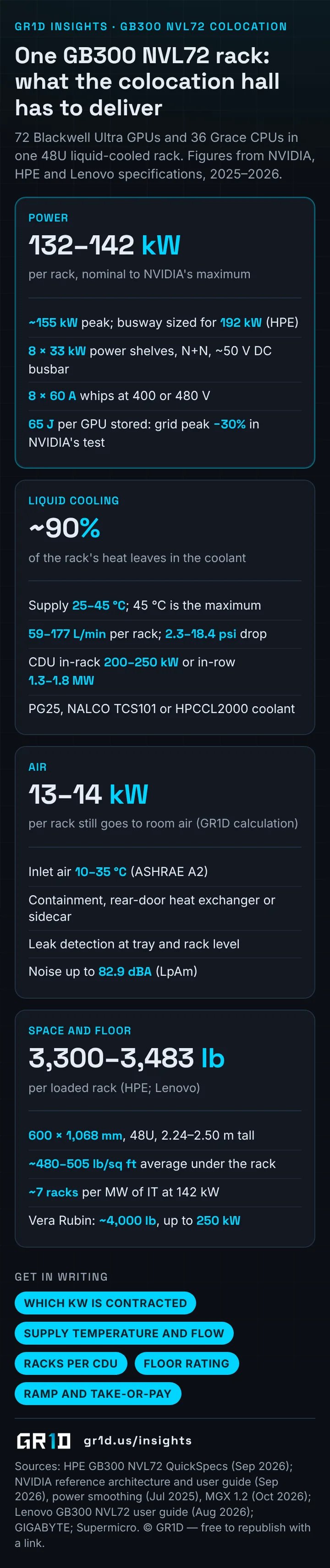
Read as text
- One GB300 NVL72 rack: what the colocation hall has to deliver
- 72 Blackwell Ultra GPUs and 36 Grace CPUs in one 48U liquid-cooled rack. Figures from NVIDIA, HPE and Lenovo specifications, 2025–2026.
- POWER · 132–142 kW · per rack, nominal to NVIDIA's maximum · ~155 kW peak; busway sized for 192 kW (HPE) · 8 × 33 kW power shelves, N+N, ~50 V DC busbar · 8 × 60 A whips at 400 or 480 V · 65 J per GPU stored: grid peak −30% in NVIDIA's test
- ~155 kW peak; busway sized for 192 kW (HPE)
- 8 × 33 kW power shelves, N+N, ~50 V DC busbar
- 8 × 60 A whips at 400 or 480 V
- 65 J per GPU stored: grid peak −30% in NVIDIA's test
- LIQUID COOLING · ~90% · of the rack's heat leaves in the coolant · Supply 25–45 °C; 45 °C is the maximum · 59–177 L/min per rack; 2.3–18.4 psi drop · CDU in-rack 200–250 kW or in-row 1.3–1.8 MW · PG25, NALCO TCS101 or HPCCL2000 coolant
- Supply 25–45 °C; 45 °C is the maximum
- 59–177 L/min per rack; 2.3–18.4 psi drop
- CDU in-rack 200–250 kW or in-row 1.3–1.8 MW
- PG25, NALCO TCS101 or HPCCL2000 coolant
- AIR · 13–14 kW · per rack still goes to room air (GR1D calculation) · Inlet air 10–35 °C (ASHRAE A2) · Containment, rear-door heat exchanger or sidecar · Leak detection at tray and rack level · Noise up to 82.9 dBA (LpAm)
- Inlet air 10–35 °C (ASHRAE A2)
- Containment, rear-door heat exchanger or sidecar
- Leak detection at tray and rack level
- Noise up to 82.9 dBA (LpAm)
- SPACE AND FLOOR · 3,300–3,483 lb · per loaded rack (HPE; Lenovo) · 600 × 1,068 mm, 48U, 2.24–2.50 m tall · ~480–505 lb/sq ft average under the rack · ~7 racks per MW of IT at 142 kW · Vera Rubin: ~4,000 lb, up to 250 kW
- 600 × 1,068 mm, 48U, 2.24–2.50 m tall
- ~480–505 lb/sq ft average under the rack
- ~7 racks per MW of IT at 142 kW
- Vera Rubin: ~4,000 lb, up to 250 kW
- GET IN WRITING · WHICH KW IS CONTRACTED · SUPPLY TEMPERATURE AND FLOW · RACKS PER CDU · FLOOR RATING · RAMP AND TAKE-OR-PAY
- GET IN WRITING
- WHICH KW IS CONTRACTED
- SUPPLY TEMPERATURE AND FLOW
- RACKS PER CDU
- FLOOR RATING
- RAMP AND TAKE-OR-PAY
What is a GB300 NVL72, and why does colocation for it look different?
A GB300 NVL72 is a single liquid-cooled rack of 72 NVIDIA Blackwell Ultra GPUs and 36 Grace CPUs that draws 132–142 kW (HPE, Sep 2026; NVIDIA, Sep 2026).
The rack is built from 18 compute trays, each with two Grace CPUs and four GPUs, plus nine NVLink switch trays that join all 72 GPUs into one 130 TB/s NVLink domain (NVIDIA user guide, Sep 2026; NVIDIA). Each Blackwell Ultra GPU carries 288 GB of HBM3e and a power budget of up to 1,400 W (NVIDIA, Aug 2025), so the GPUs alone account for about 100.8 kW per rack (GR1D calculation). Every GPU gets an 800 Gb/s ConnectX-8 SuperNIC for the scale-out network.
GB300 is not a roadmap item. NVIDIA began production shipments in the quarter that ended in July 2025 (NVIDIA earnings call, Aug 2025). CoreWeave was the first cloud to deploy it, in Dell racks at a Switch facility with Vertiv cooling (CoreWeave, Jul 2025; ServeTheHome, Jul 2025), and Microsoft Azure brought up a 4,608-GPU GB300 NVL72 cluster for OpenAI in October 2025 (NVIDIA, Oct 2025). In Texas, IREN delivered Horizon 1 in Childress, 50 MW of direct-to-chip GB300 NVL72 capacity, to Microsoft in August 2026 (IREN, Oct 2026).
The rack behaves like one computer, so the hall has to deliver power, coolant and floor capacity per position that halls built for air-cooled servers were never designed to carry. CBRE puts it plainly: "Today, 100-kW GPU servers can only be cooled by a closed-loop liquid-cooling system" (CBRE, Aug 2026). The build sequence behind a hall like that is in how a data center is built.
How much power does a GB300 NVL72 rack need?
A GB300 NVL72 rack draws 132 kW nominal and about 155 kW at peak, and HPE advises sizing busway for 192 kW per rack (HPE, Sep 2026). Published figures differ because they measure different things:
| Source | Rack power | What the figure is |
|---|---|---|
| NVIDIA user guide, Sep 2026 | About 120 kW | One text covers GB200 and GB300 systems |
| HPE QuickSpecs, Sep 2026 | 132 kW nominal; about 155 kW peak; busway for 192 kW | Thermal design power; electrical design power, peak (EDPp); provisioning advice |
| Lenovo, Aug 2026 | 135 kW; up to 155 kW peak | Thermal design power |
| Supermicro; GIGABYTE | 132–140 kW; up to 140 kW | Vendor datasheets |
| NVIDIA reference architecture, Sep 2026 | Up to 142 kW | Full rack; the Vertiv and Schneider Electric reference designs use the same 142 kW |
| NVIDIA DGX SuperPOD GB300 | 1.2 MW per 8-rack scalable unit | About 150 kW per rack (GR1D calculation) |
For a colocation contract the useful question is not which figure is right but which one each clause uses. Size branch circuits and busway to the peak, because breakers see peaks, not averages, and agree in writing whether the kW commitment, the power bill and any overage charge refer to nominal, peak or provisioned capacity. HPE's peak figure is about 1.17 times nominal and its busway advice 1.45 times (GR1D calculation).
What electrical feeds does each rack take?
Each GB300 NVL72 rack takes eight 33 kW power shelves, each with six 5.5 kW supplies, and HPE feeds every shelf from its own 60 A whip at 400 or 480 V (HPE, Sep 2026; NVIDIA, Sep 2026).
That is 264 kW of shelf nameplate per rack (GR1D calculation). NVIDIA's user guide says the eight shelves provide N+N redundancy (NVIDIA, Sep 2026), so four shelves on each of the A and B feeds can carry the rack. The shelves convert to about 50 V DC on the rack busbar: Vertiv's 33 kW shelf delivers 49 V at full load and 700 A at more than 96.5% efficiency (Vertiv, May 2026).
HPE's whips use IEC 60309 five-wire 560P6W connectors. At 415 V and a 0.99 power factor, a fully loaded 33 kW shelf draws about 46 A per phase, inside the 48 A a 60 A circuit carries continuously; at 480 V it is about 40 A (GR1D calculation). Check the shelf model against the hall's distribution voltage: Vertiv's 33 kW shelf lists a 311–457 V three-phase input, Lenovo's 311–528 V wye (Lenovo, Aug 2026). NVIDIA's DGX SuperPOD reference architecture asks for a facility that meets or exceeds Uptime Institute Tier III, TIA-942-B Rated 3 or EN 50600 Class 3: concurrently maintainable, with no single point of failure (NVIDIA).
How does GB300's power smoothing change the electrical design?
GB300 NVL72's power supplies store 65 joules per GPU, and in NVIDIA's Megatron training test the peak power demand seen by the grid fell 30% (NVIDIA, Jul 2025).
Two controls work with the storage: a power cap that ramps GPU limits at the start of a job, and a power floor that holds draw steady through idle gaps, both set through NVIDIA's management tools. NVIDIA's conclusion is that provisioning "can be closer to the target average consumption."
Read that as help for the utility connection and the upstream gear, not as ride-through. Joules of storage cover milliseconds: Vertiv's shelf specifies a 20 ms hold-up at full load, so the hall still needs UPS and generators sized for an outage. Ask whether the provider's utility agreement and protection settings account for a cluster's synchronized load swings.
How much liquid cooling does a GB300 NVL72 rack need?
About 90% of a GB300 NVL72 rack's heat leaves through liquid, so a 132–142 kW rack sends roughly 119–128 kW into the coolant loop (Lenovo, Aug 2026; GR1D calculation).
NVIDIA's own wording runs from "90 plus percent liquid-cooled," said of GB200 and GB300 at GTC 2025 (DCD, Mar 2025), to "100% liquid-cooled" in the DGX GB300 datasheet (NVIDIA, Oct 2025); Lenovo's 90/10 split is the planning number. Lenovo's user guide gives the flow each rack needs at each technology cooling system (TCS) supply temperature (Lenovo, Aug 2026):
| TCS supply temperature | Required flow per rack | Rack pressure drop | Flow per liquid kW |
|---|---|---|---|
| 25 °C (77 °F) | 59 L/min | 2.3 psi | 0.49 L/min |
| 30 °C (86 °F) | 71 L/min | 3.2 psi | 0.58 L/min |
| 35 °C (95 °F) | 89 L/min | 4.9 psi | 0.73 L/min |
| 40 °C (104 °F) | 119 L/min | 8.5 psi | 0.98 L/min |
| 45 °C (113 °F) | 177 L/min | 18.4 psi | 1.46 L/min |
The table holds one trade-off. Warmer supply water saves chiller energy, but from 25 °C to 45 °C the flow triples and the rack's pressure drop rises eightfold; by GR1D's arithmetic every row returns near 55 °C. Lenovo lists 45 °C as the highest allowable inlet, 30 psi static pressure at the quick disconnect and three approved coolants, PG25, NALCO TCS101 or HPCCL2000, and the rack "ships without water."

Read as text
- Warmer water triples the flow: coolant per GB300 NVL72 rack from 25 °C to 45 °C supply
- Lenovo's required flow and pressure drop per rack at each technology-cooling-system supply temperature. The return stays near 55 °C, so warm supply saves chiller hours but needs more pumping.
- Required flow per rack · Liters per minute; bar length to scale (0–180 L/min). Pressure drop across the rack in psi. · SUPPLY · FLOW · L/MIN · DROP · 25 °C · 59 L/min · 2.3 psi · 30 °C · 71 L/min · 3.2 psi · 35 °C · 89 L/min · 4.9 psi · 40 °C · 119 L/min · 8.5 psi · 45 °C · 177 L/min · 18.4 psi · 45 °C is the maximum allowable inlet. GR1D calculation: with about 90% of a 135 kW rack going to liquid, every row returns near 55 °C, from 0.49 L/min per liquid kW at 25 °C to 1.46 at 45 °C.
- What that does to one in-row CDU · Vertiv XDU1350, the 1.3 MW unit HPE pairs with GB300 NVL72 for up to 8 racks. Flow: 1,800 L/min with three pumps running, 1,200 L/min with one on standby (N+1). · 952 L/min · 8 racks at 40 °C supply: inside the N+1 rating · 1,416 L/min · 8 racks at 45 °C supply: above the N+1 rating · 8 racks · per unit from 25 °C to 40 °C (HPE's limit) · 6 racks · per unit at 45 °C with a pump on standby · At warm supply, flow, not kilowatts, sets how many racks one CDU carries. Ask for the rack count per CDU at the contracted temperature.
In-rack or in-row CDU?
In-rack coolant distribution units (CDUs) handle 200–250 kW, about one GB300 NVL72 rack, while in-row units handle 1.3–1.8 MW, up to eight racks (HPE, Sep 2026; Supermicro).
| CDU option | Capacity | Notes | Source |
|---|---|---|---|
| In-rack, GIGABYTE | 200 kW at a 4 °C approach | 1+1 pumps | GIGABYTE |
| In-rack, Supermicro | Up to 250 kW | Redundant pumps | Supermicro |
| In-row, Vertiv XDU1350 | 1.3 MW | HPE's pairing: "a maximum of 8 racks" | HPE, Sep 2026 |
| In-row, GIGABYTE or Supermicro | 1,350 kW at a 4 °C approach; up to 1.8 MW | Up to 8 racks | GIGABYTE; Supermicro |
| Liquid-to-air sidecar, Supermicro | Up to 200 kW | No facility water required | Supermicro |
Flow can run out before kilowatts do. Vertiv's XDU1350 moves 1,800 L/min with three pumps running, or 1,200 L/min with one pump on standby (Vertiv, Jul 2024). At a 45 °C supply, eight racks need 8 × 177 = 1,416 L/min, more than the N+1 rating, so one unit carries six racks at that temperature; at 40 °C, eight racks need 952 L/min and fit (GR1D analysis). Ask the provider for the rack count per CDU at the supply temperature in your contract, and for who owns, maintains and spares the CDU.
What facility water does the building need?
With a 4 °C CDU approach, a 45 °C rack supply needs facility water at about 41 °C or cooler, which fits ASHRAE's W40 class but not W45 (Upsite, Jul 2024; GR1D calculation).
ASHRAE's liquid-cooling classes W17 through W45 cap facility water supply at 17–45 °C, and Upsite notes that few systems run consistently above 45 °C. A 30 °C rack supply needs facility water at about 26 °C, the W27 class, which means chillers through a Texas summer. A 45 °C loop can run on dry coolers whenever the outdoor air is at or below roughly 33–36 °C, as our liquid cooling guide works through. Schneider Electric's GB300 NVL72 reference design pairs liquid-to-liquid CDUs with high-temperature chillers (Schneider Electric, Oct 2025).
What about the 10% that still goes to air?
Each GB300 NVL72 still sheds about 13–14 kW into room air, which the hall removes with containment, rear-door heat exchangers or sidecars (Lenovo, Aug 2026; GR1D calculation).
Lenovo specifies inlet air at 10–35 °C (ASHRAE class A2) and 20–80% relative humidity, ISO 14644-1 class 8 cleanliness with MERV 11 or 13 intake filtration, and emitted sound up to 82.9 dBA. HPE offers a rear-door heat exchanger for its 48U, 600 mm rack. For leaks, NVIDIA's reference architecture includes "integrated tray-level and rack-level liquid leakage detection," Lenovo adds a rack drip pan and a leak-detection interface, and the XDU1350 raises an alarm or shuts down. Wire those signals to the building management system, and put the shutdown logic and response time in the service agreement.
How much space and floor strength does a GB300 NVL72 need?
A GB300 NVL72 occupies a 600 × 1,068 mm, 48U footprint and weighs 3,300–3,483 lb loaded, an average of about 478–505 lb per square foot (HPE, Sep 2026; Lenovo, Aug 2026).
| Source | Width × depth × height | Loaded weight |
|---|---|---|
| HPE, Sep 2026 | 600 × 1,068 × 2,495 mm, 48U | 3,300 lb |
| Lenovo, Aug 2026 | 600 × 1,068 mm (1,200 mm with extension frame) × 2,236 mm | About 1,580 kg (3,483 lb) |
| Supermicro | 600 × 1,068 × 2,236 mm, 48U | Not stated |
Spread over the 0.64 m² (6.9 sq ft) footprint, HPE's weight averages 478 lb per square foot (22.9 kN/m²) and Lenovo's 505 lb (24.2 kN/m²), and casters concentrate it further (GR1D calculation). NVIDIA does not publish an official floor-loading figure (Introl, Jan 2026), so plan for slab-on-grade or a floor a structural engineer has rated for the rack, its CDU and the route in. HPE supports overhead or underfloor feeds for both coolant and power. No OEM document we reviewed publishes crate dimensions or door, ramp and lift requirements: get them from the integrator and walk the route before the delivery date, checking every door, dock and elevator against a 2.24–2.50 m rack.
| Power basis | kW per rack | Racks per MW of IT | Racks per 10 MW |
|---|---|---|---|
| NVIDIA user guide | 120 | 8.3 | 83 |
| HPE nominal | 132 | 7.6 | 75 |
| NVIDIA reference architecture maximum | 142 | 7.0 | 70 |
| DGX SuperPOD scalable unit | 150 | 6.7 | 66 |
| HPE peak (EDPp) | 155 | 6.5 | 64 |
| HPE busway advice | 192 | 5.2 | 52 |
| Vera Rubin, MGX 1.2 ceiling | 250 | 4.0 | 40 |
Network and storage racks sit outside those counts: Schneider Electric's GB300 reference hall holds three clusters of up to 1,152 GPUs each, which is 16 compute racks per cluster before networking (GR1D calculation).

Read as text
- How many GB300 NVL72 racks fit in a megawatt depends on which power figure you contract
- Compute racks per MW of IT at each published rack figure, and the average floor load under one rack. Network and storage racks are extra.
- Racks per MW of IT · 1,000 kW divided by the rack figure; per 10 MW rounded down to whole racks. Bars to scale (0–9 racks). · BASIS · RACKS PER MW · PER MW · PER 10 MW · 120 kW NVIDIA user guide · 8.3 · 83 · 132 kW HPE nominal · 7.6 · 75 · 142 kW NVIDIA maximum · 7.0 · 70 · 150 kW SuperPOD unit · 6.7 · 66 · 155 kW peak (EDPp) · 6.5 · 64 · 192 kW HPE busway · 5.2 · 52 · 250 kW Vera Rubin, MGX 1.2 · 4.0 · 40 · SuperPOD unit: NVIDIA's 1.2 MW per 8-rack scalable unit. A hall sized at 192 kW per position has headroom for peaks; a hall sized at 250 kW takes Vera Rubin.
- Average floor load under one rack · Loaded weight over a 600 × 1,068 mm footprint (6.9 sq ft). Casters concentrate it further. · 478 lb/sq ft · 3,300 lb rack (HPE); 22.9 kN/m² · 505 lb/sq ft · 3,483 lb rack (Lenovo); 24.2 kN/m² · 580 lb/sq ft · ~4,000 lb Vera Rubin NVL72 (NVIDIA); 27.8 kN/m² · NVIDIA publishes no official floor-loading figure. Plan for slab-on-grade or a floor a structural engineer has rated for the rack, its CDU and the route in.
What does GB300 colocation cost, and how fast can you get it?
CBRE's national average colocation lease rate rose 6.5% in 2025 to $194.95 per kW per month, and primary-market vacancy reached a record-low 1.4% in H1 2026 (CBRE, Feb 2026; CBRE, Aug 2026).
CBRE's 2026 asking rates for 250–500 kW requirements run $200–230 per kW per month in Chicago and $190–235 in Northern Virginia, while in Dallas–Fort Worth asking rents were unchanged and vacancy fell to a record-low 1.8% (CBRE, Jun 2026). No public index separates liquid-cooled GB300 space from those averages, so quotes move with density, term, ramp and who pays for the CDUs.
Terms are tightening. CBRE reports minimum utilization levels "ranging from 60% to 85% of allocated power" (CBRE, Aug 2026). Traditional data center leases span 10 to 15 years while neocloud GPU contracts typically run two to five, so many operators require "significant up-front collateral or a third-party guarantor" (Bisnow, Sep 2025).
Fit-out time is the hidden cost. CBRE: "RFS fit-out dates are expanding from weeks to several months," and "for air-cooled data centers requiring conversion to liquid cooling, delays can extend beyond six months." A hall that already has liquid-cooled positions, power and a delivery date is worth more to a team with racks on order than a lower rate on a hall that still needs converting. Our guide to powered shell, turnkey and colocation compares the three ways to get that capacity.
What should you ask a colocation provider before you sign?
Fifteen questions cover a GB300 NVL72 colocation contract, from the power basis to the Vera Rubin upgrade, and each maps to a published specification (GR1D analysis).
| # | Ask | What the published specs say |
|---|---|---|
| 1 | Which kW figure is contracted and billed? | 132–142 kW nominal, about 155 kW peak or 192 kW provisioned (HPE; NVIDIA) |
| 2 | How many racks per block, on what ramp, with what take-or-pay floor? | NVIDIA scales in 8-rack, 1.2 MW units; floors run 60–85% (NVIDIA; CBRE) |
| 3 | What feeds reach each rack? | A and B sides, eight 60 A whips, concurrently maintainable (HPE; NVIDIA) |
| 4 | What distribution voltage? | 400 or 480 V whips, matched to the shelf's input range (HPE; Vertiv; Lenovo) |
| 5 | How does the facility handle load swings? | 65 J per GPU cut grid peaks 30% in NVIDIA's test; shelf hold-up is 20 ms (NVIDIA; Vertiv) |
| 6 | What supply temperature and flow are guaranteed? | 25–45 °C; 59–177 L/min; 2.3–18.4 psi per rack (Lenovo) |
| 7 | Which water class, and what heat rejection on the Texas design day? | W40 facility water supports a 45 °C rack supply through a 4 °C approach (Upsite; GR1D calculation) |
| 8 | Whose CDU, and how many racks per CDU at that temperature? | In-rack 200–250 kW; in-row 1.3–1.8 MW for up to 8 racks, six at 45 °C under N+1 (OEMs; GR1D analysis) |
| 9 | Which coolant, who does the first fill, what filtration? | PG25, NALCO TCS101 or HPCCL2000; 25 or 50 µm filters on the CDU (Lenovo; Vertiv) |
| 10 | Where do leak alarms go, and what shuts down? | Tray- and rack-level detection wired to the building management system (NVIDIA; Lenovo) |
| 11 | How is the remaining air heat removed? | About 13–14 kW per rack at 10–35 °C inlet (Lenovo; GR1D calculation) |
| 12 | What is the floor rating and the route in? | 3,300–3,483 lb per rack, 478–505 lb/sq ft average, 2.24–2.50 m tall (HPE; Lenovo) |
| 13 | What fiber paths and meet-me room capacity? | 72 × 800 Gb/s ConnectX-8 plus 18 BlueField-3 per rack (NVIDIA) |
| 14 | What is the ready-for-service date, and what are the acceptance tests? | Liquid conversions can slip more than six months; test flow, pressure drop and leaks at temperature (CBRE; GR1D) |
| 15 | Is there a Vera Rubin path? | Up to 250 kW, 45 °C coolant and about 4,000 lb per rack (NVIDIA) |
Will a GB300 hall take Vera Rubin?
A GB300 hall can take Vera Rubin NVL72 if each position is sized for its envelope: up to 250 kW per rack under NVIDIA's MGX 1.2 specification, 45 °C coolant and about 4,000 lb (NVIDIA, Oct 2026; NVIDIA, Mar 2026).
In March 2026 NVIDIA said Vera Rubin NVL72 is "in full production, on track to ship in the second half of 2026," designed for 45 °C inlet water, with six times Blackwell's rack-level energy storage (400 J per GPU) cutting peak current by up to 25% and a 5,000 A liquid-cooled busbar; it says MGX racks share "the same power, cooling, and mechanical envelopes." NVIDIA has not published a single rack rating: the MGX 1.2 specification it open-sourced on October 12, 2026 allows up to 250 kW.
A Rubin-ready GB300 position therefore needs busway and branch capacity toward 250 kW instead of 192, a floor rated for about 580 lb per square foot (4,000 lb on the same footprint) and pipework sized for 45 °C flows of about 1.5 L/min per liquid kW (GR1D calculation). Neither GB300 nor Vera Rubin NVL72 requires 800 VDC, though Vera Rubin can take it through a sidecar; NVIDIA said in 2025 that full-scale production of 800 VDC data centers will coincide with its Kyber racks in 2027 (NVIDIA, May 2025). Our 800 VDC guide covers that transition.
Frequently asked questions
How much power does a GB300 NVL72 rack use?
HPE rates the rack at 132 kW nominal and about 155 kW at peak and advises busway sized for 192 kW; NVIDIA's reference architecture says up to 142 kW. Size circuits for the peak, and agree in writing which figure the kW commitment and the bill use.
Does GB300 NVL72 need liquid cooling?
Yes. About 90% of its heat leaves through direct-to-chip cold plates. Lenovo specifies 59 L/min of coolant per rack at a 25 °C supply, rising to 177 L/min at the 45 °C maximum. The remaining 13–14 kW per rack goes to room air.
How heavy is a GB300 NVL72 rack?
About 3,300 lb loaded per HPE and about 1,580 kg (3,483 lb) per Lenovo, on a 600 × 1,068 mm footprint: roughly 480–505 lb per square foot on average. NVIDIA publishes no official floor-loading figure, so have a structural engineer rate the floor and the route in.
How many GB300 NVL72 racks fit in 1 MW?
About seven at NVIDIA's 142 kW figure, 7.6 at HPE's 132 kW nominal, 6.5 at the 155 kW peak, and about five if you provision HPE's 192 kW busway. Network and storage racks are extra.
What does GB300 colocation cost?
CBRE put the national average colocation lease rate at $194.95 per kW per month in 2025, up 6.5%. No public index prices liquid-cooled GB300 space separately; density, term, ramp, take-or-pay floors and who owns the CDUs move the quote.
Can a GB300 hall run Vera Rubin later?
Yes, if each position is sized for Vera Rubin's envelope: up to 250 kW per rack under NVIDIA's MGX 1.2 specification, 45 °C coolant and about 4,000 lb. NVIDIA says MGX racks share the same power, cooling and mechanical envelopes.
Sources
- NVIDIA GB300 NVL72 by HPE QuickSpecs (version 3) — HPE, 2026-09-08
- Lenovo NVIDIA GB300 NVL72 Rack Scale AI product guide (LP2357) — Lenovo Press, 2026-08-30
- GB300 NVL72 User Guide — Lenovo, 2026-08
- SuperCluster GB300 NVL72 datasheet — Supermicro, 2025
- AI-DLC-POD: NVIDIA GB300 NVL72 — GIGABYTE, n.d.
- PowerDirect 3000 33 kW power shelf for NVIDIA GB200/GB300 NVL72 (datasheet) — Vertiv, 2026-05
- NVIDIA GB300 NVL72 — NVIDIA, n.d.
- Inside NVIDIA Blackwell Ultra: The Chip Powering the AI Factory Era — NVIDIA, 2025-08-22
- NVIDIA DGX GB300 datasheet — NVIDIA, 2025-10
- How New GB300 NVL72 Features Provide Steady Power for AI — NVIDIA, 2025-07-28
- NVIDIA DGX SuperPOD Reference Architecture: DGX GB300 — NVIDIA, n.d.
- DGX GB Rack Scale Systems User Guide: Hardware — NVIDIA, 2026-09-17
- NVL72 AI Factory Enterprise Reference Architecture: Components — NVIDIA, 2026-09-15
- NVIDIA 800 V HVDC Architecture Will Power the Next Generation of AI Factories — NVIDIA, 2025-05-20
- NVIDIA Vera Rubin POD: Seven Chips, Five Rack-Scale Systems, One AI Supercomputer — NVIDIA, 2026-03-16
- At OCP Global Summit, NVIDIA and partners scale Vera Rubin AI factories — NVIDIA, 2026-10-12
- NVIDIA Q2 fiscal 2026 earnings call transcript — NVIDIA, 2025-08-27
- Microsoft Azure unveils world's first GB300 NVL72 supercomputing cluster for OpenAI — NVIDIA, 2025-10-09
- CoreWeave becomes first cloud provider to deploy NVIDIA GB300 NVL72 platform — CoreWeave, 2025-07-03
- Dell and CoreWeave show off first NVIDIA GB300 NVL72 rack — ServeTheHome, 2025-07-03
- NVIDIA Exemplar Cloud: NVIDIA GB300 NVL72 status — IREN, 2026-10-08
- Vertiv develops energy-efficient cooling and power reference architecture for the NVIDIA GB300 NVL72 — Vertiv, 2025-06-11
- Schneider Electric reference designs for NVIDIA GB300 NVL72 — Schneider Electric via Business Wire, 2025-10-06
- Vertiv XDU1350 coolant distribution unit guide specifications — Vertiv, 2024-07
- Nvidia GTC: Jensen Huang on data center rack density — Data Center Dynamics, 2025-03-21
- Major changes to ASHRAE's fifth edition of thermal guidelines, part 3: liquid cooling — Upsite Technologies, 2024-07-31
- Fast-growing North American data center market set records in 2025 — CBRE, 2026-02-26
- North America Data Center Trends H1 2026 — CBRE, 2026-08-27
- Global Data Center Trends 2026 — CBRE, 2026-06-17
- Cloud providers like CoreWeave see "unrivaled" growth but present risks for data center firms — Bisnow, 2025-09-21
- Why NVIDIA GB300 NVL72 Blackwell Ultra matters — Introl, 2026-01-09
Building or financing an AI data center in Texas?
GR1D develops powered-shell and turnkey AI data centers — 20 MW to 150 MW sites with power, fiber and entitlements solved before the first rack arrives. See how we build, browse our sites or talk to us.