Liquid Cooling for GPU Data Centers: Direct-to-Chip, Immersion and What 100–600 kW Racks Require
Liquid cooling becomes necessary in a GPU data center somewhere between 20 and 40 kW per rack, and the racks now shipping sit far beyond that line: a GB200 NVL72 draws 125–135 kW and sends more than 90% of its heat into liquid, Vera Rubin NVL72 is specified to 250 kW on 45 °C coolant, and the 600 kW Kyber rack has no fans. This guide covers direct-to-chip, rear-door and immersion cooling, the flow and temperature math, and what a liquid-ready building in Texas must include.
Read as text
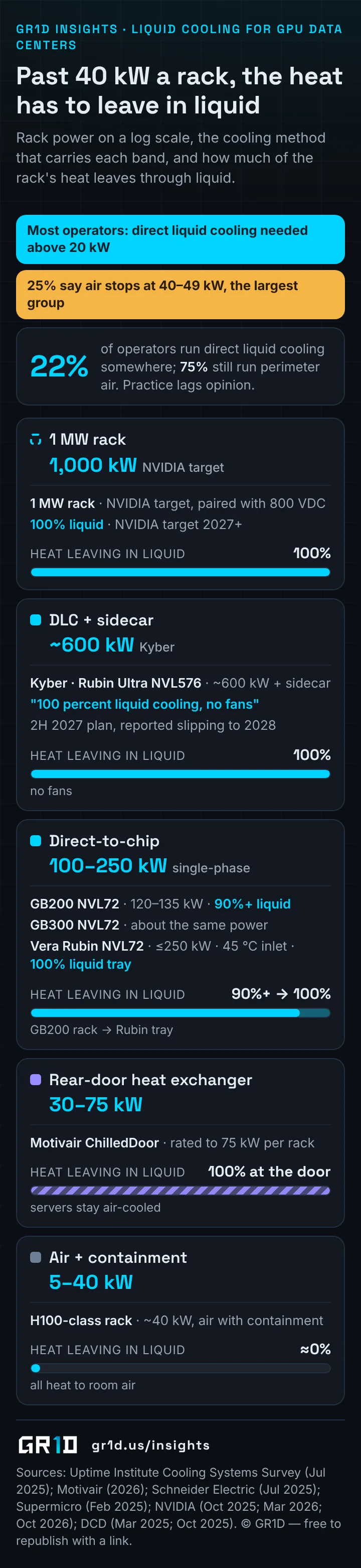
- Past 40 kW a rack, the heat has to leave in liquid
- Rack power on a log scale, the cooling method that carries each band, and how much of the rack's heat leaves through liquid.
- Most operators: direct liquid cooling needed above 20 kW
- 25% say air stops at 40–49 kW, the largest group
- 22% · of operators run direct liquid cooling somewhere; 75% still run perimeter air. Practice lags opinion.
- 1 MW rack · 1,000 kW NVIDIA target · 1 MW rack · NVIDIA target, paired with 800 VDC · 100% liquid · NVIDIA target 2027+ · HEAT LEAVING IN LIQUID · 100%
- DLC + sidecar · ~600 kW Kyber · Kyber · Rubin Ultra NVL576 · ~600 kW + sidecar · "100 percent liquid cooling, no fans" · 2H 2027 plan, reported slipping to 2028 · HEAT LEAVING IN LIQUID · 100% · no fans
- Direct-to-chip · 100–250 kW single-phase · GB200 NVL72 · 120–135 kW · 90%+ liquid · GB300 NVL72 · about the same power · Vera Rubin NVL72 · ≤250 kW · 45 °C inlet · 100% liquid tray · HEAT LEAVING IN LIQUID · 90%+ → 100% · GB200 rack → Rubin tray
- Rear-door heat exchanger · 30–75 kW · Motivair ChilledDoor · rated to 75 kW per rack · HEAT LEAVING IN LIQUID · 100% at the door · servers stay air-cooled
- Air + containment · 5–40 kW · H100-class rack · ~40 kW, air with containment · HEAT LEAVING IN LIQUID · ≈0% · all heat to room air
Why is air cooling running out for GPU racks?
A rack's heat has to leave in the air that passes through it, and above a few tens of kilowatts the fan power, airflow and temperature rise across the servers stop adding up. Uptime Institute's 2025 cooling survey asked 786 operators at what rack density air becomes too costly or inefficient: 14% said 20–29 kW, 18% said 30–39 kW, 25% said 40–49 kW and 12% said 50–59 kW, and the report's headline is that most operators believe direct liquid cooling is necessary above 20 kW (Uptime Institute, Jul 2025).
Practice lags opinion: 22% of operators run direct liquid cooling somewhere in their estate against 75% still on perimeter air, and the top barriers are lack of standardization (39%), cost (38%) and reliability concerns (35%). Rear-door heat exchangers are the usual stretch; Motivair rates its ChilledDoor at up to 75 kW per rack (Motivair). The working rule in this article, synthesized from that distribution: contained air to 20–40 kW, rear doors to 50–75 kW, cold plates above that.
How much power does a GPU rack draw, generation by generation?
NVIDIA's rack-scale systems set the density every AI hall is designed around, and each generation moves the number.
| Platform | Rack power and cooling | Source |
|---|---|---|
| H100-class rack | ~40 kW; air with containment | Schneider Electric, Jul 2025 |
| GB200 NVL72 | "About 120 kW" (NVIDIA); 125–135 kW operating, 132 kW of power shelves (Supermicro); "90 plus percent liquid-cooled" | DCD, Mar 2025; Supermicro, Feb 2025 |
| GB300 NVL72 | "Not expected to draw more power than GB200"; direct-to-chip | DCD, Mar 2025 |
| Vera Rubin NVL72 (2H 2026) | Up to 250 kW under the MGX 1.2 spec; about 4,000 lb; "100% liquid-cooled" tray on 45 °C (113 °F) coolant | NVIDIA, Oct 2025; NVIDIA, Mar 2026; NVIDIA, Oct 2026 |
| Kyber / Rubin Ultra NVL576 | About 600 kW plus a rack-sized power-and-cooling sidecar; "100 percent liquid cooling, no fans" | DCD, Mar 2025 |
| 1 MW rack | NVIDIA target, paired with 800 VDC power; 100% liquid | DCD, Oct 2025 |
Underneath the racks, Dell'Oro expects GPU thermal design power to pass 4,000 W by 2029 (Dell'Oro, Jan 2026). NVIDIA showed Kyber for the second half of 2027 and said at GTC 2025 that 1 MW racks had been under discussion with the supply chain for about 18 months (DCD, Mar 2025); Kyber has since been reported as slipping toward 2028, which we track in our 800 VDC guide. A building designed in 2026 will host at least two of these generations.
How does direct-to-chip liquid cooling work?
Direct-to-chip (DTC, also DLC) puts a cold plate on each GPU, CPU and switch ASIC and pumps coolant through it. Everything without a cold plate — memory, power supplies, drives — still sheds heat to air, which is why a GB200 rack is "90 plus percent" rather than fully liquid-cooled (DCD, Mar 2025). Single-phase DTC, where the coolant stays liquid, is "dominant" and carries "the vast majority of liquid-cooled capacity"; two-phase DTC, which boils a refrigerant on the plate, is still "mostly pilots" (Dell'Oro, Jan 2026).
The system is two loops joined by a heat exchanger. The technology cooling system (TCS) runs from the coolant distribution unit (CDU) through manifolds to the cold plates on a treated 25% propylene-glycol mix (PG25), filtered and pressure-controlled. The facility water system (FWS) runs from the CDU's primary side to dry coolers, towers or chillers; Crusoe's Abilene campus, for example, rejects its FWS heat through air-cooled chillers (Crusoe, Aug 2025). The CDU isolates the two loops, so chemistry, pressure and any leak stay on their own side.

Read as text
- Direct-to-chip: two loops, one heat exchanger
- Heat path from GPU die to outdoor air for a 45 °C design at a 10 K rise. The CDU keeps chemistry, pressure and leaks on their own side.
- GPU die · Heat flows into the cold plate · GPU power passes 4,000 W by 2029 (Dell'Oro)
- TCS · Technology cooling system · PG25 glycol, filtered, pressure-controlled
- TCS
- Technology cooling system · PG25 glycol, filtered, pressure-controlled
- Technology cooling system
- Cold plate · On every GPU, CPU and switch ASIC; coolant rises 10 K · Memory, PSUs and drives stay on air: ≈10% of a GB200 rack
- Rack manifold · Supply and return headers, drip-free quick disconnects, leak detection · ≈200 L/min per NVL72 rackCALC
- RETURN ≈55 °C ↓ · SUPPLY ↑ 45 °C
- RETURN ≈55 °C ↓
- RETURN
- SUPPLY ↑ 45 °C
- SUPPLY
- ▴ TCS SIDE · CDU coolant distribution unit · Plate heat exchanger, 4 °C approach · N+N pumps · 25–50 µm filtration · Units from 250 kW in-rack to 2.5 MW in-row · ▾ FWS SIDE
- FWS · Facility water system · to dry coolers, towers or chillers
- FWS
- Facility water system · to dry coolers, towers or chillers
- Facility water system
- RETURN ≈51 °C ↓ · SUPPLY ↑ ≈41 °C
- RETURN ≈51 °C ↓
- SUPPLY ↑ ≈41 °C
- Facility water loop · Pipe corridors sized at ≈1.5 L/min per IT kWCALC · N+N headers; feeds dry coolers, towers or chillers
- Dry cooler · Full load up to ~33–36 °C ambient (5–8 K approach) · Adiabatic assist or a trim chiller for peak hours · 0.4% design: 37 °C Austin, 36 °C Houston
- ≈1.5 L/min per kWCALC
- L/min per kW
- CALC
- Coolant per IT kW at a 10 K rise, PG25 (water ≈1.44)
- ≈200 L/minCALC
- L/min
- Per GB200 NVL72 rack: 132 kW at 10 K (≈130 at 15 K)
- GB200 NVL72
- ≈890 L/minCALC
- Per Kyber rack: 600 kW at 10 K
- Kyber
- 3,400 L/min
- Vertiv CDU 2300: 2,300 kW, 32 °C facility in → 36 °C out = 1.48 L/min per kW
- Vertiv CDU 2300:
- SAME LOOP, TWO DESIGN POINTS · GR1D DESIGN REASONING
- 45 °C design · Vera Rubin
- TCS SUPPLY · 45 °C
- − 4 °C CDU →
- FWS SUPPLY · ≈41 °C
- − 5–8 K dry cooler →
- DRY COOLERS ALONE TO · ~33–36 °C
- Nearly all Texas hours; adiabatic or trim chiller only on the hottest afternoons
- 27–32 °C · many GB200 tenants
- TCS SUPPLY · 27–32 °C
- FWS SUPPLY · 23–28 °C
- DRY COOLERS ALONE TO · ~15–23 °C
- A chiller has to cover a large share of Texas hours
CDUs come in three sizes, and the choice sets the piping: Supermicro pairs GB200 NVL72 with a 250 kW in-rack CDU or a 1.3 MW in-row unit (Supermicro, Feb 2025); Vertiv's CoolChip CDU 2300 handles 2,300 kW at a 4 °C approach, 32 °C facility water in and 36 °C secondary out, at up to 3,400 L/min with N+N pumps and 50 µm or 25 µm filtration (Vertiv, Nov 2024); Motivair's MCDU-70 is rated at 2.5 MW, with six units giving 4+2 redundancy for "10 MW building blocks" (The Machine Maker, Jan 2026; Channelwise, Apr 2026).
How much coolant flow does a GPU rack need?
The flow math is an energy balance, and it sizes every pipe, pump and corridor in the building. Rows marked [calc] are GR1D calculations, not vendor figures.
| Quantity | Value | Basis |
|---|---|---|
| Coolant per kW at a 10 K rise | ~1.44 L/min for water; ~1.5 L/min for PG25 | [calc] energy balance |
| Vertiv CDU 2300 cross-check | 2,300 kW at 3,400 L/min = 1.48 L/min per kW | Vertiv, Nov 2024 |
| GB200 NVL72 rack, 132 kW | ~190–200 L/min at 10 K; ~130 L/min at 15 K | [calc] |
| Kyber rack, 600 kW | ~890 L/min at 10 K | [calc] |
What about rear-door heat exchangers, sidecars and immersion?
A rear-door heat exchanger (RDHx) is a water coil on the back of the rack: the servers stay air-cooled, their exhaust crosses the coil, and the heat leaves the room in water. Motivair's ChilledDoor is rated to 75 kW per rack (Motivair), which makes the rear door the bridge for 30–75 kW racks and a way to catch the 10% or so of a DLC rack's heat that still goes to air. A liquid-to-air sidecar is the inverse: a DLC rack whose coolant rejects heat to room air through a coil, "no facility water required," in Supermicro's 180 kW and 240 kW versions (Supermicro, Feb 2025). Sidecars put a few liquid racks into a building with no liquid plant, but the room's air handling still carries every kilowatt, so they do not scale to a hall.
Immersion submerges whole servers in a dielectric fluid and takes close to 100% of the heat into liquid. Single-phase immersion is seeing "selective adoption where trade-offs are justified" (Dell'Oro, Jan 2026); the trade-offs are serviceability, warranties and the fact that NVIDIA's rack-scale systems ship as cold-plate designs. Two-phase immersion, which boils a fluorinated fluid on the components, has a supply problem: 3M said it would "exit all PFAS manufacturing by the end of 2025," discontinuing "all fluoropolymers, fluorinated fluids" (3M, Dec 2022). Plan AI halls around cold plates; treat immersion as a niche for specific hardware.
What water temperature should the building design for?
ASHRAE's liquid-cooling classes name the warmest facility water a piece of IT equipment must accept with "full, unthrottled operation": W17, W27, W32, W40 (added in the 2021 fifth edition), W45 and W+ above 45 °C. Vendors tend to design around 40 °C entering water, and "few can operate consistently above 45 °C" (Upsite, Jul 2024).
| ASHRAE class | Maximum facility supply | Who designs for it |
|---|---|---|
| W17 / W27 | 17 °C / 27 °C | Chilled-water sites; tenants asking for 20–24 °C |
| W32 | 32 °C | Where Uptime sees facility water converging; Meta standardizes on 30 °C |
| W40 | 40 °C | New in 2021; the common vendor design point |
| W45 | 45 °C | NVIDIA Vera Rubin NVL72 (45 °C / 113 °F coolant) |
| W+ | above 45 °C | Few products operate here consistently |
The market is split. Schneider Electric's analysis is that chips above 500 W need roughly 30 °C supply and 700 W parts about 27 °C, with some tenants asking for 20–24 °C (DCD, Jul 2024); NVIDIA's bet with Vera Rubin runs the other way, at 45 °C with a "100% liquid-cooled" tray (NVIDIA, Oct 2025). Every degree is money: Johnson Controls puts chiller savings at roughly 2–3% per 1 °C rise in chilled-water temperature, and Schneider found that at 300 W chips about 95% of its sites needed no mechanical cooling while above 500 W only about 5% could free-cool (DCD, Jul 2024). The W-class the tenant signs for decides whether the yard holds dry coolers or a chiller plant.
How do you reject the heat in Texas without a cooling tower?
Work backward from the chip; what follows is design reasoning, not a vendor figure. A 45 °C TCS supply minus the CDU's 4 °C approach (Vertiv, Nov 2024) means facility water must arrive at about 41 °C; a dry cooler needs its own 5–8 K approach to ambient, so outside air has to be at or below roughly 33–36 °C for the dry cooler to carry the full load. The 0.4% cooling design dry-bulb is about 99 °F (37 °C) at Austin-Bergstrom and 96.8 °F (36 °C) at Houston Bush (NOAA Engineering Weather Data; ASHRAE 2009 design conditions via ERCOT), so a W45 hall runs on dry coolers for nearly all hours and needs adiabatic assist or a trim chiller only on the hottest afternoons. Drop the TCS supply to the 27–32 °C many GB200 tenants specify and the same arithmetic puts facility water at 23–28 °C and the dry-cooler threshold near 15–23 °C ambient, which a chiller has to cover for a large share of Texas hours.
How the heat leaves the site also decides water use. LBNL's ranking: water-cooled chillers without economizers have the highest water usage effectiveness (WUE); dry coolers with adiabatic assist come next, using water only while pre-cooling; the remaining designs are "minimal"; and air-cooled chillers "use no water, they use more energy," a trade-off between low PUE and low site WUE (LBNL, Dec 2024). Operators still lean on the energy-hungry end: 35% reject heat through air-cooled chillers, 22% through evaporative towers and only 6% through dry coolers (Uptime Institute, Jul 2025). The developer's answer is to reserve yard space and electrical capacity for dry coolers plus a trim-chiller plant, and to fix the tenant's W-class and ΔT in the lease, because those two numbers decide which plant gets built.
Does liquid cooling use more water?
Not by itself. A closed liquid loop evaporates nothing; water consumption comes from the heat-rejection plant. LBNL puts the industry's site WUE at just over 0.36 L/kWh through 2023, rising to 0.45–0.48 L/kWh by 2028 in its scenarios; the hyperscale median is 0.32 (LBNL, Dec 2024). Microsoft reports a fleet WUE of 0.30 L/kWh, down 39% since 2021, and since August 2024 has designed new sites around a zero-water-evaporation closed loop it says saves more than 125 million liters per datacenter per year, at the cost of slightly more power (Redmond Magazine, Dec 2024). Crusoe's Abilene campus is the Texas reference: a closed loop that "does not consume any water as part of the heat-rejection process," a one-time fill of about 1 million gallons per building ("fewer than 16 average U.S. households" for the initial campus) and about 50,000 gallons per building per year of make-up after that (Crusoe, Apr 2026).

Read as text
- Heat rejection, not liquid cooling, decides water use
- A closed liquid loop evaporates nothing. The plant in the yard sets the water bill, and in Texas that plant is now part of the permit file.
- FOUR WAYS TO REJECT THE HEAT · relative water and energy use after LBNL; share of operators from Uptime Institute
- FOUR WAYS TO REJECT THE HEAT
- relative water and energy use after LBNL; share of operators from Uptime Institute
- Cooling towers
- 22% · of operators
- 22%
- of operators
- Evaporate water to cool the facility loop, often with water-cooled chillers
- WATER
- Highest
- ENERGY
- Low
- Water-cooled chillers without economizers have the highest WUE (LBNL)
- highest WUE
- Adiabatic dry coolers
- — · not broken out
- not broken out
- Dry coolers that pre-cool the incoming air with water on hot hours
- Pre-cooling only
- Low–moderate
- The assist a 45 °C loop needs only on the hottest Texas afternoons
- 45 °C loop
- Dry coolers
- 6% · of operators
- 6%
- Fans push outside air across a closed coil; nothing evaporates
- Near zero
- Low with a warm loop
- Full load to ~33–36 °C ambient at a 45 °C design; only to ~15–23 °C at 27–32 °C
- ~33–36 °C
- Air-cooled chillers
- 35% · of operators
- 35%
- Chillers reject the heat to outside air; nothing evaporates
- None
- "Use no water, they use more energy" (LBNL). Crusoe Abilene rejects heat this way
- Crusoe Abilene
- More water, less energy
- More water
- No water, more energy
- No water
- SITE WATER USE · WUE in L/kWh
- SITE WATER USE
- WUE in L/kWh
- Industry, 2028LBNL scenarios
- LBNL scenarios
- 0.45–0.48
- Industry, through 2023LBNL, "just over"
- LBNL, "just over"
- 0.36
- Hyperscale medianLBNL
- LBNL
- 0.32
- Microsoft fleet−39% since 2021
- −39% since 2021
- 0.30
- 0 · 0.1 · 0.2 · 0.3 · 0.4 · 0.5
- 0.1
- 0.2
- 0.3
- 0.4
- 0.5
- CRUSOE ABILENE, TEXAS · CLOSED LOOP
- 1Mgal
- gal
- one-time fill per building
- ~50,000gal
- per building per year after that
- "Does not consume any water as part of the heat-rejection process"
- MICROSOFT · SINCE AUG 2024
- 125M+liters
- liters
- saved per datacenter per year by a zero-water-evaporation closed-loop design, at the cost of slightly more power
- TEXAS 2026: WATER MOVES INTO THE PERMIT FILE · STATUS AS OF OCT 14, 2026
- TEXAS 2026: WATER MOVES INTO THE PERMIT FILE
- AUG 3
- Audit ordered, water included
- Governor orders a PUCT and ERCOT audit of 25 MW+ queue projects, including "natural resources, especially water"
What is happening with water and data centers in Texas?
Water moved from the sustainability report to the permit file in six weeks. On August 3, 2026 the governor ordered the PUCT and ERCOT to audit data centers of 25 MW and above in the queue, including their impact on "natural resources, especially water." On September 14 ERCOT's State and Community Impact request for information asked projects about their cooling technologies, and the governor ordered the Texas Water Development Board to enforce water-use reporting, with non-filers "ineligible for TCEQ permits." On September 21 he ordered TCEQ to "pause the issuance of all permits related to data center projects," with a compliance report due October 19 (Bracewell, Sep 23, 2026; Beveridge & Diamond, Sep 29, 2026).
A closed-loop, dry-cooler design is now a permitting and political asset in Texas, not only an efficiency choice: a project that can show a one-time fill, near-zero evaporative use and a TWDB filing on record has an answer for the RFI, the county and the newspaper. We cover the grid side in ERCOT large-load interconnection and the land side in AI data center site selection in Texas.
What does a liquid-ready powered shell include?
A powered shell is handed over before the cooling plant exists (see How a Data Center Is Built), so the developer's job is to make sure the liquid plant can go in without rebuilding the building:
- Slab for 2-tonne racks and flooded CDUs. GB200 NVL72 weighs 3,245 lb (HPE, Sep 2026), Vera Rubin NVL72 about 4,000 lb (NVIDIA, Mar 2026), and a 2.3 MW CDU is a 2.4 × 1.2 × 1.2 m cabinet full of water.
- Pipe corridors sized at about 1.5 L/min per IT kW [calc], with room for N+N headers.
- Yard for dry coolers, trim chillers and adiabatic water, with electrical capacity for CDU pumps and chillers.
- A make-up water source and backup, on the order of 1 million gallons per building for the first fill (Crusoe, Apr 2026), plus a chemistry room for glycol, inhibitors and filtration.
- Leak detection and drains on manifolds and under-rack trays, with drip-free quick disconnects.
- Redundancy as a design basis: N+N pumps in the CDU, 4+2 at the CDU level for 10 MW blocks (The Machine Maker, Jan 2026).
- The W-class and ΔT fixed in the lease, plus an electrical room that can take 800 VDC sidecars when Kyber-class racks arrive.
What does liquid cooling cost, and can the supply chain deliver it?
JLL's 2026 outlook puts shell-and-core construction at a global average of $10.7M per MW in 2025 and a forecast $11.3M per MW in 2026, with AI tenant fit-out up to $25M per MW on top (JLL, Jan 2026). Turner & Townsend puts the US construction premium for high-density, liquid-cooled AI facilities at 7–10% (Turner & Townsend, Nov 2025) and reports that 83% of 280 industry experts say local supply chains are "not fully equipped" to deliver them (DCD, Nov 2025). The equipment market is doubling into that gap: Dell'Oro sizes data center liquid cooling at roughly $3 billion in 2025 and about $7 billion by 2029, with Vertiv leading and CoolIT, nVent, Boyd and Aaon behind it (Dell'Oro, Jan 2026). CDU and chiller lead times are in our long-lead equipment table; the per-MW picture is in Data Center Cost per MW.
Frequently asked questions
At what rack density do I need liquid cooling?
Most operators say direct liquid cooling becomes necessary above about 20 kW per rack, and the largest group puts air's limit at 40–49 kW (Uptime Institute, 2025). Contained air tops out near 40 kW, rear-door heat exchangers reach about 75 kW, and NVL72-class racks at 120 kW and up need cold plates.
What does a CDU do?
A coolant distribution unit separates the IT loop (treated glycol, filtered and pressure-controlled) from facility water through a plate heat exchanger with an approach of about 4 °C, and pumps the IT loop with N+N redundancy. Sizes run from 250 kW in-rack units to 1.3–2.5 MW in-row units.
Does liquid cooling use more water?
No. A closed loop evaporates nothing; water use depends on heat rejection. Evaporative towers use the most, adiabatic dry coolers some, and dry coolers and air-cooled chillers essentially none (LBNL, 2024). Crusoe's Abilene campus fills each building once with about 1 million gallons and uses about 50,000 gallons a year after that.
Is immersion cooling dead?
No, but it is a niche. Single-phase immersion sees "selective adoption where trade-offs are justified" (Dell'Oro, 2026). Two-phase immersion depends on fluorinated fluids that 3M said it would stop making by the end of 2025. NVIDIA's rack-scale systems ship as cold-plate designs, so direct-to-chip is the default for AI halls.
What water temperature should a Texas site design for?
Vera Rubin targets 45 °C coolant, which lets dry coolers carry the load whenever ambient is at or below roughly 33–36 °C. Many GB200 tenants still specify 27–32 °C, which needs chillers for a large share of Texas hours. Build the yard for dry coolers plus a trim chiller and fix the W-class in the lease.
Sources
- Data Center Cooling Systems Survey 2025 (Data Report 181) — Uptime Institute, 2025-07
- ChilledDoor rear door heat exchanger — Motivair, 2026
- NVIDIA GTC: Jensen Huang on data center rack density — Data Center Dynamics, 2025-03-21
- SuperCluster with NVIDIA GB200 NVL72 datasheet — Supermicro, 2025-02
- Vera Rubin NVL144 MGX rack, 45 °C liquid cooling and 800 VDC at OCP 2025 — NVIDIA, 2025-10-13
- NVIDIA prepares data center industry for 1 MW racks and 800 volt DC power architectures — Data Center Dynamics, 2025-10-14
- NVIDIA Vera Rubin pod: seven chips, five rack-scale systems, one AI supercomputer — NVIDIA Developer Blog, 2026-03-16
- OCP Global Summit 2026: Vera Rubin and the MGX 1.2 rack specification — NVIDIA, 2026-10-12
- AI data center design and deployment are moving at an incredible pace — Schneider Electric, 2025-07-23
- Data center liquid cooling market to approach $7 billion by 2029 — Dell'Oro Group, 2026-01-08
- Hot water, cold water: the liquid cooling temperature debate — Data Center Dynamics, 2024-07-31
- 3M to exit PFAS manufacturing by the end of 2025 — 3M, 2022-12-20
- Vertiv CoolChip CDU 2300 data sheet — Vertiv, 2024-11
- Motivair by Schneider Electric MCDU-70 coolant distribution unit — The Machine Maker, 2026-01-24
- Motivair by Schneider Electric debuts CDU — Channelwise, 2026-04-17
- 2024 United States Data Center Energy Usage Report — Lawrence Berkeley National Laboratory, 2024-12-20
- An inside look at the Abilene AI data center — Crusoe, 2025-08-05
- Water stewardship at our data centers — Crusoe, 2026-04-23
- Major changes to ASHRAE's fifth edition of Thermal Guidelines, part 3: liquid cooling — Upsite Technologies, 2024-07-31
- Microsoft rolls out water-saving datacenter design — Redmond Magazine, 2024-12-09
- Governor Abbott orders TCEQ to pause all permit issuance for data center projects — Bracewell, 2026-09-23
- Texas pauses all environmental permitting for data centers — Beveridge & Diamond, 2026-09-29
- Batch Zero Update — ERCOT, 2026-09-11
- PUCT sets financial commitments for data center interconnection; Governor pauses permits — White & Case, 2026-09-25
- Data Center Outlook 2026 — JLL, 2026-01-05
- AI data centre rush raises alarm over construction supply chain — Turner & Townsend, 2025-11-05
- Experts believe local supply chains are not fully equipped to support high-density AI workloads — Data Center Dynamics, 2025-11-07
- HPE NVIDIA GB200 NVL72 QuickSpecs — HPE, 2026-09-08
- Engineering Weather Data: Bergstrom AFB, Austin, TX (1967–1996) — NOAA NCEI, n.d.
- Houston 2009 ASHRAE design conditions — ASHRAE via ERCOT, 2009
Building or financing an AI data center in Texas?
GR1D develops powered-shell and turnkey AI data centers — 20 MW to 150 MW sites with power, fiber and entitlements solved before the first rack arrives. See how we build, browse our sites or talk to us.