How Liquid-Cooled Colocation Works: From Reservation to Rack Power-On
Liquid-cooled colocation works by reservation. You commit to capacity months before the hall is finished, specify your GPU racks' power, coolant and UPS needs, and the provider builds the cooling and power to that spec, then powers your racks on in a commissioned hall on an agreed date. It is sold this way because 100 kW GPU servers can only be cooled by closed-loop liquid, and 80.4% of primary-market space under construction is already preleased. Here are the six steps and what to get in writing.
Read as text
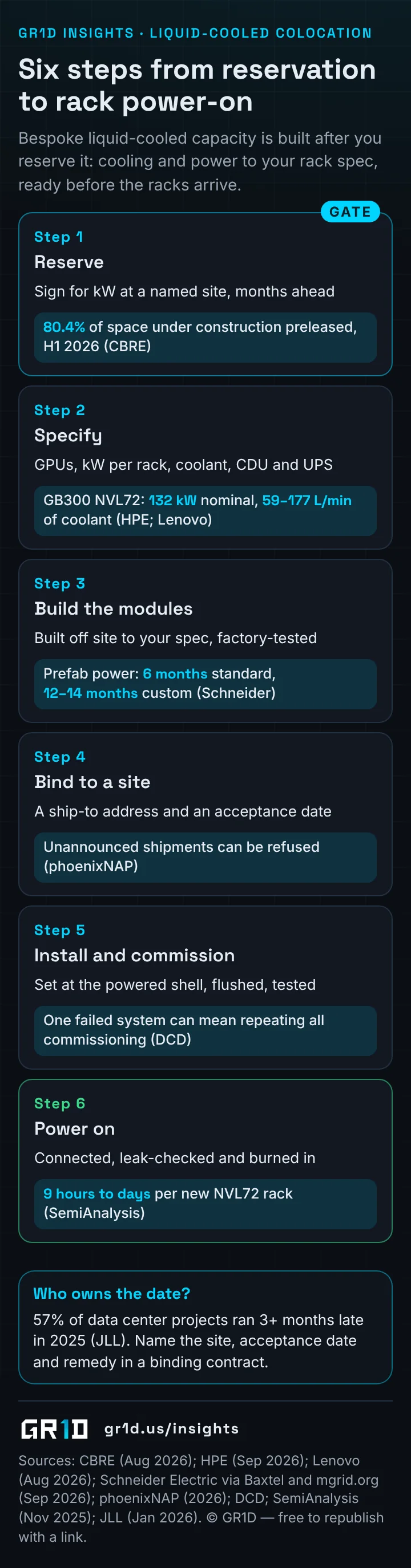
- Six steps from reservation to rack power-on
- Bespoke liquid-cooled capacity is built after you reserve it: cooling and power to your rack spec, ready before the racks arrive.
- Step 1 · Reserve · Sign for kW at a named site, months ahead · 80.4% of space under construction preleased, H1 2026 (CBRE)
- Step 2 · Specify · GPUs, kW per rack, coolant, CDU and UPS · GB300 NVL72: 132 kW nominal, 59–177 L/min of coolant (HPE; Lenovo)
- Step 3 · Build the modules · Built off site to your spec, factory-tested · Prefab power: 6 months standard, 12–14 months custom (Schneider)
- Step 4 · Bind to a site · A ship-to address and an acceptance date · Unannounced shipments can be refused (phoenixNAP)
- Step 5 · Install and commission · Set at the powered shell, flushed, tested · One failed system can mean repeating all commissioning (DCD)
- Step 6 · Power on · Connected, leak-checked and burned in · 9 hours to days per new NVL72 rack (SemiAnalysis)
- Who owns the date? · 57% of data center projects ran 3+ months late in 2025 (JLL). Name the site, acceptance date and remedy in a binding contract.
- Who owns the date?
- 57% of data center projects ran 3+ months late in 2025 (JLL). Name the site, acceptance date and remedy in a binding contract.
What is liquid-cooled colocation, and how is it different from standard colocation?
Liquid-cooled colocation delivers a coolant loop to each rack, not only cold air, because in 2026 GPU racks of 100 kW and more need closed-loop liquid cooling (CBRE, Aug 2026).
Standard colocation sells air-cooled cabinets. Flexential puts traditional deployments at 5–10 kW per rack and says air cooling "hits physical limits around 15-20kW per rack" (Flexential, Nov 2025). A GB300 NVL72 is a different load: HPE rates the rack at 132 kW nominal and about 155 kW at peak (HPE, Sep 2026), and about 90% of its heat leaves through liquid (Lenovo, Aug 2026). That heat travels from cold plates on the chips through a rack manifold and a technology cooling system (TCS) loop to a coolant distribution unit (CDU), which hands it to the facility water system and the heat rejection plant outside.
Who supplies each piece separates the offers. At Equinix, liquid cooling "may be allowed" in private cages, through a self-contained in-rack liquid-to-air heat exchanger that the customer supplies (Equinix). Digital Realty offers direct liquid cooling for 30 kW to above 150 kW per rack across 170 data centers (Data Center Frontier, May 2024). Uptime Intelligence notes that providers selling liquid-ready space have to accommodate tenant cooling equipment and design specifications that vary, and tailor service levels to each tenant (Uptime Intelligence, Sep 2025). NVIDIA's DGX-Ready Colocation program lists "Liquid Cooled Ready" halls separately (NVIDIA, Sep 2026).
| Standard colocation | Liquid-ready colocation | Bespoke liquid-cooled colocation | |
|---|---|---|---|
| Rack density | 5–10 kW; air tops out near 15–20 kW | 30 kW to above 150 kW in published offers | Built to the rack: 132–142 kW for GB300 NVL72, up to 250 kW for Vera Rubin |
| Cooling at the rack | Cold air | A liquid loop or rear doors where the hall has them | A CDU and TCS loop sized to the tenant's coolant temperature and flow |
| Who supplies the CDU | Nobody, or the tenant's own in-rack heat exchanger | The provider, in standard sizes | The provider, built to the tenant's spec |
| When it is built | Already built | Built or retrofitted ahead of demand | After the reservation, before the racks arrive |
| How it is bought | Order a cabinet | Lease available space | Reserve months ahead, then ship racks to an acceptance date |
The cooling technology itself, from cold plates to dry coolers, is in our liquid cooling guide. This guide follows the third column, bespoke liquid-cooled colocation, from reservation to power-on.
How does liquid-cooled colocation work, step by step?
Bespoke liquid-cooled colocation runs in six steps: reserve, specify, build the modules, bind the reservation to a site, install and commission at the powered shell, and power on (GR1D analysis).
| Step | What happens | The tenant | The provider | Timing or evidence, 2026 |
|---|---|---|---|---|
| 1. Reserve | Capacity is committed at a named site before it goes live | Signs a binding contract; posts the deposit or credit support | Commits kW at the site's go-live date | 80.4% of space under construction preleased (CBRE); Texas providers pre-lease 2026–2027 capacity (TRG; Colovore) |
| 2. Specify | The rack spec is fixed | GPU platform, rack count, kW basis, coolant temperature and flow, UPS | Checks the spec against the site | GB300 NVL72: 132 kW nominal and 59–177 L/min of coolant (HPE; Lenovo) |
| 3. Build | Cooling and power modules are built off site | Witnesses the factory tests | Orders and builds the modules | Standard prefab power modules: as little as 6 months; custom: 12–14 months (Baxtel; mgrid.org) |
| 4. Bind to a site | The reservation is tied to a building | Books freight to the acceptance date | Issues the ship-to address and acceptance date | Unannounced shipments can be refused (phoenixNAP) |
| 5. Install and commission | Modules are set at the powered shell, flushed, filled and tested | Witnesses integrated systems testing | Commissions power and cooling together | One failed system "can require the entire commissioning process to be repeated" (DCD) |
| 6. Power on | Racks are placed, connected, leak-checked and burned in | Provisions and burns in each rack | Hands over power and cooling at the spec | 9 hours to multiple days per new NVL72 rack (SemiAnalysis) |
Steps 3 and 4 run in parallel while the shell is finished. The order matters more than the overlap: a spec that changes after the modules are released to the factory reopens their design, and racks that arrive before step 5 is done wait in their crates (GR1D analysis). How far ahead to start, and the full terms of a capacity reservation, are in reserving data center capacity for GPUs on order.
What do you specify when you reserve liquid-cooled colocation?
In 2026 a liquid-cooled reservation is specified per rack: power on a named basis, coolant supply temperature and flow, the CDU arrangement, the UPS and the route in (GR1D analysis).
| What you specify | Why it matters | Published GB300 NVL72 figure | Source |
|---|---|---|---|
| Power per rack, and which figure | Breakers see peaks; the commitment and the bill need one basis | 132 kW nominal, about 155 kW peak, busway for 192 kW | HPE, Sep 2026 |
| Feeds and voltage | The power module's output has to match the rack's shelves | Eight 33 kW shelves on 60 A whips at 400 or 480 V | HPE, Sep 2026 |
| Coolant supply temperature | Sets the flow, the CDU count and the heat rejection plant | 25–45 °C | Lenovo, Aug 2026 |
| Coolant flow | Sizes pumps and piping | 59 L/min at 25 °C to 177 L/min at 45 °C | Lenovo, Aug 2026 |
| CDU arrangement | In-rack or in-row, and how many racks per unit | In-rack 200–250 kW; in-row 1.3–1.8 MW for up to eight racks | HPE; Supermicro |
| UPS and ride-through | AI loads swing in milliseconds; rack storage covers milliseconds, not outages | 65 J per GPU of storage; 20 ms of shelf hold-up | NVIDIA, Jul 2025; Vertiv, May 2026 |
| Weight and route in | Floors, docks and doors must carry the rack | 3,300–3,483 lb; 2.24–2.50 m tall | HPE; Lenovo |
| The next platform | Avoids rebuilding for the next rack | Vera Rubin: up to 250 kW, 45 °C coolant | NVIDIA, Oct 2026 |

Read as text
- You specify the rack; the modules are built to it
- What a liquid-cooled reservation fixes, with NVIDIA GB300 NVL72 as the example, and what is built to it.
- You specify · GB300 NVL72 example · Power per rack 132 kW nominal · 155 kW peak · 192 kW busway · Feeds 8 × 33 kW shelves, 60 A whips, 400 or 480 V · Coolant supply 25–45 °C to the rack · Coolant flow 59–177 L/min per rack, more when warmer · CDU In-rack 200–250 kW, or in-row 1.3–1.8 MW (≤ 8 racks) · UPS Redundancy (N, N+1, 2N) and battery minutes · Rack and route 3,300–3,483 lb, 2.24–2.50 m tall · Next platform Vera Rubin: up to 250 kW, 45 °C coolant
- Power per rack 132 kW nominal · 155 kW peak · 192 kW busway
- Feeds 8 × 33 kW shelves, 60 A whips, 400 or 480 V
- Coolant supply 25–45 °C to the rack
- Coolant flow 59–177 L/min per rack, more when warmer
- CDU In-rack 200–250 kW, or in-row 1.3–1.8 MW (≤ 8 racks)
- UPS Redundancy (N, N+1, 2N) and battery minutes
- Rack and route 3,300–3,483 lb, 2.24–2.50 m tall
- Next platform Vera Rubin: up to 250 kW, 45 °C coolant
- Cooling module BUILT TO SPEC · CDUs, pumps, filtration and the coolant loop to each rack manifold, sized to your supply temperature and flow. · CDU filters are usually 50 microns; cold-plate passages are 25–50 microns (Vertiv).
- Power module BUILT TO SPEC · UPS, switchgear, batteries and busway in one factory-tested enclosure. · Schneider's standard 2–2.5 MW modules: as little as 6 months to manufacture.
- At the powered shell · Set, connected, flushed and filled, then power and cooling commissioned together.
- Why the UPS still matters · GB300 stores 65 J per GPU, cutting grid peaks 30% in NVIDIA's test, but a 33 kW shelf holds up for 20 ms. Outages are the UPS's job.
- Why the UPS still matters
- GB300 stores 65 J per GPU, cutting grid peaks 30% in NVIDIA's test, but a 33 kW shelf holds up for 20 ms. Outages are the UPS's job.
The UPS needs its own conversation. Schneider Electric describes AI workloads as "triggering power surges in milliseconds" and synchronized training as "an oscillating load profile," and says lithium-ion batteries handle those swings better than VRLA (Schneider Electric, May 2025). A GB300's power supplies store 65 joules per GPU, which cut the grid peak by 30% in NVIDIA's test (NVIDIA, Jul 2025), but a 33 kW shelf holds up for 20 milliseconds at full load (Vertiv, May 2026), so the UPS and generators still carry an outage. The redundancy you ask for, N, N+1 or 2N, and the battery minutes behind it are design inputs for the power module: put them in the reservation, not a change order. The full 15-question acceptance checklist for a GB300 hall is in GB300 NVL72 colocation requirements.
How are bespoke cooling and power modules built?
Cooling and power modules are built off site to the tenant's spec and factory-tested; Schneider Electric's standard prefab power modules take as little as six months to manufacture (Baxtel, Sep 2026).
A power module is an electrical room in a box. Schneider Electric's 2 to 2.5 MW modules, launched in September 2026 on reference designs developed with NVIDIA for GB300 NVL72, put a Galaxy VXL UPS, switchgear, batteries, cooling, busway and power distribution in one factory-tested enclosure, shipping in Europe first (Baxtel, Sep 2026). Six months is the standard product. For the custom prefabricated systems it sold before, Schneider cites 12 to 14 months (mgrid.org, Sep 2026). A module engineered to one tenant's UPS and voltage sits toward the custom end, which is why bespoke capacity is reserved before it is built.
A cooling module centers on CDUs, pumps, filtration and the TCS piping that runs to the rack manifolds. Modular CDUs can be added as load grows. When US Signal converted a live colocation hall built for about 5 kW per cabinet to serve a customer at about 30 kW, it installed seven CDUs and runs two or three of them, with a direct-to-chip phase to follow, and aimed to have the customer running "within about six months" (Vertiv, 2026). Demand for the units is climbing: LiquidStack booked a 300 MW CDU order from one US operator in January 2026 (LiquidStack, Jan 2026).
Factory testing is the first level of commissioning. ASHRAE defines Level 1 as "factory acceptance testing to ensure components meet design expectations before shipment" (ASHRAE). It is also the step that rushed schedules squeeze. Uptime Institute warns: "When speed takes priority, and/or CDUs are retrofitted into an existing facility, FWT is more likely to be overlooked" (Vertiv, Feb 2026). FWT is the factory witness test. Ask to attend the one for your modules.
What does it mean when a reservation is bound to a site?
A site-bound reservation names the building that will host your racks, the address to ship them to and the date that site can accept them (GR1D analysis).
That date matters because a GPU rack is heavy freight and colocation sites control deliveries tightly. TransPak designs its NVIDIA MGX GB200 and GB300 crate around "a 3,500+ lb. L11 rack with a high center of gravity" (Open Compute Project, Aug 2026), and HPE lists the loaded GB300 NVL72 at 3,300 lb and 2.5 m tall (HPE, Sep 2026). Delivery rules are strict: phoenixNAP asks for 48 hours' notice and a ticket number, warns that "Lacking prior notice, incoming shipments will be refused," and stores equipment free for up to seven business days (phoenixNAP, Mar 2026).
Racks with nowhere to go cost money. Supermicro said its June-quarter revenue came in at $11.1 billion "due to some short-term customer delays in power, cooling, and networking" (Supermicro, Aug 2026): the servers were ready before the sites were. Before you book freight, get these in writing:
- The ship-to address, receiving contact and hours.
- The acceptance date, and how much notice a change to it needs.
- The route from truck to position: dock height, doors, ramps, elevators and floor rating; GB300 NVL72 colocation requirements has the numbers.
- Storage terms if racks arrive early, and who signs for them.
- When custody and insurance pass from the carrier to the site.
How are the modules installed and commissioned at the powered shell?
At the powered shell, modules are set, connected, flushed, filled and commissioned through integrated systems testing before any GPU rack powers on; ASHRAE's Level 5 is that integrated test (ASHRAE).
A powered shell is a building with utility power delivered to it; our guide to powered shell vs turnkey vs colocation explains the split, and how a data center is built covers the phases around it. Factory-built modules replace months of on-site electrical and mechanical work there, but commissioning still happens on site, and liquid cooling makes it stricter.
Coolant cleanliness comes first. CDUs carry "supply-side filters, usually 50 microns in size" (Vertiv, Mar 2024), and cold plates have "25–50-micron passages," so "a single particle of construction debris or a pocket of entrained air is not a maintenance nuisance" (Vertiv, Feb 2026). ASHRAE puts it plainly: "Failure to maintain proper fluid cleanliness can result in extensive project delays" (ASHRAE).
Power and cooling are then proven together. "A problem with either the electrical or cooling system can require the entire commissioning process to be repeated," says Nick Funyak of Starline, and commissioning "increasingly requires either liquid-cooled load banks or relocating conventional air-cooled load banks" (DCD). Ask to witness the integrated systems test at the coolant temperature in your contract, with load banks that heat the loop the way your racks will.
What happens on power-on day?
On power-on day, racks are set, connected to the coolant manifolds and power whips, checked and energized, and a new NVL72 rack takes 9 hours to multiple days to provision (SemiAnalysis, Nov 2025).
The order inside the day follows the coolant. CoreWeave describes its own bring-up: "After the hardware is plugged in and the liquid cooling loop has been provisioned, our automation takes over," then "We run hours of repeated GPU diagnostics," and "a system that performs below the expected range goes into troubleshooting, not into production" (CoreWeave, Sep 2026). SemiAnalysis found that "the provisioning process for a fresh backplane or a brand new NVL72 rack can take anywhere from 9 hours to multiple days" (SemiAnalysis, Nov 2025).
Two terms decide what power-on means on paper. The acceptance tests: flow, pressure drop and leak checks at the contracted supply temperature. And the billing start: Morgan Lewis advises colocation agreements to state "whether billing is based on reserved capacity or actual usage" (Morgan Lewis, May 2026), which decides whether you pay from the ready-for-service date or from the day your racks draw power.
Why do providers ask for deposits and binding contracts, not LOIs?
Bespoke cooling and power are built for one tenant before rent starts, so providers want a signed contract and a deposit; an LOI binds neither side to the deal (CommercialCafe, Jun 2026).
A letter of intent sets out the business terms, such as rent, term, security deposit and contingencies, but it is non-binding overall, apart from clauses such as confidentiality and exclusivity, and signing one does not commit either party to complete the lease (CommercialCafe, Jun 2026). That works for space that already exists, not for capacity that has to be built: a cooling module engineered to one tenant's racks can't sensibly be ordered against a document that lets the tenant walk away.
Colocation agreements already carry the tools. Morgan Lewis lists customer protections such as "security deposits, or the right to require prepayment if a customer's credit profile deteriorates," and notes that "Providers often seek multi-year commitments, sometimes extending up to a decade" (Morgan Lewis, May 2026). With newer AI tenants, operators have asked for "letters of credit or parent backing," and one neocloud that offered a 15-year term and "agreed to prepay six months of recurring charges" still saw the deal fall through (Data Center Knowledge, Apr 2026). CBRE adds that take-or-pay floors of 60% to 85% of allocated power are becoming increasingly common in the US (CBRE, Aug 2026).
Before you sign, ask what the deposit secures (the capacity, the modules or both), when it converts to rent, and what happens to it if the provider misses its date.
What happens if construction runs late?
Late delivery is common: 57% of data center projects had a construction delay of three months or more in 2025, so the contract has to say who carries the date (JLL, Jan 2026).
The largest buyers are not exempt. In November 2025 CoreWeave set its 2025 revenue forecast below Wall Street's after one of its third-party developers fell "behind schedule on a key data center facility"; the affected customer agreed to adjust its delivery schedule (SiliconANGLE, Nov 2025). In December 2025 Bloomberg reported that Oracle had pushed some data centers for OpenAI from 2027 to 2028 because of labor and material shortages; Oracle replied: "There have been no delays to any sites required to meet our contractual commitments, and all milestones remain on track" (DatacenterDynamics, Dec 2025). NVIDIA's Jensen Huang put the cost of a three-month delay on a 1 GW AI factory at about $10 billion of missed revenue (The Next Platform, Oct 2026).
| The paper | Binding? | Site and date named | If the hall is late | Who holds the idle racks |
|---|---|---|---|---|
| Letter of intent | No, apart from clauses such as confidentiality | Usually not | No remedy: the deal can lapse | The tenant |
| Colocation agreement with RFS remedies | Yes | A ready-for-service (RFS) date | "tiered credits and termination rights for RFS delays" | The tenant, compensated in credits |
| Site-bound reservation, provider responsible for power-on | Yes | The site, a ship-to address and an acceptance date | The provider brings the racks online in a ready shell, its own or a partner's | The provider, which has to find powered space |

Read as text
- When the hall is late, the paper decides who holds the racks
- Delays are common, and expensive at AI scale. Three kinds of paper, and what each does when the ready date slips.
- LATE IN 2025 · 57% · of data center projects ran 3 months or more late (JLL)
- COST OF 3 MONTHS, 1 GW · ~$10B · of missed revenue, per NVIDIA's Jensen Huang (The Next Platform)
- AIR-TO-LIQUID CONVERSION · 6+ mo · of delay can follow converting an air-cooled hall (CBRE)
- Letter of intent · BINDING? · No, apart from clauses like confidentiality · IF THE HALL IS LATE · No remedy: the deal can lapse · WHO HOLDS THE IDLE RACKS · The tenant
- Agreement with RFS remedies · BINDING? · Yes, with a ready-for-service date · IF THE HALL IS LATE · Tiered credits and termination rights · WHO HOLDS THE IDLE RACKS · The tenant, paid in credits
- Site-bound reservation, provider owns power-on · BINDING? · Yes, naming the site, ship-to address and acceptance date · IF THE HALL IS LATE · The provider brings racks online in a ready shell, its own or a partner's · WHO HOLDS THE IDLE RACKS · The provider, which must find powered space
- Credits compensate; they don't power racks on. With GPUs on the dock, the useful remedy is powered space on the contracted date. Ask which row a provider's paper is in.
- Credits compensate; they don't power racks on.
Credits compensate; they don't power anything on. With GPUs on the dock, the useful remedy is space: a provider that has to bring the racks online on the contracted date, in another ready hall if its own is late. Ask any provider which row its paper is in. Power and permit dates add their own risk in Texas; our reservation guide carries a dated status box.
Frequently asked questions
How long does it take to set up liquid-cooled colocation?
It depends on what already exists. Where a liquid-ready hall has free space, fit-out runs from weeks to several months; converting an air-cooled hall can add delays beyond six months (CBRE, Aug 2026). Bespoke capacity is built after the reservation, so it is booked months before the site comes online.
Who supplies the CDU in liquid-cooled colocation?
It varies by provider. Some allow liquid cooling only through a self-contained, in-rack heat exchanger that the tenant supplies in a private cage (Equinix). In purpose-built liquid-cooled colocation the provider supplies the CDU and the coolant loop to the rack. Put CDU ownership, maintenance, spares and the number of racks per CDU in the contract.
What is an acceptance date in colocation?
The date a site can receive your racks, with the dock, the route and the position ready for them. Colocation sites control deliveries tightly: phoenixNAP, for example, refuses unannounced shipments and stores equipment free for up to seven business days. Book the OEM ship window and the freight against the acceptance date.
Is a letter of intent for colocation binding?
Generally not. A letter of intent sets out business terms such as rent, term and deposit, but apart from clauses such as confidentiality it does not commit either side to complete the deal (CommercialCafe, Jun 2026). Capacity built for one tenant is ordered against a signed contract instead.
Why do colocation providers ask for deposits?
To secure capacity and equipment committed to one tenant before rent starts. Colocation agreements can provide for security deposits or prepayment (Morgan Lewis, May 2026), and operators have asked newer AI tenants for letters of credit or parent backing (Data Center Knowledge, Apr 2026). Ask what the deposit secures and when it converts to rent.
What happens if the colocation site isn't ready when my racks arrive?
That depends on the contract. Many agreements offer tiered credits and termination rights for missed ready-for-service dates (Morgan Lewis, May 2026); credits compensate but do not power anything on. Some providers instead stay responsible for bringing the racks online on time in another ready hall. Without either, the tenant holds the idle hardware.
Sources
- North America Data Center Trends H1 2026 — CBRE, 2026-08-27
- Liquid cooling for high-density colocation — Flexential, 2025-11-26
- NVIDIA GB300 NVL72 by HPE QuickSpecs — HPE, 2026-09-08
- Lenovo NVIDIA GB300 NVL72 Rack Scale AI product guide (LP2357) — Lenovo Press, 2026-08-30
- GB300 NVL72 User Guide — Lenovo, 2026-08
- Liquid Cooling (colocation products) — Equinix, n.d.
- Digital Realty Adds Direct Liquid Cooling for High-Density Colocation in 170 Data Centers Globally — Data Center Frontier, 2024-05-18
- Guiding questions for liquid-cooled colocation planning — Uptime Intelligence, 2025-09
- DGX-Ready Colocation Data Centers — NVIDIA, 2026-09-10
- GPU Colocation Services — TRG Datacenters, 2026-11-03
- Austin market — Colovore, 2026-11-03
- Schneider Electric launches 2.5MW power modules for AI data centers — Baxtel, 2026-09-16
- Schneider Electric Launches a 2.5 MW Prefabricated Power Block, With North America Waiting Until Later This Year — mgrid.org, 2026-09-21
- Equipment Delivery Procedure — phoenixNAP, 2026-03-27
- How AI is reshaping data center power testing and commissioning — DatacenterDynamics, n.d.
- ClusterMAX 2.0: The Industry Standard GPU Cloud Rating System — SemiAnalysis, 2025-11-06
- SuperCluster GB300 NVL72 datasheet — Supermicro, 2025
- How New GB300 NVL72 Features Provide Steady Power for AI — NVIDIA, 2025-07-28
- PowerDirect 3000 33 kW power shelf for NVIDIA GB200/GB300 NVL72 (datasheet) — Vertiv, 2026-05
- At OCP Global Summit, NVIDIA and partners scale Vera Rubin AI factories — NVIDIA, 2026-10-12
- AI-tolerant UPSs: The first line of defense in data center resilience — Schneider Electric, 2025-05-20
- Vertiv Cooling Innovation Day 2026: Lessons from a live colocation deployment — Vertiv, 2026
- LiquidStack Secures 300-Megawatt CDU Order from Major U.S. Data Center Operator — LiquidStack via GlobeNewswire, 2026-01-06
- Commissioning and Performance Validation, AI Data Center Framework — ASHRAE
- The circulatory system of the AI factory: Why "flush and fill" is no longer enough — Vertiv, 2026-02-02
- TransPak NVIDIA MGX GB200/GB300 Rack Crate — Open Compute Project, 2026-08-26
- Fourth Quarter Fiscal 2026 Prepared Remarks — Super Micro Computer, 2026-08-11
- Deploying liquid cooling in data centers: installing and managing coolant distribution units (CDUs) — Vertiv, 2024-03-15
- What it takes to bring up a multi-rack NVIDIA Vera Rubin NVL72 cluster — CoreWeave, 2026-09-16
- Activating the Colo Model: What Really Matters in Data Center Colocation Agreements — Morgan Lewis, 2026-05-18
- Letter of Intent for a Commercial Lease: A Tenant's Guide — CommercialCafe, 2026-06-23
- Neocloud Storm Gathers as Data Center Deals Stall Over Credit Risk — Data Center Knowledge, 2026-04-06
- 2026 Global Data Center Outlook — JLL, 2026-01-08
- CoreWeave's stock wavers on data center delay and lower revenue forecast — SiliconANGLE, 2025-11-10
- Oracle delays some of its OpenAI data centers from 2027 to 2028: report — DatacenterDynamics, 2025-12
- Huang shrugs off protestors to kick off GTC Berlin with DSX pods, robots — The Next Platform, 2026-10-21
Building or financing an AI data center in Texas?
GR1D develops powered-shell and turnkey AI data centers — 20 MW to 150 MW sites with power, fiber and entitlements solved before the first rack arrives. See how we build, browse our sites or talk to us.