Liquid-Cooled Colocation Pricing in 2026: What $/kW per Month Buys
Colocation costs about $190 to $235 per kW per month in 2026 for a 250–500 kW requirement in Northern Virginia and Chicago, and CBRE's primary-market average reached a record of about $196. Large AI campus leases, signed for 10 to 15 years, work out to about $65 to $159 per kW-month. The rate buys backed-up power and cooling delivered to your racks; electricity, cross-connects and fit-out are often billed on top. Liquid cooling mainly changes how many kilowatts each rack needs.
Read as text
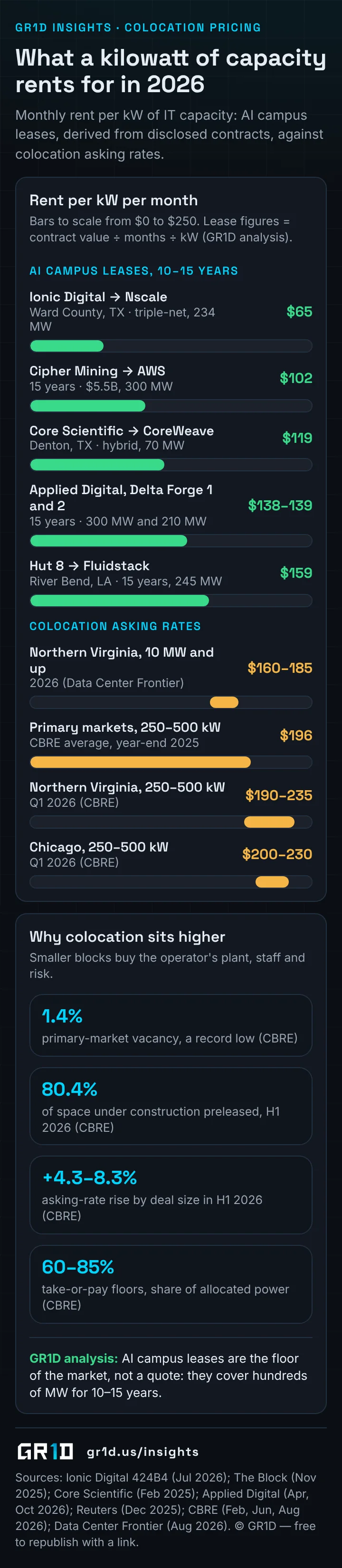
- What a kilowatt of capacity rents for in 2026
- Monthly rent per kW of IT capacity: AI campus leases, derived from disclosed contracts, against colocation asking rates.
- Rent per kW per month · Bars to scale from $0 to $250. Lease figures = contract value ÷ months ÷ kW (GR1D analysis). · AI CAMPUS LEASES, 10–15 YEARS · Ionic Digital → Nscale · Ward County, TX · triple-net, 234 MW · $65 · Cipher Mining → AWS · 15 years · $5.5B, 300 MW · $102 · Core Scientific → CoreWeave · Denton, TX · hybrid, 70 MW · $119 · Applied Digital, Delta Forge 1 and 2 · 15 years · 300 MW and 210 MW · $138–139 · Hut 8 → Fluidstack · River Bend, LA · 15 years, 245 MW · $159 · COLOCATION ASKING RATES · Northern Virginia, 10 MW and up · 2026 (Data Center Frontier) · $160–185 · Primary markets, 250–500 kW · CBRE average, year-end 2025 · $196 · Northern Virginia, 250–500 kW · Q1 2026 (CBR
- Why colocation sits higher · Smaller blocks buy the operator's plant, staff and risk. · 1.4% · primary-market vacancy, a record low (CBRE) · 80.4% · of space under construction preleased, H1 2026 (CBRE) · +4.3–8.3% · asking-rate rise by deal size in H1 2026 (CBRE) · 60–85% · take-or-pay floors, share of allocated power (CBRE) · GR1D analysis: AI campus leases are the floor of the market, not a quote: they cover hundreds of MW for 10–15 years.
How much does colocation cost per kW in 2026?
In 2026, colocation costs about $190 to $235 per kW per month for a 250–500 kW requirement in the largest US markets (CBRE, Jun 2026).
CBRE's year-end 2025 survey put the average asking rate for 250–500 kW in primary markets at a record of about $196 per kW per month, up about 6.5% in a year, with 3–10 MW blocks up 12.5% and primary-market vacancy at a record-low 1.4% (CBRE, Feb 2026). Prices kept climbing in 2026. In the first half, "asking rates rose in every deployment size": 8.3% for 3–10 MW, 7.9% for 500 kW–3 MW, 6.7% for 10 MW and up and 4.3% for 250–500 kW, while 80.4% of the 7,481 MW under construction in primary markets was already preleased (CBRE via Exchange, Aug 2026).
Large blocks price lower per kW than small ones in the same market. In Northern Virginia, 10 MW-plus requirements asked $160 to $185 per kW per month in 2026 (Data Center Frontier, Aug 2026), against $190 to $235 for 250–500 kW.
| Market or deal size | Asking rate or change | Period | Source |
|---|---|---|---|
| Primary markets, 250–500 kW | About $196 per kW-month, a record | Year-end 2025 | CBRE, Feb 2026 |
| Northern Virginia, 250–500 kW | $190–$235 per kW-month | Q1 2026 | CBRE, Jun 2026 |
| Chicago, 250–500 kW | $200–$230 per kW-month, up 14.7% in a year | Q1 2026 | CBRE, Jun 2026 |
| Northern Virginia, 10 MW and up | $160–$185 per kW-month | 2026 | Data Center Frontier, Aug 2026 |
| Dallas–Fort Worth | Asking rents unchanged; 88% of 716.7 MW under construction preleased | Q1 2026 | CBRE, Jun 2026; W.Media, Jul 2026 |
| 10 MW and up, by market | New York Tri-State +19%, Atlanta +14.5%, Chicago +9.7%, Northern Virginia +1.5%, Silicon Valley and Hillsboro flat | H1 2026 | CBRE via Exchange, Aug 2026 |
Texas is not one market. Houston carried 19.7% colocation vacancy in the first half of 2025 while Austin–San Antonio sat at 2.3% (CBRE, Sep 2025; CBRE, Sep 2025), so the same 2 MW requirement can be a buyer's market in one metro and a waiting list in the other. Vacant space in an older air-cooled hall is also not the same product as liquid-cooled positions for 132 kW racks.
What does a colocation price per kW include?
In 2026, a colocation price per kW per month buys reserved IT power at your racks, with backup and cooling for that load, plus space and operations; energy, cross-connects and setup are often separate charges (Morgan Lewis, May 2026).
Morgan Lewis splits colocation pricing into monthly recurring charges, which "may include charges such as base space charges, power and utility costs, connectivity fees, taxes", and one-time, non-recurring charges. It flags three items buyers underestimate: "whether billing is based on reserved capacity or actual usage", cross-connects ("recurring cross-connect and interconnect fees can become a meaningful expense") and the "remote hands and other ancillary services" needed to fill the space (Morgan Lewis, May 2026).
| Line item | In the per-kW rate? | What to pin down |
|---|---|---|
| Reserved IT capacity (kW) with UPS and generator backup | Yes: it is what the rate prices | Which kW the contract counts (nominal or peak) and the redundancy (N+1 or 2N) |
| Cooling for that load, air or liquid | Yes, to the agreed spec | Supply temperature, flow per rack, who owns and maintains the coolant distribution unit (CDU) |
| Space: cabinets, cage, floor | Usually | Rack weight limits and room for CDUs |
| Electricity used | Either inside an all-in rate or metered on top | Price per kWh and any cooling or PUE factor applied to it |
| Cross-connects and interconnects | No: a monthly charge per connection | Price per cross-connect and which carriers are on site |
| Remote hands | No | Hourly rates and response times |
| Setup and fit-out (non-recurring) | No: a one-time charge | Cage build, power whips, coolant piping, CDU installation |
| Escalators and taxes | No | Fixed or index-linked increase, and which taxes pass through |
Liquid cooling adds a coolant loop to that list. Some providers allow liquid cooling only through a self-contained, in-rack heat exchanger that the tenant supplies in a private cage (Equinix); purpose-built liquid-cooled colocation supplies the CDU and the loop to the rack. Either way, someone pays for the CDU, the piping and the spares, in the rate or as a setup charge, and the contract should say who. Our guide to how liquid-cooled colocation works walks through the reservation, spec and commissioning steps behind those line items.
How is power billed in colocation: reserved kW or metered use?
In 2026, colocation power is billed either on the kilowatts you reserve, used or not, or on metered use above a take-or-pay floor that runs "from 60% to 85% of allocated power" (CBRE, Aug 2026).
The difference decides what each kilowatt you actually use costs. Billed on reserved capacity, a tenant drawing half its reservation pays twice the headline rate per kW used. Billed on usage with a floor, the penalty starts only below the floor.
| Share of reserved kW the racks draw | Billed on reserved kW | Billed on use, 60% floor | Billed on use, 85% floor |
|---|---|---|---|
| 100% | $196 | $196 | $196 |
| 85% | $231 | $196 | $196 |
| 70% | $280 | $196 | $238 |
| 50% | $392 | $235 | $333 |

Read as text
- Unused kilowatts still cost money
- Effective price per kW the racks actually draw, per month, at a $196 rate (CBRE's year-end 2025 average for 250–500 kW), under three billing models.
- RACKS DRAW, SHARE OF RESERVED KW BILLED ON RESERVED KW BILLED ON USE, 60% FLOOR BILLED ON USE, 85% FLOOR · 100% $196 $196 $196 · 85% $231 $196 $196 · 70% $280 $196 $238 · 50% $392 $235 $333
- RACKS DRAW, SHARE OF RESERVED KW BILLED ON RESERVED KW BILLED ON USE, 60% FLOOR BILLED ON USE, 85% FLOOR
- 100% $196 $196 $196
- 85% $231 $196 $196
- 70% $280 $196 $238
- 50% $392 $235 $333
- Take-or-pay floors · run 60% to 85% of allocated power in 2026 (CBRE, Aug 2026).
- Method · Reserved billing: rate ÷ share drawn. Usage billing: rate × the larger of share drawn and floor ÷ share drawn. Electricity excluded.
- Match the kW basis · A GB300 NVL72 is 132 kW nominal and about 155 kW at peak (HPE): sizing to peak costs about 17% more per rack.
Two more clauses move the bill. Morgan Lewis lists "potential overage charges, derating practices, and any limitations on increasing density over time" among the power terms to settle (Morgan Lewis, May 2026). And the kW basis must match the hardware: HPE rates a GB300 NVL72 rack at 132 kW nominal and about 155 kW at peak (HPE, Sep 2026), so a reservation sized to peak costs about 17% more per rack than one sized to nominal (155 ÷ 132), and one sized to nominal needs an agreed overage rule for the peaks.
What does it cost to colocate one GB300 NVL72 rack?
In 2026, one GB300 NVL72 rack at its 132 kW nominal rating rents for about $21,100 to $31,000 a month at $160 to $235 per kW, before electricity (GR1D analysis of CBRE and HPE data).
| Monthly cost for one GB300 NVL72 rack | At $160 per kW | At $196 per kW | At $235 per kW |
|---|---|---|---|
| Rent on 132 kW (nominal) | $21,120 | $25,872 | $31,020 |
| Rent if reserved at 155 kW (peak) | $24,800 | $30,380 | $36,425 |
| Electricity at 7.21¢ per kWh (Texas industrial), PUE 1.3, full nominal load | $9,032 | $9,032 | $9,032 |
| Electricity at 9.64¢ per kWh (US industrial), same load | $12,076 | $12,076 | $12,076 |
| Rent plus Texas-average power, per GPU-hour | $0.57 | $0.66 | $0.76 |

Read as text
- One GB300 NVL72 rack, colocated: the monthly bill
- Rent on the rack's 132 kW nominal rating at three 2026 rates, plus electricity at full nominal load and a PUE of 1.3, if energy is billed on top.
- AT $160 PER KW · $21,120 /mo rent · Low end of Northern Virginia 10 MW-plus asking rates · Reserved at 155 kW peak · $24,800 · Power, Texas 7.21¢/kWh · $9,032 · Power, US 9.64¢/kWh · $12,076 · Rent + Texas power, per GPU-hour · $0.57
- AT $196 PER KW · $25,872 /mo rent · CBRE primary-market average for 250–500 kW, year-end 2025 · Reserved at 155 kW peak · $30,380 · Power, Texas 7.21¢/kWh · $9,032 · Power, US 9.64¢/kWh · $12,076 · Rent + Texas power, per GPU-hour · $0.66
- AT $235 PER KW · $31,020 /mo rent · High end of Northern Virginia 250–500 kW asking rates · Reserved at 155 kW peak · $36,425 · Power, Texas 7.21¢/kWh · $9,032 · Power, US 9.64¢/kWh · $12,076 · Rent + Texas power, per GPU-hour · $0.76
- Scale: 72 GPUs × 730 hours = 52,560 GPU-hours a month. Renting a B200 on demand ran $7.69 to $8.60 per GPU-hour at specialist clouds in November 2026, so rent and power are under a tenth of a rented GPU-hour.
- Scale:
Electricity can be a fifth to a third of the bill. At full load, the rack burns about 96,000 kWh of IT energy a month (132 kW × 730 hours), about 125,000 kWh with cooling at a PUE of 1.3, so a contract that meters energy at cost turns the power price into a line item worth about $9,000 to $12,000 a month at 2026 industrial averages (EIA, Oct 2026). The PUE assumption matters too: Uptime Institute reports an industry average of 1.54, 1.44 for sites of 20 MW or more (Uptime Institute, 2025), and hyperscale fleets run 1.10–1.15 (mgrid, Oct 2025).
Per GPU-hour, hosting is a small share of GPU economics. About $0.66 for rent and power compares with $7.69 to $8.60 per GPU-hour to rent a B200 on demand from specialist GPU clouds in November 2026; our rent-or-buy guide runs the full ownership math. A megawatt of capacity at $196 per kW is $196,000 a month, about $2.35 million a year, before power, and holds about 7.6 GB300 NVL72 racks at 132 kW each (GR1D, Nov 2026).
What do AI campus leases cost per kW-month?
Disclosed AI campus leases signed in 2025 and 2026 work out to about $65 to $159 per kW-month over 10- to 15-year terms (GR1D analysis of filings and press releases).
| Deal | Structure | Term | Contract | Derived $/kW-month |
|---|---|---|---|---|
| Ionic Digital → Nscale, Ward County, TX | Triple-net; landlord builds nothing above grade | 126 months | $182.5M a year, 234 MW | $65 |
| Cipher Mining → AWS | Space and power for AI workloads; rent from Aug 2026 | 15 years | $5.5B, 300 MW | $102 |
| Core Scientific → CoreWeave, Denton, TX | Hybrid: landlord funds about $1.5M per MW, tenant the rest | 12 years | $1.2B, 70 MW | $119 |
| Applied Digital → investment-grade hyperscaler, Delta Forge 2 | Turnkey build-to-suit | 15 years | $5.2B, 210 MW | $138 |
| Applied Digital → investment-grade hyperscaler, Delta Forge 1 | AI factory campus, 300 MW of critical IT, from mid-2027 | About 15 years | $7.5B, 300 MW | $139 |
| Hut 8 → Fluidstack (Anthropic), River Bend, LA, with a Google backstop | AI data center lease | 15 years | About $7B, 245 MW | $159 |
The contract terms come from Ionic Digital's prospectus (Ionic Digital 424B4, Jul 2026), the report of Cipher's AWS lease (The Block, Nov 2025), Core Scientific's Denton release (Core Scientific, Feb 2025), Applied Digital's earnings release and Delta Forge 1 announcement (Applied Digital, Oct 2026; Applied Digital, Apr 2026) and Reuters' report of the Hut 8 lease (Reuters via BNN Bloomberg, Dec 2025).
These leases price lower per kW than colocation for four reasons: they cover hundreds of megawatts, run 10 to 15 years, are signed by investment-grade tenants or carry a backstop (Google stands behind the 15-year Hut 8 term), and some leave the fit-out or the plant to the tenant. Ionic's lease sits at the bottom because the landlord is "not responsible for construction or site development" (Ionic Digital 424B4, Jul 2026); Delta Forge 2, a turnkey build-to-suit that Applied Digital designs, builds and operates, and Delta Forge 1 land within about $1 of each other. Our comparison of powered shell, turnkey and colocation explains what each structure leaves to the tenant.
None of these deals is open to a buyer with four racks or 2 MW of GPUs on order. They are the floor of the market, not a quote: a tenant taking a few hundred kilowatts buys the operator's plant, staff and risk in a smaller block, which is why colocation asks about $196.
Does liquid-cooled colocation cost more per kW?
In 2026 we found no public index that separates liquid-cooled colocation rates from air-cooled ones; quotes move with rack density, term, ramp and who funds the coolant distribution units (GR1D review, Nov 2026).
What liquid cooling changes is the bill per rack and the time to get space. A GB300 NVL72 needs 132 kW of capacity, so its bill is set by 132 kW at whatever the rate is, and the CDU, the technology cooling loop and its spares are paid for in the rate or as a setup charge. Availability is the bigger cost. CBRE reports that "RFS fit-out dates are expanding from weeks to several months," and that "for air-cooled data centers requiring conversion to liquid cooling, delays can extend beyond six months" (CBRE, Aug 2026).
A month of delay is worth more than a few dollars per kW. A $15 per kW difference on a 132 kW rack is about $2,000 a month, while 72 GPUs rented at $7.69 an hour, the low end of November 2026 on-demand rates for the older B200, would bring in about $404,000 a month (GR1D calculation). A hall with liquid-ready positions, power and a contracted ready-for-service date is worth more to a team with racks on order than a lower rate on a hall that still needs converting. The GB300 NVL72 requirements guide lists what liquid-ready means in kW, coolant flow and floor load.
How do escalators, term and deposits change the price?
In 2026, colocation contracts commonly add an annual escalator, fixed or tied to an index, and providers "often seek multi-year commitments, sometimes extending up to a decade" (Morgan Lewis, May 2026).
- Escalators: Ionic Digital's Texas lease steps up 3% a year after year five (Ionic Digital 424B4, Jul 2026). At a 3% fixed escalator, a $196 rate becomes about $221 in year 5 and $256 in year 10, and the ten-year total runs about 15% above a flat rate (GR1D calculation).
- Term: wholesale and AI leases run 10 to 15 years, and 15-year initial terms are common in large deals (Clifford Chance, Jul 2026); renewals can carry "pricing that may reset at renewal" (Morgan Lewis, May 2026).
- Deposits and credit: providers protect themselves with "security deposits, or the right to require prepayment if a customer's credit profile deteriorates" (Morgan Lewis, May 2026), and operators renting to GPU clouds on two- to five-year contracts often require "significant up-front collateral or a third-party guarantor" (Bisnow, Sep 2025).
- Delay remedies: "tiered credits and termination rights for RFS delays" are among the most negotiated terms (Morgan Lewis, May 2026); they decide who pays when the hall is late and the GPUs are not.
What should a colocation price quote include?
A comparable 2026 colocation quote states the price per kW, which kW it counts, how energy is billed, the take-or-pay floor, the escalator and every one-time charge, so two providers can be compared on the same basis (Morgan Lewis, May 2026).
- The rate per kW per month, and whether it is all-in or excludes energy.
- The kW basis: nominal or peak per rack, and the overage rule above it.
- How energy is metered and priced: per kWh, with or without a cooling or PUE factor.
- The take-or-pay floor and the ramp: how many kW are billed from which month.
- Cooling spec and ownership: supply temperature, flow per rack, CDU ownership, maintenance and spares.
- One-time charges: cage, power whips, coolant piping, CDU installation.
- Recurring extras: cross-connects, remote hands, taxes.
- Escalator, term and renewal pricing.
- Ready-for-service date, delay credits and termination rights.
- Deposit, prepayment and credit support.
A quote that leaves out items 2, 3 or 9 is not yet a price. For how a reservation turns those terms into a site, a spec and a date, see how liquid-cooled colocation works; for where the whole build fits, see how a data center is built.
Frequently asked questions
How much does colocation cost per kW per month in 2026?
About $190 to $235 per kW per month for a 250–500 kW requirement in Northern Virginia and Chicago in early 2026, and CBRE's primary-market average reached a record of about $196 at the end of 2025. Blocks of 10 MW and up price lower, $160 to $185 in Northern Virginia, and AI campus leases lower still.
How much does it cost to colocate one GPU rack?
A GB300 NVL72 rack rated at 132 kW nominal rents for about $21,000 to $31,000 a month at $160 to $235 per kW, before electricity. At Texas's 7.21¢ industrial average and a PUE of 1.3, power adds about $9,000 a month at full load, about $0.66 per GPU-hour with rent at $196 per kW.
Is electricity included in colocation pricing?
Sometimes. Some providers quote an all-in rate per kW; others bill the capacity you reserve and meter the energy you use on top. Ask whether billing is based on reserved capacity or actual usage, the price per kWh, and any cooling or PUE factor applied to it.
Why do AI data center leases cost less per kW than colocation?
Scale, term and who builds. AI campus leases cover hundreds of megawatts for 10 to 15 years, often with investment-grade tenants or a backstop, and some leave the fit-out or plant to the tenant. Disclosed deals work out to about $65 to $159 per kW-month, against about $196 for 250–500 kW of colocation.
Does liquid-cooled colocation cost more than air-cooled?
Per kW, no public index shows a separate rate. Per rack, yes: a GB300 NVL72 needs 132 kW of capacity, and the CDU and coolant loop are paid for in the rate or as a setup charge. What liquid-ready space mostly costs in 2026 is time, because converting an air-cooled hall can take more than six months.
How much do colocation prices rise each year?
Contracts usually carry an annual escalator, fixed or tied to an index; Ionic Digital's Texas lease uses 3% a year after year five. At 3%, a $196 rate reaches about $256 by year 10. Market asking rates rose 4.3% to 8.3% by deal size in the first half of 2026 (CBRE).
Sources
- North America Data Center Trends H2 2025 — CBRE, 2026-02-25
- Global Data Center Trends 2026 — CBRE, 2026-06-17
- North America Data Center Trends H1 2026 — CBRE, 2026-08-27
- Record data center construction didn't move vacancy. It's still 1.4%. — Exchange, 2026-08
- North America's data center growth slows as capacity runs out: CBRE — W.Media, 2026-07-24
- CBRE: record data center construction fails to ease capacity crunch — Data Center Frontier, 2026-08
- North America Data Center Trends H1 2025: Houston — CBRE, 2025-09
- North America Data Center Trends H1 2025: Austin–San Antonio — CBRE, 2025-09
- Activating the colo model: what really matters in data center colocation agreements — Morgan Lewis, 2026-05
- Liquid cooling in colocation — Equinix, 2026
- NVIDIA GB300 NVL72 by HPE QuickSpecs (version 3) — HPE, 2026-09-08
- Electric Power Monthly, Table 5.6.A: average price of electricity to ultimate customers by end-use sector, by state — EIA, 2026-10
- Uptime Institute Global Data Center Survey 2025 — Uptime Institute, 2025
- Uptime Institute: data center PUE stagnation in 2025 and liquid cooling — mgrid, 2025-10-01
- Ionic Digital prospectus (Form 424B4) — Ionic Digital via SEC EDGAR, 2026-07
- Cipher Mining shares jump 33% on $5.5 billion AWS AI deal, new 1 GW Texas site — The Block, 2025-11-03
- Core Scientific expands CoreWeave contract at Denton — Core Scientific, 2025-02-26
- Applied Digital fiscal Q1 2027 earnings release (Form 8-K exhibit) — Applied Digital via SEC EDGAR, 2026-10-07
- Applied Digital announces new U.S. based high investment-grade hyperscaler tenant at Delta Forge 1, a 430 MW AI factory campus — Applied Digital via GlobeNewswire, 2026-04-23
- Hut 8 shares jump as ex-bitcoin miner signs US$7 billion AI data center lease — Reuters via BNN Bloomberg, 2025-12-17
- The data center lease is the bond — Clifford Chance, 2026-07
- Cloud providers like CoreWeave see "unrivaled" growth but present risks for data center firms — Bisnow, 2025-09
Building or financing an AI data center in Texas?
GR1D develops powered-shell and turnkey AI data centers — 20 MW to 150 MW sites with power, fiber and entitlements solved before the first rack arrives. See how we build, browse our sites or talk to us.