Rent or Buy GPU Servers in 2026: Cost per GPU-Hour and Breakeven
Renting a GPU server in November 2026 costs about $3 to $14 per GPU-hour. An H100 averages about $3 on market indexes, and a B200 lists at $7.69 to $8.60 on demand at specialist GPU clouds and $14.24 at AWS. Buying an 8-GPU B200 server and hosting it costs about $3.69 per GPU-hour at full use, by GR1D's analysis, so owning beats on-demand rental once the server is busy 25 to 46% of the time. It rarely beats a multi-year contract.
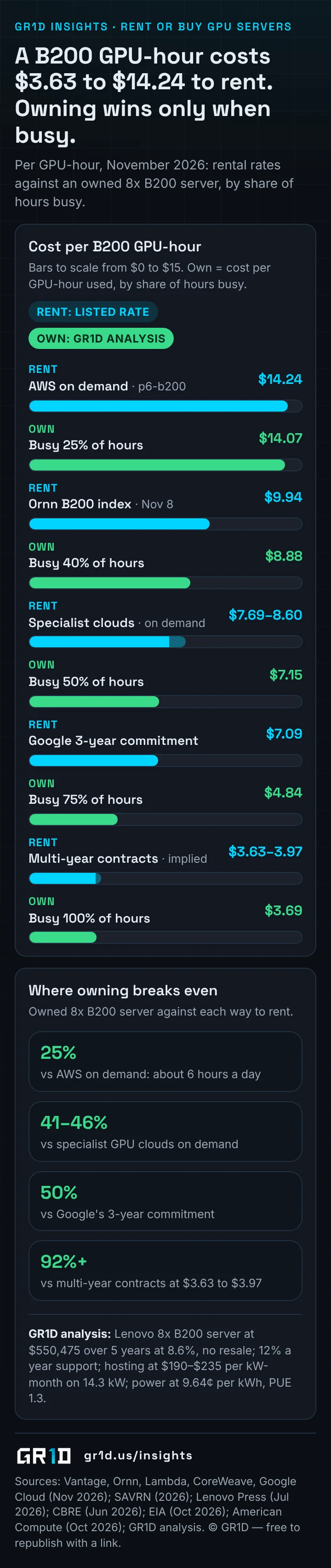
Read as text
- A B200 GPU-hour costs $3.63 to $14.24 to rent. Owning wins only when busy.
- Per GPU-hour, November 2026: rental rates against an owned 8x B200 server, by share of hours busy.
- Cost per B200 GPU-hour · Bars to scale from $0 to $15. Own = cost per GPU-hour used, by share of hours busy. · RENT: LISTED RATE · OWN: GR1D ANALYSIS · RENTAWS on demand · p6-b200 · $14.24 · OWNBusy 25% of hours · $14.07 · RENTOrnn B200 index · Nov 8 · $9.94 · OWNBusy 40% of hours · $8.88 · RENTSpecialist clouds · on demand · $7.69–8.60 · OWNBusy 50% of hours · $7.15 · RENTGoogle 3-year commitment · $7.09 · OWNBusy 75% of hours · $4.84 · RENTMulti-year contracts · implied · $3.63–3.97 · OWNBusy 100% of hours · $3.69
- Where owning breaks even · Owned 8x B200 server against each way to rent. · 25% · vs AWS on demand: about 6 hours a day · 41–46% · vs specialist GPU clouds on demand · 50% · vs Google's 3-year commitment · 92%+ · vs multi-year contracts at $3.63 to $3.97 · GR1D analysis: Lenovo 8x B200 server at $550,475 over 5 years at 8.6%, no resale; 12% a year support; hosting at $190–$235 per kW-month on 14.3 kW; power at 9.64¢ per kWh, PUE 1.3.
How much does it cost to rent a GPU server in 2026?
In November 2026, renting a GPU costs about $3 per GPU-hour for an H100 on market indexes and $7.69 to $14.24 for a B200 on demand, depending on the provider (Silicon Data, Nov 2026; Lambda, Nov 2026; Vantage, Nov 2026).
GPU clouds price by the GPU-hour, and most rent the GPUs in 8-GPU servers, so an 8x H100 instance at $55.04 an hour is $6.88 per GPU-hour. Three kinds of seller set the market. The hyperscalers (AWS, Microsoft Azure and Google Cloud) charge the most on demand. Specialist GPU clouds, often called neoclouds (CoreWeave, Lambda, Nebius, Together AI and others), list about half the hyperscaler rate. Marketplaces such as RunPod sit at or below the neoclouds. Two public indexes track what renters pay: Silicon Data's H100 index read $3.01 per GPU-hour on November 9 (Silicon Data, Nov 2026), and Ornn's transaction-weighted index read $3.37 for the H100 SXM, $6.82 for the H200 and $9.94 for the B200 on November 8 (Ornn, Nov 2026).
| GPU | Hyperscaler, on demand | Specialist GPU clouds, on demand | Committed rates |
|---|---|---|---|
| H100 | $6.88 at AWS; $11.06 at Google Cloud; $12.29 at Azure (Sep 2026) | $3.99 at RunPod and Together AI; $4.50 at Nebius; $4.59 at Lambda; $6.16 at CoreWeave | $2.97 on a 3-year AWS reservation (Vantage); $4.86 on a 3-year Google commitment |
| H200 | $10.60 at Google Cloud; $6.87 in AWS Capacity Blocks (AWS) | $5.29 at RunPod; $5.40 at Nebius; $5.99 at Together AI; $6.31 at CoreWeave | From $3.99 reserved for up to 6 months, prepaid, at Together AI |
| B200 | $14.24 at AWS (Vantage); $14.21 in AWS Capacity Blocks | $7.69 at Lambda from November 16; $7.99 at RunPod; $8.19 at Together AI; $8.50 at Nebius; $8.60 at CoreWeave | $7.09 on a 3-year Google commitment; $6.79 reserved at Together AI |
| B300 | $16.15 in AWS Capacity Blocks | $8.99 at RunPod; $9.50 at Nebius; $9.99 at Together AI | $5.60 for 8x B300 bare metal on a 12-month term at Latitude.sh (getdeploying) |
| GB200 NVL72 | $10.58 in AWS Capacity Blocks, Dallas Local Zone only | $10.50 at CoreWeave | Multi-year deals implied at about $3.63 to $3.97 for GB200 and GB300 (SAVRN) |
By the month, an 8x H100 server rented around the clock costs about $23,300 at $3.99 per GPU-hour and about $40,200 at the AWS on-demand rate. An 8x B200 server costs about $44,900 a month at Lambda's $7.69 and about $83,200 at AWS. Rack-scale systems are mostly sold by contract: of 14 providers listed for the GB300, 10 quote only on request (getdeploying, Nov 2026).
Why did GPU rental prices rise in 2026?
In 2026 GPU rental prices rose instead of falling: Silicon Data's H100 index climbed about 50%, from $2.00 per GPU-hour on December 9, 2025 to $3.01 on November 9, 2026 (Silicon Data, Nov 2026).
The three years before went the other way. H100 rentals routinely ran $7 to $10 per GPU-hour in 2023; by the second half of 2025 the median H100 rate was $1.95 on marketplaces, $3.33 at neoclouds and $6.26 at hyperscalers (Silicon Data, Dec 2025). AWS cut its on-demand H100 price by 44% in June 2025 (AWS, Jun 2025).
Then demand caught up with supply:
- Sold out: SemiAnalysis's index showed H100 on-demand capacity as sold out from February to April 2026, and 1-year H100 contracts rose from $1.50–$2.05 per GPU-hour in January to $2.10–$2.70 in April (SemiAnalysis, 2026).
- Hyperscaler increases: AWS raised its EC2 Capacity Block prices about 15% in January (The Register, Jan 2026) and about 20% on July 1 (Investing.com via Yahoo Finance, Jun 2026); its price page says current rates are "scheduled to be updated next in January, 2027" (AWS, Nov 2026).
- Neocloud list prices: RunPod's H100 SXM went from $2.99 per GPU-hour in July (Vast.ai, Jul 2026) to $3.99 in November, and its B200 from $5.89 to $7.99 (RunPod, Nov 2026). Lambda publishes new list prices that take effect November 16 (Lambda, Nov 2026).
- Newer chips moved most: Ornn's index put the H200 up 20.1% and the B200 up 33.1% in the month to November 8 (Ornn, Nov 2026).
- Hardware costs: NVIDIA reportedly told its largest customers that systems shipping in early 2027 would cost more than 15% more, citing memory (Tom's Hardware, Aug 2026).
For a renter this changes the planning rule. A rate quoted today may not hold next quarter unless the contract fixes it, and the cheapest capacity goes to buyers who commit early.
Dedicated GPU server or cloud GPU instances?
In 2026 a dedicated 8-GPU server on a 12- to 48-month term lists at about $2 to $6 per GPU-hour, well below on-demand rates for the same GPUs (Vultr, Nov 2026; getdeploying, Nov 2026).
A dedicated GPU server is a whole bare-metal machine reserved for one customer, usually for months or years. A cloud GPU instance is rented by the hour and released when the job ends. The price gap is the cost of flexibility: Latitude.sh lists an 8x B300 bare-metal server at $128 an hour on demand, $64 an hour reserved for a month and $44.80 an hour reserved for 12 months, or $5.60 per GPU-hour (getdeploying, Nov 2026). Vultr advertises $1.99 per GPU-hour for HGX H100 on a 24-month contract and for HGX B200 on a 48-month contract (Vultr, Nov 2026).
| Need | Better fit | Why |
|---|---|---|
| Experiments, fine-tuning runs, bursts of a few days | On-demand cloud instances | No commitment; pay only for the hours used |
| A multi-node training run on a fixed date | Reserved cluster with a high-speed fabric | Spot capacity is unsuitable for multi-node training (SemiAnalysis, 2025) |
| Production inference running around the clock | Dedicated servers on a 1- to 3-year term, or owned servers | Steady load earns the committed rate |
| Data that cannot leave a jurisdiction or a cage | Dedicated or owned servers in colocation | Physical control and tenant isolation |
Clusters cost more than single servers. RunPod charges $4.79 per GPU-hour for H100 SXM in clusters against $3.99 for single pods, and Lambda's B200 1-Click Clusters run $8.87 to $9.86 against $7.69 for an instance (RunPod, Nov 2026; Lambda, Nov 2026). Minimum terms vary: Lambda's B200 clusters start at 16 GPUs for two weeks, TensorWave requires six months on dedicated bare metal (Hostline, Jul 2026), and AWS Capacity Blocks run 1 to 182 days, are paid up front and cannot be cancelled (AWS, 2026).
H100, H200 or B200: which should you rent?
In November 2026 an H100 rents for about $3 to $4 per GPU-hour, an H200 for about $5 to $7 and a B200 for $7.69 to $9.94 at specialist clouds and indexes (Ornn, Nov 2026; RunPod, Nov 2026).
The H200 is an H100 with more memory: an 8-GPU DGX H200 carries 1,128 GB of GPU memory against 640 GB in a DGX H100, in the same 10.2 kW power envelope (NVIDIA, 2026). The B200 carries 180 GB per GPU (Together AI, Nov 2026), and a DGX B200 is rated at up to 14.3 kW (NVIDIA, 2026).
Compare GPUs on the cost of the job, not the hour. A model that fits in 80 GB and runs for days rents cheapest on H100s. A model that needs more memory per GPU, or long-context inference, usually runs on fewer H200s. Large training runs and high-volume inference favor Blackwell: NVIDIA says inference providers cut their cost per token by up to 10x on Blackwell against Hopper (NVIDIA, Feb 2026). That is a vendor figure for specific models, so benchmark your own workload on a short rental before you commit to a term.
What does it cost to buy and run a GPU server?
In 2026 an 8-GPU server sells for about $320,000 to $400,000 with H200s and $384,000 to $562,000 with B200s, before networking, hosting, power and support (GPUPerHour, Sep 2026; Lenovo Press, Jul 2026).
NVIDIA publishes no list prices for data center GPUs, so buyers work from OEM and reseller quotes:
| System | Price | Basis and source |
|---|---|---|
| 8x H200 server | $319,422 to $397,802 | Supermicro eStore starting price, Sep 2026 (GPUPerHour); Lenovo SR675 V3 sale price, Jun 15, 2026 (Lenovo Press) |
| 8x B200 server | $384,228 to $562,154 | Supermicro, last listed on Newegg; NVIDIA DGX B200 default configuration at Broadberry; Lenovo SR680a V3 at $550,475 (same sources) |
| 8x B300 server | About $400,000 to $785,607 | NVIDIA DGX B300 at about $400,000 US retail, as reported by the Financial Times (PCMag via Yahoo Finance, Jun 2026); Supermicro eStore from $536,771 and a DGX B300 at $646,878 (GPUPerHour); Lenovo SR680a V4 at $785,607 (Lenovo Press) |
| GB200 NVL72 rack | $3.1 million, about $3.9 million all-in | SemiAnalysis estimate for a hyperscaler, Aug 2025 (SemiAnalysis) |
| GB300 NVL72 rack | About $4 million to just under $5 million; about $5.7 million deployed | Morgan Stanley via MarketScale, Jul 2026; purchase orders reviewed by Data Gravity, Aug 2026 |
The server is only part of the bill:
- Networking: a scale-out fabric adds about $50,000 to $90,000 per HGX B300 server, more in larger clusters (American Compute, Oct 2026); SemiAnalysis puts an H100 server at about $190,000 and $250,000 with its storage and networking (SemiAnalysis, Aug 2025).
- Payment terms: resellers now ask for 50% to 100% up front, and quotes stay valid 7 to 14 days instead of 30 to 90 (Arc Compute, Mar 2026).
- Hosting: wholesale colocation for 250–500 kW asked $190 to $235 per kW per month in Northern Virginia and $200 to $230 in Chicago in the first quarter of 2026 (CBRE, Jun 2026), and 10 MW-plus blocks in Northern Virginia $160 to $185 (Data Center Frontier, Aug 2026). A DGX B200 at its 14.3 kW rating takes about $2,700 to $3,400 a month of that.
- Electricity: US industrial power averaged 9.64¢ per kWh in August 2026 and Texas 7.21¢ (EIA, Oct 2026); with cooling at a PUE of 1.3, a busy DGX B200 uses about $1.79 of power an hour at the US average.
- Support: Lenovo's cost model budgets maintenance at 12% of the system price a year (Lenovo Press, Jul 2026).
- Financing: GPU loans backed by investment-grade customers priced at a median of SOFR plus 2.375%, about 6.25%, in 2026; loans backed by other customers at a median of SOFR plus 4.75%, about 8.6%; facilities with no investment-grade customer at 9% to 10% fixed (American Compute, Oct 2026). Lambda's $1 billion investment-grade GPU loan priced at 6.78% fixed (The AI Insider, Oct 2026).
How long the server earns decides most of the math. The largest buyers depreciate servers over five to six years: Amazon five, Meta 5.5, and Alphabet, Microsoft and Oracle six in 2025 (J.P. Morgan Asset Management, Jan 2026); CoreWeave uses six (GPU Insights, Oct 2026), Lambda five and Nebius four (SiliconANGLE, Nov 2025). Michael Burry argues those lives are too long and puts the understated depreciation at about $176 billion from 2026 to 2028 (TheStreet, Sep 2026), and NVIDIA now ships a new generation every year (NVIDIA, Mar 2026). The resale market has held up so far: a used HGX H100 node was valued at about $195,000 in August 2026, 58% of its estimated original price (American Compute, Oct 2026), and used H100 servers were listed at $150,000 to $180,000 in April (Hashrate Index, Apr 2026).
When does buying GPUs beat renting?
By GR1D's analysis, an owned 8x B200 server beats on-demand rental once it is busy about 25% of the time against AWS and 41–46% against specialist GPU clouds, and needs 92% or more against multi-year contracts.
The method is simple and conservative. Every fixed cost of owning is spread over the hours the GPUs actually work, then compared with what the same hours cost to rent:
| Cost per GPU-hour | Owned 8x H200 server | Owned 8x B200 server |
|---|---|---|
| Purchase price, Lenovo, June 15, 2026 | $397,802 | $550,475 |
| Capital: five years, financed at 8.6%, no resale | $1.44 | $2.00 |
| Support at 12% of the price a year | $0.68 | $0.94 |
| Hosting at $190–$235 per kW per month on the rated 10.2 or 14.3 kW | $0.33–$0.41 | $0.47–$0.58 |
| Electricity at 9.64¢ per kWh and a PUE of 1.3, busy hours only | $0.16 | $0.22 |
| Cost per GPU-hour used at 100% utilization | $2.66 | $3.69 |
| At 75% utilization | $3.49 | $4.84 |
| At 50% utilization | $5.15 | $7.15 |
| At 25% utilization | $10.15 | $14.07 |
Set those costs against the rental rates of November 2026 and the breakeven falls out:
| Rental rate per GPU-hour, November 2026 | Owned 8x H200 breaks even at | Owned 8x B200 breaks even at |
|---|---|---|
| Hyperscaler on demand: H200 $10.60 at Google Cloud; B200 $14.24 at AWS | 24% utilization | 25% utilization |
| Ornn index: H200 $6.82; B200 $9.94 | 37% | 36% |
| Specialist clouds on demand: H200 $5.29–$6.31; B200 $7.69–$8.60 | 41–49% | 41–46% |
| Committed: H200 $3.99 reserved at Together AI; B200 $7.09 on Google's 3-year commitment | 65% | 50% |
| Multi-year contracts implied at $3.63–$3.97 for GB200 and GB300 | — | 92% to never |

Read as text
- The busier an owned server, the cheaper each GPU-hour
- Cost per GPU-hour used of an owned 8-GPU server, by utilization, against B200 rental rates in November 2026.
- Owned 8x B200: cost per GPU-hour used · Busy 25% of hours · $14.07 · Busy 40% · $8.88 · Busy 50% · $7.15 · Busy 75% · $4.84 · Busy 100% · $3.69 · B200 rental rates, per GPU-hour · AWS on demand · $14.24 · Ornn B200 index · $9.94 · Specialist clouds on demand · $7.69–8.60 · Google 3-year commitment · $7.09 · Multi-year contracts, implied · $3.63–3.97
- Breakeven utilization · Share of hours an owned server must be busy to cost the same as renting. · RENT AT 8X H200 8X B200 · Hyperscaler on demand · $10.60 Google · $14.24 AWS 24% 25% · Ornn index · $6.82 · $9.94 37% 36% · Specialist clouds · $5.29–6.31 · $7.69–8.60 41–49% 41–46% · Committed · $3.99 reserved · $7.09 3-year 65% 50% · Multi-year contracts · $3.63–3.97 (GB200, GB300) — 92%+ · At full use: $2.66 per GPU-hour (H200 server), $3.69 (B200 server). Rates shown H200 · B200.
- RENT AT 8X H200 8X B200
- Hyperscaler on demand · $10.60 Google · $14.24 AWS 24% 25%
- Ornn index · $6.82 · $9.94 37% 36%
- Specialist clouds · $5.29–6.31 · $7.69–8.60 41–49% 41–46%
- Committed · $3.99 reserved · $7.09 3-year 65% 50%
- Multi-year contracts · $3.63–3.97 (GB200, GB300) — 92%+
Three things move the answer more than the price of power:
- Utilization is the whole game. About 83% of enterprises that run their own GPUs report utilization of 50% or less (VentureBeat, Jul 2026), and Cast AI's telemetry from Kubernetes clusters puts average GPU utilization near 5%, nights and weekends included (HPCwire, Apr 2026). A dedicated training cluster can do far better: Meta logged 466 job interruptions in 54 days on 16,384 H100s, 78% of the unexpected ones from hardware, and still kept more than 90% effective training time (Meta, 2024).
- Support and resale. Without a 12% support contract, the owned B200 server breaks even with an $8.00 rental rate at about 32% utilization instead of 45%. A 20% resale value after five years lowers its full-use cost from $3.69 to about $3.42.
- The rental you compare against. Lenovo's own paper finds an 8x B200 server cheaper than AWS on demand once it runs 5.3 hours a day (Lenovo Press, Jul 2026), close to the 25% above. Against specialist cloud rates the bar rises to 41–46%, and against multi-year contracts to 92% or more.

Read as text
- Capital is over half the cost of an owned GPU-hour. Power is 6%.
- Cost per GPU-hour of an owned 8-GPU server at full use, by component, and what renters pay outside the hourly rate.
- Owned 8x H200 server · $397,802 (Lenovo, Jun 2026) · 10.2 kW · Capital · 5 years at 8.6%, no resale · $1.44 · 54% · Support · 12% of the price a year · $0.68 · 26% · Hosting · $190–$235 per kW-month · $0.37 · 14% · Electricity · 9.64¢ per kWh, PUE 1.3 · $0.16 · 6% · Per GPU-hour at full use · $2.66
- Owned 8x B200 server · $550,475 (Lenovo, Jun 2026) · 14.3 kW · Capital · 5 years at 8.6%, no resale · $2.00 · 54% · Support · 12% of the price a year · $0.94 · 26% · Hosting · $190–$235 per kW-month · $0.52 · 14% · Electricity · 9.64¢ per kWh, PUE 1.3 · $0.22 · 6% · Per GPU-hour at full use · $3.69
- Renters pay outside the hourly rate · Ask for each in writing before you sign. · Egress: $0.09/GB for the first 10 TB a month at AWS; none at CoreWeave or Lambda · Storage: from $0.06 per GB a month at CoreWeave · Cluster fabric: +15–28% per GPU-hour over single servers at RunPod and Lambda · Support: 3–9% of the monthly bill for AWS Business Support+ · Prepayment: 25% assumed on 3-month-plus contracts in SemiAnalysis's index · No exit: AWS Capacity Blocks are paid up front and cannot be cancelled
- Egress: $0.09/GB for the first 10 TB a month at AWS; none at CoreWeave or Lambda
- Storage: from $0.06 per GB a month at CoreWeave
- Cluster fabric: +15–28% per GPU-hour over single servers at RunPod and Lambda
- Support: 3–9% of the monthly bill for AWS Business Support+
- Prepayment: 25% assumed on 3-month-plus contracts in SemiAnalysis's index
- No exit: AWS Capacity Blocks are paid up front and cannot be cancelled
Electricity is about 6% of an owned GPU-hour at full use, so cheap power matters less to a server buyer than steady work and a low price for the server and its money. The practical split: rent for experiments, bursts and anything with an uncertain future; sign a committed contract when the load is steady but you do not want the hardware; buy when the load is steady, the servers will stay busy for most of five years, and you have a place to put them.
Where do owned GPU servers go?
Owned GPU servers need about 10 to 15 kW per 8-GPU system and 132 to 155 kW per GB200 or GB300 NVL72 rack, and the rack-scale systems need liquid cooling (NVIDIA, 2026; Lenovo Press, Aug 2026).
An 8-GPU DGX H100, H200 or B200 is air-cooled and rated at up to 10.2 or 14.3 kW (NVIDIA, 2026). A rack of four or five such servers already runs at 40 to 70 kW. Supermicro rates its GB200 NVL72 rack at 132 kW (Supermicro, 2026), and Lenovo puts the GB300 NVL72 at 135 kW, up to 155 kW at peak, with about 90% of its heat going to liquid (Lenovo Press, Aug 2026). CBRE notes that 100 kW GPU servers "can only be cooled by a closed-loop liquid-cooling system" (CBRE, Aug 2026), and only 24% of operators run any racks above 30 kW (Uptime Institute, Jul 2026).
Space is tight. Primary-market vacancy hit a record-low 1.4% in the first half of 2026, and converting an air-cooled hall for liquid-cooled hardware can push delivery out by more than six months (CBRE, Aug 2026; Data Center Frontier, Aug 2026). So the buy decision is also a hosting decision, and the hall should be booked before the purchase order is signed. The hall-side specification for rack-scale systems is in GB300 NVL72 colocation requirements, the timing in reserving data center capacity for GPUs on order, and the long-lead steps behind any new hall in how a data center is built.
What to ask before you rent GPU servers
Before you sign a GPU rental in 2026, get the delivery date, the interconnect, the SLA and every fee outside the hourly rate in writing; SemiAnalysis's contract index assumes 25% prepayment on terms of three months or more (SemiAnalysis, 2026).
- The delivery date and the remedy if it slips. SemiAnalysis calls the exact delivery date "one essential item" in a master services agreement (SemiAnalysis, 2025).
- Term, prepayment and cancellation. AWS Capacity Blocks are paid up front and cannot be cancelled (AWS, 2026); Together AI's reserved clusters run up to six months, prepaid (Together AI, Nov 2026).
- Whether the rate is fixed. AWS raised its Capacity Block prices at least twice in 2026 and publishes the next review date (AWS, Nov 2026).
- The fabric. InfiniBand or RoCE Ethernet, the topology, and nccl-tests results at the message sizes you use; InfiniBand "still tends to perform the best" (SemiAnalysis, 2025).
- Burn-in and acceptance. SemiAnalysis recommends at least three to four weeks of cluster-wide burn-in before acceptance (same source).
- The SLA. DigitalOcean, for example, commits to 99% monthly uptime per GPU node, with service credits of 10% to 50% when uptime falls below 99% (DigitalOcean, Oct 2025); ask how fast a failed node is replaced and whether spares are kept on site.
- Egress and storage. AWS charges $0.09 per GB for the first 10 TB out each month (Security Boulevard, Jun 2026); CoreWeave and Lambda charge no egress, while CoreWeave bills storage from $0.06 per GB a month (CoreWeave, Nov 2026; Lambda, Nov 2026).
- Support. AWS Business Support+ adds 3% to 9% of the monthly bill (AWS, Nov 2026).
- Security and isolation. SOC 2 or ISO 27001, and network isolation for your tenancy (SemiAnalysis, 2025).
Frequently asked questions
How much does it cost to rent an H100 per hour in 2026?
About $3 per GPU-hour on market indexes in November 2026: Silicon Data's H100 index read $3.01 on November 9 and Ornn's $3.37 on November 8. On-demand list prices run from $3.99 at RunPod and Together AI to $6.88 at AWS and $11.06 at Google Cloud.
How much does it cost to rent an 8-GPU server for a month?
Around the clock, an 8x H100 server costs about $23,300 a month at $3.99 per GPU-hour and about $40,200 at AWS's on-demand rate. An 8x B200 server costs about $44,900 at Lambda's $7.69 and about $83,200 at AWS. Terms of one to three years cut these rates by a fifth to more than half.
Is it cheaper to buy or rent GPUs?
It depends on how busy the GPUs stay. By GR1D's analysis an owned 8x B200 server costs about $3.69 per GPU-hour at full use and $7.15 at half use. That beats on-demand rental above about 25% utilization against AWS and 41–46% against specialist clouds, but rarely beats a multi-year contract.
How long do GPU servers last?
The largest buyers depreciate servers over five to six years: Amazon five, Meta 5.5, Alphabet, Microsoft, Oracle and CoreWeave six; Nebius uses four. Critics such as Michael Burry argue the economic life is shorter because NVIDIA ships a new generation every year, while a used H100 server was still valued at more than half its estimated original price in 2026.
What power and cooling does an owned GPU server need?
An 8-GPU DGX H100 or H200 is rated at up to 10.2 kW and a DGX B200 at 14.3 kW, both air-cooled. Rack-scale GB200 and GB300 NVL72 systems draw about 132 to 155 kW per rack and send about 90% of their heat to liquid, so they need liquid-cooled colocation or a liquid-cooled hall.
Why are GPU rental prices going up in 2026?
Demand has outrun supply. SemiAnalysis's index showed H100 on-demand capacity sold out from February to April, AWS raised Capacity Block prices in January and July, and Ornn's B200 index rose 33% in the month to November 8. Server costs are rising too, with NVIDIA reportedly warning of increases above 15% for early-2027 shipments.
Sources
- H100 Rental Price Index — Silicon Data, 2026-11-09
- H100 Rental Price Over Time (2023–2025): A Complete Market Analysis — Silicon Data, 2025-12-21
- Compute Price Index (OCPI): Live GPU Rental Prices — Ornn, 2026-11-08
- H100 Daily & Contract Pricing Index — SemiAnalysis, 2026-11-10
- Lambda pricing — Lambda, 2026-11-10
- p6-b200.48xlarge pricing — Vantage, 2026-11-09
- AWS EC2 p5.48xlarge on-demand and spot pricing in us-east-1 — DoiT, 2026-11-10
- Accelerator-optimized machine pricing — Google Cloud, 2026-11-10
- Azure ND96isr H100 v5 pricing and specs — Economize, 2026-09-03
- Amazon EC2 Capacity Blocks for ML pricing — AWS, 2026-11-05
- RunPod GPU pricing — RunPod, 2026-11-04
- Together AI Instant Clusters — Together AI, 2026-11-10
- AI Cloud pricing — Nebius, 2026-11-10
- CoreWeave Cloud pricing — CoreWeave, 2026-11-10
- p5.48xlarge pricing — Vantage, 2026-11-10
- Latitude.sh: review, pricing and alternatives — getdeploying, 2026-11-09
- GPU wholesale contract rates and AI data center lease prices — SAVRN, 2026-11-10
- Nvidia GB300 rental prices: compare providers — getdeploying, 2026-11-10
- Announcing up to 45% price reduction for Amazon EC2 NVIDIA GPU-accelerated instances — AWS News Blog, 2025-06-05
- AWS raises GPU prices 15% on a Saturday, hopes you weren't paying attention — The Register, 2026-01-05
- AWS raising GPU instance prices 20% on July 1 — Investing.com via Yahoo Finance, 2026-06-26
- How much does it cost to rent a GPU in the cloud? Live pricing guide — Vast.ai, 2026-07-22
- Nvidia reportedly warns biggest customers of 15% price hikes on AI servers — Tom's Hardware, 2026-08-23
- Vultr pricing — Vultr, 2026-11-10
- The GPU Cloud ClusterMAX rating system: how to rent GPUs — SemiAnalysis, 2025-03-26
- Bare-metal GPU servers for AI: 10 compared (2026) — Hostline, 2026-07-08
- Find and purchase Capacity Blocks — AWS, 2026-11-10
- Introduction to NVIDIA DGX H100/H200 systems — NVIDIA, 2026-10-17
- Introduction to NVIDIA DGX B200 systems — NVIDIA, 2026-10-17
- Leading inference providers achieve lowest token cost with open source models on NVIDIA Blackwell — NVIDIA, 2026-02-12
- H200, B200, A100 prices: you buy a server, not a GPU — GPUPerHour, 2026-09-21
- Smuggled Nvidia AI servers now cost over $1 million in China — PCMag via Yahoo Finance, 2026-06-25
- On-premise vs cloud: generative AI total cost of ownership (2026 edition) — Lenovo Press, 2026-07-24
- H100 vs GB200 NVL72 training benchmarks: power, TCO and reliability analysis — SemiAnalysis, 2025-08-20
- Nvidia Vera Rubin rack costs $7.8M: memory is why — MarketScale, 2026-07-06
- How much does an NVIDIA NVL72 cost? — Data Gravity, 2026-08-31
- GB300 NVL72 vs HGX B300: price per GPU, specs, power — American Compute, 2026-11-10
- Why AI servers are getting more expensive in 2026 — Arc Compute, 2026-03-02
- Global Data Center Trends 2026 — CBRE, 2026-06-17
- CBRE: record data center construction fails to ease capacity crunch — Data Center Frontier, 2026-08-28
- Electric Power Monthly, Table 5.6.A: average price of electricity to ultimate customers by end-use sector — U.S. Energy Information Administration, 2026-10-23
- GPU loan spreads and interest rates (2026) — American Compute, 2026-10-10
- Lambda closes $1B investment-grade loan to expand GPU infrastructure — The AI Insider, 2026-10-06
- Eye on the Market: Smothering Heights — J.P. Morgan Asset Management, 2026-01-01
- Server useful life: what five 10-Ks disclose — GPU Insights, 2026-10-03
- Resetting GPU depreciation: why AI factories bend, but don't break, useful life assumptions — SiliconANGLE, 2025-11-22
- Michael Burry sends stark warning on AI hyperscalers — TheStreet, 2026-09-23
- NVIDIA Vera Rubin opens agentic AI frontier — NVIDIA, 2026-03-16
- HGX H100 server value: $195,000 per node — American Compute, 2026-10-17
- Inside the used GPU market: pricing, players and the depreciation debate — Hashrate Index, 2026-04-08
- Wall Street is debating the AI buildout. Enterprises just answered: more than 80% say their GPUs run at half capacity or less — VentureBeat, 2026-07-10
- Companies are racing to buy GPUs. Many sit idle — AIwire (HPCwire), 2026-04-21
- The Llama 3 herd of models — Meta AI (arXiv), 2024-07-31
- Lenovo NVIDIA GB300 NVL72 rack scale AI product guide — Lenovo Press, 2026-08-30
- SuperServer SRS-GB200-NVL72 — Supermicro, 2026-11-10
- North America Data Center Trends H1 2026 — CBRE, 2026-08-27
- Uptime Institute Global Data Center Survey 2026 — Uptime Institute, 2026-07-29
- DigitalOcean GPU Droplet SLA — DigitalOcean, 2025-10-21
- AWS data transfer costs: how to cut your egress bill without rebuilding your stack — Security Boulevard, 2026-06-05
- AWS Support plan pricing — AWS, 2026-11-10
Building or financing an AI data center in Texas?
GR1D develops powered-shell and turnkey AI data centers — 20 MW to 150 MW sites with power, fiber and entitlements solved before the first rack arrives. See how we build, browse our sites or talk to us.