Solar Powered Data Centers: What Solar + Battery Storage Can Power in Texas (2026)
A solar powered data center is possible in Texas, but not on panels alone. A data center draws near-flat power around the clock, while ERCOT's solar fleet delivered 23% of its rated output in 2025. In our hour-by-hour model on ERCOT's own data, solar with no storage stalls near 45% of a flat 20 MW load, and reaches only 48% at ten times the load in panels. Reaching about 90% takes 100 MW of solar, 320 MWh of batteries and on-site gas for the rest; 99% takes nearly ten times the load in panels.
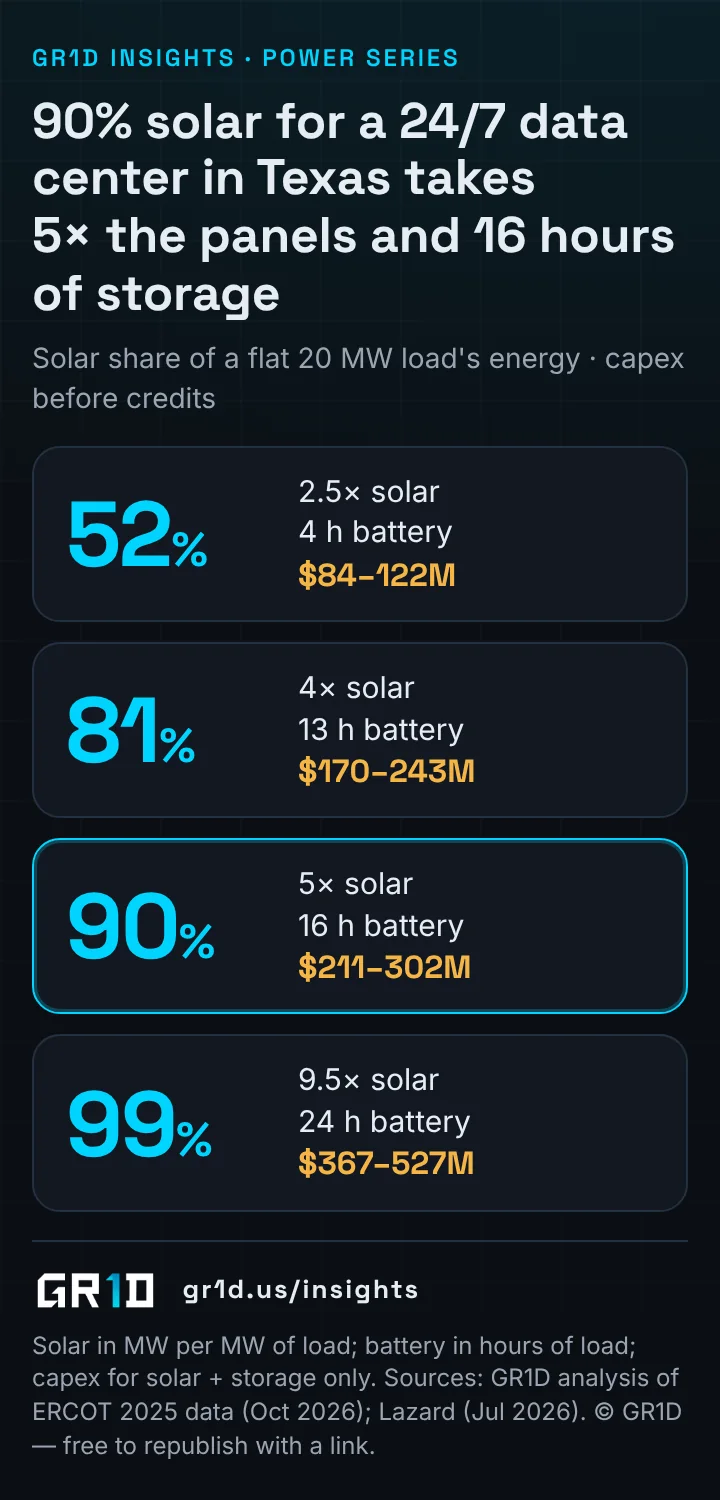
Read as text
- 90% solar for a 24/7 data center in Texas takes 5× the panels and 16 hours of storage
- Solar share of a flat 20 MW load's energy · capex before credits
- 52% · 2.5× solar · 4 h battery · $84–122M
- 81% · 4× solar · 13 h battery · $170–243M
- 90% · 5× solar · 16 h battery · $211–302M
- 99% · 9.5× solar · 24 h battery · $367–527M
Can solar power a data center 24/7?
Not on its own: ERCOT's solar fleet produced 23.3% of its rated output in 2025, while a flat 20 MW data center uses 175,200 MWh a year. The gap is one of hours, not of annual energy.
We took ERCOT's 15-minute solar output for 2025 (ERCOT, 2026), divided it by the solar capacity in operation each month (ERCOT, Oct 2026) and ran it hour by hour against a flat 20 MW load. Each megawatt of operating ERCOT solar produced 2,039 MWh in 2025, so 86 MW of panels makes as much energy in a year as the data center uses. Hour by hour, those 86 MW cover only 44% of the load and spill 56% of their output at midday; doubling to 200 MW with no batteries reaches 48%. Data for October 2025 to September 2026, at 23.8%, moved every solar share below by under 1.5 points (ERCOT, Oct 2026).
Seasons and weather do the rest. Per megawatt, the fleet produced 14.8% of rated output in December 2025 against 29.8% in June. The worst week, November 28 to December 4, 2025, delivered 44% of an average week, and January 24, 2026 delivered 11% of an average day.

Read as text
- Storage lifts Texas solar from 45% to 90% of a 24/7 load, then winter caps it
- 100 MW of solar · flat 20 MW load · ERCOT 2025 data
- no battery · 45%
- 4 h · 60%
- 8 h · 74%
- 16 h · 90%
- 48 h · 92%
- 16 h → 48 h: only +2 points
How much solar and battery storage does a 20 MW data center need in Texas?
In our 2026 ERCOT model, 90% solar for a flat 20 MW load takes 100 MW of solar and 320 MWh of batteries: 5× the load, 16 hours of storage. The three configurations below share that load and 2026 unit costs.
| GR1D analysis, flat 20 MW load | A. Solar + 4 h battery + grid | B. Solar + battery + on-site gas | C. Solar + 48 h storage, no gas |
|---|---|---|---|
| Solar (AC) and storage | 60 MW; 20 MW / 80 MWh | 100 MW; 80 MW / 320 MWh | 150 MW; 240 MW / 960 MWh |
| Firm supply | ERCOT grid | 25 MW of engines, 1.25× load | None |
| Share of annual energy from solar | 55% | 90% | 99.3–99.5% |
| Hours a year on grid or gas (longest run) | 4,400–4,500 h (67 h) | 970–1,090 h (41–61 h) | 52–77 h short (16 h) |
| Solar output spilled or exported | 18–19% | 17–18% | 38–39% |
| Land | ~335 acres | ~560 acres | ~845 acres |
| Capex before tax credits, power plant only | $97–140M | $254–352M | $447–628M |
Up to about 90%, storage does the work: at 100 MW of solar each added hour buys about 3 points. Past 90% the limit is winter: tripling storage from 16 to 48 hours adds about 2 points, because December panels cannot make December's load. And at lithium-ion prices, more panels beat more storage for the last stretch; the cheapest 99% mix we found, 190 MW with 480 MWh, spills half its output.
| Share of annual energy from solar | Solar and storage for a flat 20 MW load | Land | Capex before tax credits |
|---|---|---|---|
| ~52% | 50 MW (2.5×), 80 MWh (4 h) | ~280 acres | $84–122M |
| ~81% | 80 MW (4×), 260 MWh (13 h) | ~450 acres | $170–243M |
| ~90% | 100 MW (5×), 320 MWh (16 h) | ~560 acres | $211–302M |
| ~99% | 190 MW (9.5×), 480 MWh (24 h) | ~1,060 acres | $367–527M |
Our model matches the most detailed public study we found. Stripe, Scale Microgrids and Paces, whose best off-grid sites were in West Texas, sized a 100 MW load at 200 MW of solar and 200 MWh for 44% solar, 400 MW and 1,400 MWh for 82%, and 500 MW and 1,600 MWh for 90% (Paces, Scale Microgrids and Stripe, Dec 2024). Scaled to 20 MW, our model puts those mixes at 43–44%, 81–82% and 89.5–91%. They priced them at $93, $103 and $109 per MWh against $86 for off-grid gas turbines, with a 30% credit on solar and batteries.
Energy share is not availability. Configuration C still leaves the load short 52–77 hours a year, about 99.1–99.4% of hours, which is why designs keep a firm supply, as our guide to data center microgrids with solar, batteries and gas explains. Against $17.6M per MW for an all-in greenfield data center before GPUs (Cushman & Wakefield, Sep 2026), configuration B adds $12.7–17.6M per MW of load: the power plant can cost as much as the data center.
How much solar and battery storage does ERCOT have in 2026?
As of October 2026, ERCOT counts 41.9 GW of solar and 21.5 GW of storage in operation, up from 29.3 GW and 10.0 GW at end-2024 (ERCOT, Oct 2026). Solar set its output record at 35,427 MW on July 30, 2026 and its share record at 72.74% of load on May 2, 2026 (ERCOT fact sheet, Oct 2026). Batteries discharged a record 11,980 MW on July 22, 2026, the day of ERCOT's 91.1 GW peak (GridStatus, Aug 2026). Solar's share of ERCOT generation rose from 13.7% in 2025 to 16.4% in the first nine months of 2026 (GR1D calculation from ERCOT's fuel-mix files).
ERCOT's batteries are built for evenings, not a data center's nights. Modo Energy counted 13.9 GW and 22.9 GWh in commercial operation at the end of 2025, an average of 1.65 hours (Modo Energy, Feb 2026). The market monitor counted more than 17,000 MW and 31,500 MWh, an average of 1.83 hours (Potomac Economics, May 2026); ERCOT's own count is also higher, and its staff told a board committee that market signals favor one- to three-hour builds (ERCOT, Feb 2026). A 90% solar data center needs about 16 hours at its own load. ERCOT also curtailed 7.1% of its solar in 2024, mostly in congested West Texas (LBNL, Oct 2025).
What does solar plus storage cost for a data center in 2026?
In 2026, utility solar costs $1,250–1,850 per kW and four-hour batteries $270–365 per kWh installed, before tax credits (Lazard, Jul 2026). Texas is the cheap end for panels: ERCOT projects completed in 2024 averaged $1.38 per watt AC against $1.61 nationally, and batteries in solar hybrids cost $458/kWh all-in that year (LBNL, Oct 2025). BNEF's turnkey storage systems averaged $219/kWh in the US in 2025 against $117/kWh globally (Energy-Storage.News, Dec 2025).
Per MWh, unfirmed solar is still the cheapest new energy: Lazard's 2026 ranges are $40–98/MWh for utility solar, $61–156 for solar plus storage and $51–129 for new combined cycle. Firming changes that. With ERCOT's 22% solar capacity factor and capacity accreditation, Lazard adds $62/MWh of firming cost to $73/MWh of solar, $135 in total, and $35 to $115/MWh of solar plus four-hour storage, $150 in total, while noting this is not the cost of a 24/7 resource on one site. For buyers who need only annual energy, ERCOT solar contracts were the cheapest of any grid region in LevelTen's index, near $40/MWh in early 2025 (LBNL, Oct 2025); the North American P25 price was $61.40/MWh in the second quarter of 2026 (pv magazine USA, Jul 2026).
Tax credits changed in 2025. The One Big Beautiful Bill Act, signed July 4, 2025, keeps the 45Y and 48E credits for wind and solar only if construction began before July 4, 2026 or the project is in service by December 31, 2027; storage keeps the full credit for construction starting through 2033, then 75% in 2034, 50% in 2035 and none after, with foreign-entity limits from 2026 (McGuireWoods, Jul 2025). IRS Notice 2025-42 ended the 5% cost safe harbor for solar above 1.5 MW AC (Husch Blackwell, Aug 2025). The off-grid study's 30% solar credit is therefore gone for a plant started after July 4, 2026 that cannot be in service by end-2027; the battery credit survives.
How much land does a solar powered data center need, and what about hail and heat?
Tracking solar plants used a median 5.6 acres per MW in 2019 (LBNL), so the 90% case for a flat 20 MW load needs about 560 acres. That median is 0.18 MW per acre (LBNL, Jan 2022); individual sites vary: Google's 500 MW Duffy Solar contract with Linea Energy covers 3,526 acres in Matagorda County, about 7 acres per MW, beside a 235 MW battery (W.Media, May 2026).
Hail is the largest physical risk. It causes 73% of insured solar losses by damage amount, standard 2 mm glass is not enough for 52% of the US, and 13% of the lower 48, mainly the central and southern plains, needs hail-hardened modules plus stow at 70 degrees or more (pv magazine USA, Jun 2026). On March 15, 2024 golf-ball hail damaged thousands of panels at the 350 MW Fighting Jays plant in Fort Bend County, southwest of Houston (Renewable Energy World, Mar 2024); three nearby plants that stowed trackers at 52 degrees reported no or minor damage (kWh Analytics, Jun 2025). Wind adds to it: VDE Americas found winds during hailstorms more than double earlier estimates at some stations (VDE Americas, Mar 2026).
Heat costs less than it seems. Standard modules lose 0.37% of output per degree Celsius above 25°C in NREL's PVWatts model (NREL System Advisor Model), about 15% at 65°C. Yet ERCOT's fleet produced the most per MW in the hottest months: 29.8% of rated output in June and 29.5% and 29.2% in July and August 2025, against 23.2% in April: long summer days outweigh the heat.
The grid connection sets the rules. Under Senate Bill 6 a load of 75 MW or more is a large load and, if non-exporting backup can serve half its demand, can be told to switch to it in an emergency; SB 6's pre-approval for pairing loads with generation covers only generators registered by September 1, 2025, so new solar built with a new data center is outside it (Baker Botts, Jul 2025). A data center net-metered with an existing plant must fully curtail within 30 minutes of an ERCOT emergency instruction, under the PUCT's Goodnight Wind order (White & Case, Aug 2026). At 75 MW or more, 16 TAC §25.194 adds a $100,000 study fee and $50,000 per MW of security (Compute Law Blog, Oct 2026); the process is in our ERCOT large-load guide.
Why does solar need batteries and grid-forming inverters to serve a data center directly?
Grid-following solar inverters need a voltage to follow, so a data center served directly needs grid-forming batteries or generators; ERCOT requires similar capability from storage contracted since April 2026. A grid-following inverter tracks grid voltage and injects current to match it; a grid-forming inverter creates its own voltage reference and can surge above its rating in the first cycles of a disturbance (pv magazine USA, Oct 2026). ERCOT's NOGRR272 requires advanced grid support, which ERCOT calls similar to grid forming, from energy storage whose interconnection agreement was signed on or after April 1, 2026 (ERCOT, Mar 2026).
AI loads raise the bar. Microsoft, OpenAI and NVIDIA measured training swings of tens to hundreds of megawatts with energy at 0.2–3 Hz; holding GPUs at a 90% power floor costs 10.5% more energy, and the authors favor rack-level storage, with large batteries at bigger sites (arXiv, Aug 2025). Batteries are fast enough: ERCOT's fast frequency response must deploy fully within 0.25 seconds, and NERC found batteries supplied all of ERCOT's regulation capacity in several 2024 events. In July 2024, six faults in 82 seconds disconnected about 1,500 MW of data center load in Northern Virginia (pv magazine USA, Oct 2026). ERCOT's ride-through rule for new large computational loads, NOGRR282, is covered in our data center microgrid guide; the wider power picture is in How Data Centers Are Powered.
Batteries handle seconds and evenings; days still need fuel or the grid. Reciprocating engines cost $1,700–2,000/kW and take 12–24 months; fuel cells cost $3,000–4,000/kW and can arrive in about 90 days (Rabobank, May 2026). We cover the fuel cell route in Bloom Energy fuel cells for data centers and long-duration chemistries in flow batteries for data centers. Rabobank's verdict: renewables "are not a substitute for firm generation on the timeline the market requires."
Which Texas data centers use solar and storage today?
Texas data center solar comes in three forms in 2026: grid contracts such as Google's 875 MW Orion deal, co-located plants such as Quantum's 640 MW, and gas-led islanded campuses.
| Structure | What the data center gets | Texas rules that apply | Example |
|---|---|---|---|
| Grid PPA | Annual energy match; hourly power is ERCOT's mix | Normal large-load process at 75 MW or more | Orion Solar Belt, 875 MW, about 85% for Google, Oct 2024 |
| Co-located | Solar and storage first, grid or gas for the rest | Large-load process if grid-tied at 75 MW or more; SB 6 backup terms | Quantum, 640 MW + 1.3 GWh beside Google, Jun 2026 |
| Islanded microgrid | On-site solar, storage and gas; no grid backstop | No ERCOT interconnection; TCEQ air permits for gas | GW Ranch, up to 7.65 GW gas + 750 MW solar for Amazon |
SB Energy's Orion Solar Belt opened in October 2024 with Google taking about 85% of its output for Ellis County data centers, and Google says it has contracted more than 2,800 MW of new Texas wind and solar (Power Engineering, Oct 2024). Meta announced a 240 MW Texas solar contract with Origis in January 2026 (Baxtel, Jan 2026). These deals match annual energy; in our model an annual match covers about 44% of a flat load hour by hour.
Co-location is newer. Intersect's Quantum in Haskell County pairs 640 MW of solar with 1.3 GWh of storage beside a Google data center and was due to start operating in June 2026; Google's Meitner Energy Center in Gray and Roberts counties pairs more than a gigawatt of wind, solar and storage with on-site gas that firms a smaller share of demand (Intersect, Jun 2026). Neither data center's load is disclosed, so hourly solar shares cannot be checked.
Islanded campuses lead with gas. Amazon's GW Ranch, about 8,000 acres in Pecos County, holds permits for 35 gas turbines of up to 7.65 GW, plans up to 750 MW of solar and 1.8 GW of batteries, and starts off the grid (ENR, Aug 2026); developer Pacifico Energy promises "over 99.99% availability" (Pacifico Energy, 2026). At ERCOT's 2025 output per MW, 750 MW of solar makes about 1.5 TWh a year, roughly 3.5% of a flat 5 GW load: a fuel saver.
What does this mean for a 20–60 MW data center in Texas?
For a 20–60 MW Texas build, solar works best as an energy saver: about 55% of annual energy with four hours of storage, plus grid or gas for firm power. Four planning rules follow.
- Start near 3× the load in solar with four hours of storage: 55% of annual energy for about $5–7M per MW of load, with grid or gas carrying the rest.
- Go past 80% only where land and capital are cheap: 90% takes 5× solar, 16 hours of storage and about 28 acres per MW of load.
- Size the firm supply for the full load; winter weeks at 44% of normal output, hail and GPU swings all land on it.
- Specify hail-hardened modules and 70-degree stow, and plan on the storage credit, not the solar credit, unless the panels can be in service by December 31, 2027.
Frequently asked questions
Can a data center run entirely on solar power?
Not every hour. In our ERCOT model, 86 MW of solar matches a flat 20 MW load's annual energy but covers 44% of it hour by hour, and 150 MW with 48 hours of storage still leaves 52–77 hours a year uncovered. Real projects keep the grid or on-site gas as the firm supply.
How much land does a solar powered data center need?
About 5.6 acres per MW of tracking solar, the LBNL median. For a flat 20 MW load that is roughly 335 acres for 55% solar, 560 acres for 90% and 1,060 acres for 99%. Google's 500 MW Duffy Solar contract covers a 3,526-acre site.
How much battery storage does a solar data center need?
Four hours at the load, 80 MWh for 20 MW, lifts 100 MW of solar from 45% to 60% of annual energy; 16 hours, 320 MWh, reaches 90%. ERCOT's grid batteries average under two hours (1.65 by Modo Energy's count, Feb 2026), sized for evening peaks, not overnight supply.
Is solar cheaper than gas for a data center?
For unfirmed energy, yes: Lazard's 2026 range is $40–98/MWh for utility solar against $51–129 for new combined cycle. Firmed for a 24/7 load, not yet: the Stripe, Scale Microgrids and Paces study priced 90% solar at $109/MWh against $86 for off-grid gas turbines, with a 30% tax credit.
Do solar tax credits still apply to data center projects in 2026?
For solar, only if construction began before July 4, 2026 or the project is in service by December 31, 2027. Battery storage keeps the full credit for construction starting through 2033, then phases down, subject to foreign-entity rules that began in 2026 (McGuireWoods, Jul 2025).
Sources
- Fuel Mix Report 2025 (15-minute generation by fuel) — ERCOT, 2026-01
- Fuel Mix Report 2026 (through September) — ERCOT, 2026-10
- Capacity Changes by Fuel Type, September 2026 — ERCOT, 2026-10-06
- Fast, scalable, clean, and cheap enough: how off-grid solar microgrids can power the AI race — Paces, Scale Microgrids and Stripe, 2024-12
- 2026 Data Center Development Cost Guide — Cushman & Wakefield, 2026-09
- ERCOT fact sheet — ERCOT, 2026-10
- Another record bites the dust — GridStatus, 2026-08-03
- ERCOT annual buildout report: battery capacity reaches 14 GW entering 2026 — Modo Energy, 2026-02-02
- Understanding battery energy storage systems: current and future — ERCOT Technology and Security Committee, 2026-02-09
- Utility-Scale Solar 2025 data update — Lawrence Berkeley National Laboratory, 2025-10
- Levelized Cost of Energy+ 2026 — Lazard, 2026-07-13
- Battery storage system prices continue to fall sharply, BNEF and Ember reports find — Energy-Storage.News, 2025-12-16
- Solar PPA prices dip in Q2 while wind climbs as July 4 tax credit deadline looms — pv magazine USA, 2026-07-27
- Tax bill enacted on July 4, 2025 contains scaled-back renewable energy provisions — McGuireWoods, 2025-07-07
- Treasury guidance tightens beginning-of-construction standards, eliminating 5% safe harbor for wind and solar — Husch Blackwell, 2025-08-18
- Land requirements for utility-scale PV: an empirical update on power and energy density — LBNL, IEEE Journal of Photovoltaics, 2022-01
- Google signs 15-year power deal with Linea Energy — W.Media, 2026-05-18
- Fire, hail and the hard lessons: brokers weigh in on the 2026 Solar Risk Assessment — pv magazine USA, 2026-06-09
- Texas hailstorm damages thousands of solar panels at 350-MW farm — Renewable Energy World, 2024-03-26
- Solar Risk Assessment 2025 — kWh Analytics, 2025-06
- VDE Americas enhances hail risk model with wind speed data — VDE Americas, 2026-03-13
- PVWatts module types and temperature coefficients — NREL System Advisor Model
- Texas Senate Bill 6: understanding the impacts to large loads and co-located generation — Baker Botts, 2025-07-18
- PUCT affirms curtailment authority over co-located data centers in first net-metering approval — White & Case, 2026-08-05
- ERCOT large load interconnection in Texas — Compute Law Blog, 2026-10-04
- Batch Zero update (Board item 14) — ERCOT, 2026-09-11
- Governor Abbott orders TCEQ to pause all permit issuance for data center projects — Bracewell, 2026-09-23
- "It ain't right": Texas said it would halt data center permits; the state is pushing ahead anyway — 404 Media, 2026-10-19
- Texas data center permits after the governor's halt — FracTracker Alliance, 2026-10-19
- Grid inertia is the new reliability — pv magazine USA, 2026-10-15
- Advanced grid support incentive program concept — ERCOT IBRWG, 2026-03-27
- Power stabilization for AI training datacenters (arXiv 2508.14318) — Microsoft, OpenAI and NVIDIA, 2025-08-20
- The sprint: data centers are building a parallel energy system in the US — Rabobank, 2026-05-06
- One of the largest solar projects in the US opens in Texas, backed by Google — Power Engineering, 2024-10-21
- Meta inks solar PPA with Origis Energy in Texas — Baxtel, 2026-01-19
- Quantum — Intersect, 2026
- Google and Intersect deepen Texas roots with new data center and energy investments in Gray and Roberts counties — Intersect, 2026-06-04
- Amazon discloses ownership of GW Ranch, giant Texas data center-gas power complex — ENR, 2026-08-11
- GW Ranch — Pacifico Energy, 2026
- 2025 State of the Market Report for the ERCOT Electricity Markets — Potomac Economics, 2026-05
- TCEQ backtracks, suspends data center permits issued after investigation shows it ignored Abbott's pause — Public Citizen, 2026-10-22
- Texas environmental agency shuts down online permit filing system after data center controversy — The Texas Tribune, 2026-10-21
Building or financing an AI data center in Texas?
GR1D develops powered-shell and turnkey AI data centers — 20 MW to 150 MW sites with power, fiber and entitlements solved before the first rack arrives. See how we build, browse our sites or talk to us.