Bloom Energy Fuel Cells for AI Data Centers: How They Work, What They Cost and Who Is Buying
Bloom Energy sells data centers the Energy Server, a 325 kW solid oxide fuel cell that turns natural gas into electricity without combustion, arrayed by the hundred into on-site plants. The 2026 buyers include Oracle, with up to 2.8 GW, AEP, with 702 MW for Google, and Brookfield, with a $25 billion financing framework. Bloom says it delivers power in 55 to 90 days at 53–65% efficiency. Federal plant data put operating fleets near the low end, and capital cost estimates run $3,000–8,300 per kW.
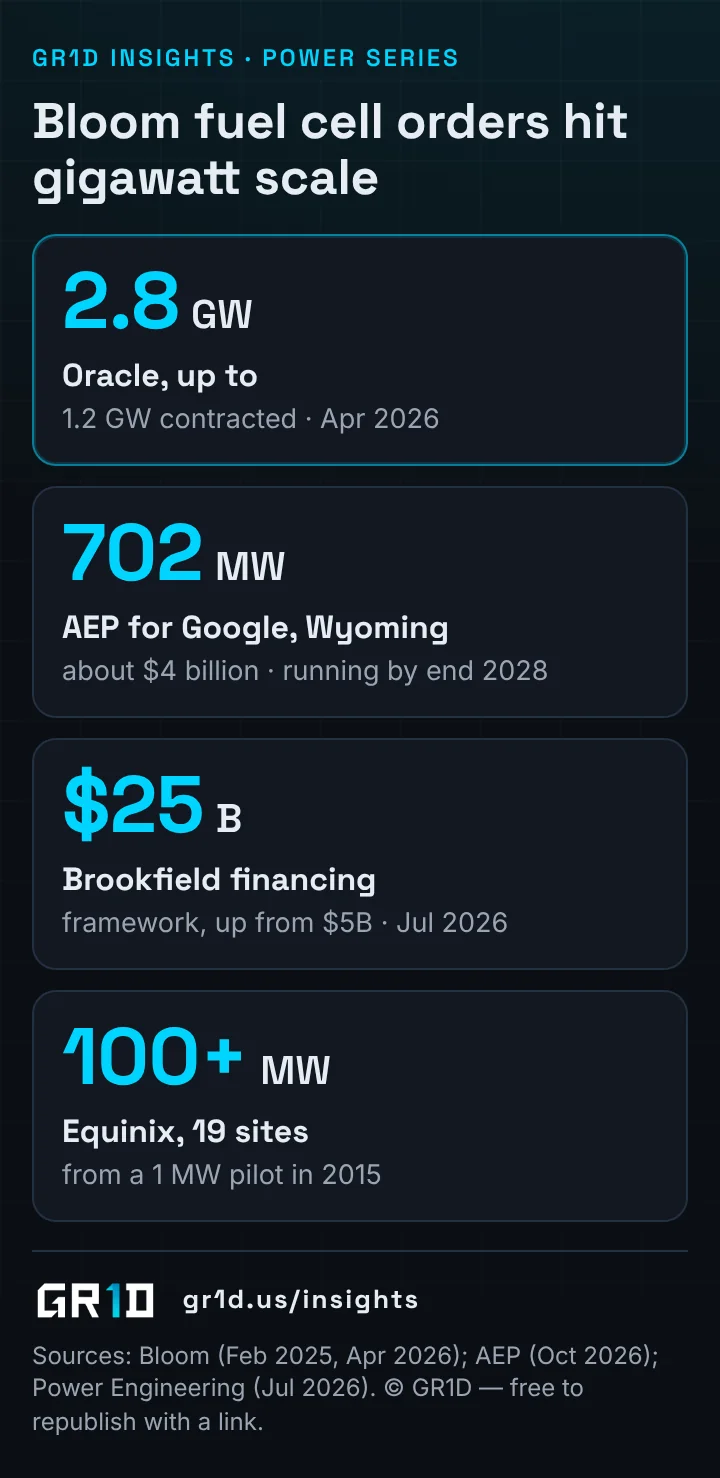
Read as text
- Bloom fuel cell orders hit gigawatt scale
- 2.8GW
- GW
- Oracle, up to
- 1.2 GW contracted · Apr 2026
- 702MW
- MW
- AEP for Google, Wyoming
- about $4 billion · running by end 2028
- $25B
- Brookfield financing
- framework, up from $5B · Jul 2026
- 100+MW
- Equinix, 19 sites
- from a 1 MW pilot in 2015
How does a Bloom Energy fuel cell make electricity from natural gas?
A Bloom Energy Server 6.5 generates 325 kW by reforming natural gas inside hot ceramic fuel cells and oxidizing it electrochemically, without combustion (Bloom datasheet, Feb 2026). In a solid oxide fuel cell (SOFC), oxygen from air becomes oxide ions that cross a dense ceramic electrolyte, and the heat lets methane reform into hydrogen and carbon monoxide in place (MDPI review, Aug 2026). Bloom's filings describe no external reformer and no moving parts (Bloom 10-K, Feb 2026).
Stacks of roughly 1 kW make modules of about 65 kW, and five modules make a server (SemiAnalysis, Dec 2025). Each server is a 29-foot outdoor skid delivering 480, 415 or 400 V AC. A 100 MW plant needs about 308 servers and at least 3,600 m² of equipment area before auxiliaries (MDPI); Bloom says its deployments reach 100 MW per acre (Bloom, Nov 2024).
- Heat. Exhaust leaves above 350 °C, and electricity plus recoverable heat exceeds 90% of the fuel's energy (Bloom datasheet). A single-effect absorption chiller turns 1 MW of heat into about 0.70–0.79 MW of cooling (MDPI).
- Water. None in normal operation. At Project Jupiter in New Mexico, the state engineer put the earlier turbine plan at about 1 million gallons a day, mostly for emissions control; developers say fuel cells use "a negligible amount of water" (Santa Fe New Mexican, Apr 2026).
- Fuel. Natural gas at 12–18 psig, biogas or a natural gas and hydrogen blend. Bloom sells a 100% hydrogen version at about 60% efficiency when new (Bloom, Aug 2024) but does not say a natural gas unit converts in the field.
- Direct current. The datasheet lists AC output, but Bloom said in September 2026 its cells can deliver 800 V DC natively, cutting non-compute capex 27% for a 1 GW campus in its own model (Bloom, Sep 2026); the rack side is in 800 VDC Data Centers and Vera Rubin.
How efficient are Bloom fuel cells, claimed versus measured?
Bloom rates the Energy Server at 65% efficiency (LHV) when new, falling to 53%; in 2025 the median US plant run by Bloom reported 7,057 Btu/kWh, the 53% end (EIA-923, Sep 2026). Lower heating value (LHV) figures read higher than the higher heating value (HHV) basis of heat rates: 65–53% LHV equals 5,811–7,127 Btu/kWh (Bloom datasheet). The US Department of Energy puts solid oxide fuel cell efficiency at 60% LHV (Power Engineering, Jul 2026).
| Measure | Heat rate, Btu/kWh | Efficiency | Source |
|---|---|---|---|
| Bloom Energy Server 6.5, rated | 5,811–7,127 | 58.7–47.9% HHV | Bloom, Feb 2026 |
| EIA planning assumption, 10 MW SOFC | 6,469 | 52.7% HHV | EIA, Apr 2026 |
| Bloom-operated US plants, 2025 median of 61 | 7,057, middle half 6,918–7,280 | 48.3% HHV | GR1D analysis of EIA-923 |
| Same plants, output-weighted, 2025 and 2024 | 7,687 and 6,983 | 44.4% and 48.9% HHV | GR1D analysis of EIA-923 |
| All 125 US natural gas fuel cell plants, 2025 | 8,245 | 41.4% HHV | GR1D analysis of EIA-923 |
The fleet sits inside the rated range but near its low-efficiency end: 34 of 61 plants were at or better than 7,127 Btu/kWh, the best reported 6,609 against the rated 5,811, and one Los Angeles site at 12,104 pulled the weighted figure up. The plants date from 2010–2022, older than the 6.5, and report their own figures. Joined to EIA-860 nameplates, the 61 plants produced 82.9% of nameplate output in 2025; the median plant ran at 88.9% and nine reached 95% (EIA-860, Sep 2026). Capacity factor is not availability, since a behind-the-meter unit may follow its load, but it is what the meter sees.
Efficiency falls as modules age, and replacing them drives the service bill. Bloom's data showed a median 4.7 years to replacement for its 2015 modules, with five or more expected from 2018 on (Bloom primer, 2019). Hunterbrook, a newsroom whose affiliated fund disclosed a position against Bloom, found faster wear: New York systems started near 52% HHV and lost about 2.4 points a year (Hunterbrook, Jul 2026). With sources this far apart, contract on a guaranteed heat rate and output measured at the meter.
How fast can Bloom fuel cells power a data center?
Bloom delivered Oracle's first fully operational fuel cell system in 55 days in 2025, against a 90-day commitment; utility-scale projects take about two years (Bloom, Apr 2026).
| Measure | Duration | Dates | Source |
|---|---|---|---|
| Oracle's first system, delivered fully operational | 55 days | 2025 | Bloom, Apr 2026 |
| Contract to installation, per Bloom | 6–12 months or more | FY2025 | Bloom 10-K |
| AEP Ohio for AWS, 228 servers, air permit filed to service | about 26 months | Jul 2025 to early fall 2027 | AEP Ohio, 2025 |
| AEP for Google, 702 MW, announced to full operation | about 26 months | Oct 2026 to end of 2028 | AEP, Oct 2026 |
The 55 days measured delivery and commissioning of one system at an Oracle site; utility projects also carry permits, siting and gas supply. Factory output is the other limit: Bloom said in October 2025 it was on track to double annual capacity to 2 GW by the end of 2026 (Utility Dive, Oct 2025). Scale is untested. The largest operating SOFC plants are in the tens of megawatts (SemiAnalysis), and Project Jupiter's 2.45 GW would be about seven times the 344 MW of natural gas fuel cells in EIA's 2025 inventory of plants of 1 MW or more (GR1D calculation from EIA-860).
Who is buying Bloom fuel cells for data centers?
As of October 2026, Bloom's data center buyers and partners include Oracle (up to 2.8 GW), AEP (702 MW for Google), Equinix (100+ MW) and Brookfield ($25 billion).
| Buyer | Announced | Size | Structure |
|---|---|---|---|
| Equinix | 2015; Feb 2025 | 1 MW pilot, now over 100 MW at 19 sites | Supplements grid power (Bloom, Feb 2025) |
| AEP | Nov 2024; Jan 2026; Oct 2026 | Up to 1 GW; 98 MW in Ohio; 702 MW near Cheyenne, about $4 billion | Utility owns plants; Google buys the Cheyenne output for 20 years (AEP 10-Q, Jul 2026; AEP, Oct 2026) |
| Oracle | Jul 2025; Apr 2026 | Up to 2.8 GW, 1.2 GW contracted; Project Jupiter, New Mexico, up to 2.45 GW | Master services agreement (Bloom, Apr 2026; Oracle, Apr 2026) |
| Brookfield | Oct 2025; Jul 2026 | $5 billion, raised to $25 billion | Financing framework (Power Engineering, Jul 2026) |
CoreWeave, at a campus in Volo, Illinois (Bloom, Jul 2024), and Quanta Computing (Power Engineering) also have on-site power agreements. The AEP deal began in November 2024 as up to 1 GW with a 100 MW first order (Bloom, Nov 2024); AEP's filing places the $2.65 billion purchase near Cheyenne with a 20-year offtake (AEP 10-Q), and AEP plans to add carbon capture there (AEP, Oct 2026). Oracle's releases do not say whether Jupiter's 2.45 GW sits inside the 2.8 GW agreement.
What do Bloom fuel cells cost per kW and per MWh?
Published capital cost estimates for fuel cells span $3,000–4,000 per kW (Rabobank, May 2026) to $8,287 per kW in EIA's 2026 planning assumptions (EIA, Apr 2026). AEP's $4 billion for 702 MW works out to about $5,700 per kW all-in (GR1D calculation from AEP's release). Bloom says its capex runs only 10–15% above small turbines and engines, offset by needing about 10% spare capacity for 99.99% uptime where rotating machines need double or triple (Bloom-sponsored content, Sep 2025). Published estimates put fuel cells at 1.5–2.4 times the $1,700–2,000 per kW of engines, so the sources disagree.
Fuel is the second cost. At the measured 7,057 Btu/kWh, the $3.94/MMBtu that EIA expects power plants to pay in 2026 means $27.80 of fuel per MWh; January 2026's Henry Hub average of $7.72, during winter storm Fern, means $54.50 (EIA STEO, Oct 2026). A 100 MW plant burns about 16,900 MMBtu a day, so firm pipeline capacity matters as much as price.
Service is the third. Bloom sells operations and maintenance agreements of 5 to 20 years, cancellable yearly, with periodic fuel cell replacement (Bloom 10-K); stacks last five to six years and replacements are about 65% of service cost (SemiAnalysis). Buyers can purchase the servers or pay through a power purchase agreement (PPA), a fixed capacity payment or a lease (Bloom 10-K). The recent deals split three ways: Oracle procures systems, Brookfield finances deployments, and AEP owns plants and sells the output.
How do fuel cells compare with engines, turbines and the grid?
On GR1D's like-for-like 2026 assumptions, fuel cells cost an estimated $94–152/MWh, against $88–122 for engines, $103–126 for aeroderivative turbines and $45–60 for ERCOT grid power.
| Option, as of Oct 2026 | Time to first power | Heat rate and CO2 | Indicative cost |
|---|---|---|---|
| Bloom-type SOFC | 55–90 days on a ready site; 6–12 months or more from contract | 5,811–7,127 Btu/kWh rated, 7,057 measured; 679–833 lb CO2/MWh rated, about 823 measured | $94–152/MWh at $3,000–4,000/kW; $153–199 at $5,700/kW |
| Reciprocating engines | 12–24 months | 8,000–9,000 Btu/kWh; 933–1,050 lb/MWh | $88–122/MWh |
| Aeroderivative turbines, simple cycle | 12–24 months; heavy-duty frames 36–84 months | 9,447 Btu/kWh; about 1,100 lb/MWh | $103–126/MWh |
| ERCOT grid, transmission voltage | 18+ months with substation headroom; 36–84 months otherwise | 733.9 lb/MWh ERCOT average, 2023 | $45–60/MWh, GR1D estimate |
Lead times and engine heat rates come from Rabobank (May 2026); turbine heat rates and O&M from EIA (AEO2026; AEO2023); the carbon factor from EIA (Sep 2024); the grid rate from EPA (eGRID2023). Fuel cells win on schedule when a site is ready and on efficiency against simple-cycle machines. They lose on capital: at EIA's $8,287 per kW they would cost $210–272/MWh. The grid is still the cheapest power, which is why on-site gas is usually a bridge (How Data Centers Are Powered). Other benchmarks differ by scope: Rabobank estimates behind-the-meter gas at about $100–165/MWh, depending on overbuild (40–65%), bridge duration and gas price (Rabobank, May 2026), and the $45–60 grid figure is transmission-voltage energy, against a 2025 West South Central industrial average of 6.48¢/kWh, about $65/MWh (EIA, Oct 2026).

Read as text
- Fuel cells beat engines and turbines on CO2, not the ERCOT grid
- Measured, 2025
- 823
- lb CO2 per MWh
- median US plant run by Bloom
- ERCOT grid average, 2023
- 734
- Bloom fuel cells, rated
- 679–833
- Bloom-run plants, measured
- Gas engines
- 933–1,050
- Aeroderivative turbines
- 1,102
What do fuel cells emit, and how are they permitted?
Bloom's 2026 datasheet lists 679–833 lb CO2 and 0.003 lb NOx per MWh on natural gas, against ERCOT's 2023 averages of 733.9 lb CO2 and 0.4 lb NOx (EPA eGRID2023). Carbon is the weak point: the measured median implies about 823 lb/MWh, 12% above ERCOT's average but well below the 1,242.7 lb/MWh of its non-baseload plants. Bloom makes the same marginal comparison, claiming 34% lower CO2 than the PJM generation it displaces (Bloom, Nov 2024). At gigawatt scale, Oracle's proposed cap on Project Jupiter's fuel cell output would cut projected greenhouse gases from about 8.8 million to 5.7 million tons a year (Oracle, Oct 2026).
Local pollutants are where fuel cells separate from engines and turbines, and permits reflect it state by state:
- California: Bloom holds CARB Distributed Generation certification (Bloom datasheet); the Bay Area air district says fuel cells "are generally exempt from permitting", with a health risk review from about 20 MW (BAAQMD, 2026).
- Ohio: AEP Ohio's AWS project needed an Ohio EPA permit, filed in July 2025 and approved October 8, 2025 as a minor source under 250 tons a year per pollutant (AEP Ohio).
- New Mexico: Project Jupiter's air permit goes to a hearing on December 7, 2026; state modeling released in October showed higher pollutant concentrations than first forecast (Source NM, Oct 2026). Oracle says the fuel cells cut NOx about 92% from the turbine plan (Oracle, Apr 2026).
In Texas, a statewide pause covers behind-the-meter projects.
Can fuel cells handle AI load swings and run without the grid?
Bloom's February 2026 annual report puts fleet availability near 99.9% for non-redundant installations and nearly 99.999% for the most demanding sites (Bloom 10-K); AI swings still need storage. Arrays of 325 kW units make redundancy granular, and the servers can run with no grid connection; Bloom calls Project Jupiter one of the largest islanded microgrids in the world (Santa Fe New Mexican).
Microsoft, OpenAI and NVIDIA researchers describe training swings of tens or hundreds of megawatts at 0.2–3 Hz and recommend GPU smoothing plus rack-level storage, with batteries at scale (arXiv, Aug 2025). Bloom says its servers respond at least twice as fast as turbines and engines (Bloom 10-K), but its own paper shows supercapacitors carrying the first instant of a 40%-to-100% step (Bloom, Feb 2024), and Bloom does not advertise ramp rates (SemiAnalysis). An independent review says SOFCs suit steady output, with batteries for transients and ride-through (MDPI), and Power Engineering lists long start-up times and a limited number of shutdowns among SOFC drawbacks (Power Engineering): they are run continuously, not held as backup.
The common-mode risk is gas: every server on a site shares one supply. In January 2026, heating demand cut gas supply and Henry Hub averaged $7.72 (EIA STEO). Firm transport, a second supply path or storage belongs in the design; our microgrid pillar covers hybrid solar, battery and gas configurations.
What are the alternatives to Bloom fuel cells?
Bloom is one of several on-site options in 2026: engines and aeroderivative turbines in 12–24 months, heavy-duty turbines in 36–84 months (Rabobank, May 2026).
- Engines. VoltaGrid is to deploy 2,300 MW of modular Jenbacher engine plants for Oracle across Texas and says they install within months (POWER, Oct 2025). Wärtsilä booked 40 engines, 412 MW, for an Ohio campus running in early 2028 (Power Engineering, Apr 2026). ERock (formerly Enchanted Rock) builds gas microgrids that carry a data center until the grid arrives, then serve the utility as peaking capacity (Latitude Media, May 2024).
- Turbines. Crusoe ordered 29 of Boom's 42 MW aeroderivatives for a 1.21 GW plan (Data Center Frontier, Feb 2026); GE Vernova's gas turbine backlog hit 116 GW, with reservations now for 2031 (Utility Dive, Jul 2026).
- Other fuel cells. FuelCell Energy, near 1 GW deployed, signed a July 2026 memorandum with Siemens for electrical systems on projects of 100 MW or more, data centers first (FuelCell Energy, Jul 2026). Doosan Fuel Cell, maker of 440 kW phosphoric acid units and solid oxide products, signed data center power partnerships with Korean firms in November 2025 and February 2026 (Doosan Fuel Cell, 2026).
- Hydrogen backup. PowerCell agreed to lease two hydrogen fuel cell systems to a US data center provider for 6–12 months from early 2026, a field test with backup among the uses (PowerCell, Dec 2025).
Storage sits alongside all of them; flow batteries cover longer durations than a fuel cell plant's supercapacitors.
What does this mean for a 20–150 MW AI site?
For a 20–150 MW AI site in 2026, fuel cells buy schedule and low local emissions at 1.5–2.4 times the per-kW capital cost of engines (Rabobank, May 2026). Five checks decide the fit:
- Gas first: about 16,900 MMBtu a day per 100 MW on firm transport.
- Measured guarantees: heat rate and output at the meter, and who pays for module replacement.
- Storage for swings: batteries or supercapacitors for GPU steps and ride-through.
- Permit path: generally exempt in the Bay Area, minor-source in Ohio, contested in New Mexico, paused in Texas.
- Real dates: 55 days is a delivery record; schedule gas, permits and interconnection around it.
Frequently asked questions
What does Bloom Energy do for data centers?
Bloom sells and services 325 kW solid oxide fuel cells that run on natural gas and power a site alongside the grid or alone. As of October 2026, Oracle, AEP for Google, Equinix and CoreWeave are named customers, and Brookfield has a $25 billion financing framework.
How much does a Bloom fuel cell cost?
Published estimates run from $3,000–4,000 per kW (Rabobank, SemiAnalysis) to $8,287 (EIA's 2026 assumption), and AEP's Wyoming project implies about $5,700 all-in. At the lower costs GR1D estimates $94–152 per MWh delivered.
How efficient are Bloom Energy fuel cells?
Bloom rates them at 65% falling to 53% (LHV). In EIA's 2025 data the median US plant run by Bloom used 7,057 Btu/kWh, about 48% on a higher-heating-value basis, the 53% LHV end of Bloom's range.
Are Bloom fuel cells zero emission?
No. On natural gas they emit 679–833 lb of CO2 per MWh by Bloom's rating and about 823 at the 2025 measured median, 12% above the ERCOT grid average. Local pollutants are very low: 0.003 lb of NOx per MWh and negligible sulfur oxides.
How fast can Bloom install fuel cells at a data center?
Bloom powered Oracle's first system in 55 days in 2025, against a 90-day commitment. Its 10-K puts contract-to-installation at 6–12 months or more, and AEP's Ohio and Wyoming projects run about 26 months end to end.
Do fuel cells need an air permit?
The Bay Area air district treats them as generally exempt, Ohio issued a minor-source permit for AEP's AWS project in October 2025, and New Mexico holds a hearing on Project Jupiter on December 7, 2026. Texas paused all data center permits on September 21, 2026.
Sources
- The Bloom Energy Server 6.5 datasheet — Bloom Energy, 2026-02
- Bloom Energy Form 10-K for fiscal 2025 — Bloom Energy via SEC, 2026-02-09
- Solid oxide fuel cells for AI data centers: materials durability, system reliability, and prospects for on-site firm power — MDPI Processes, 2026-08-13
- How AI labs are solving the power crisis: the onsite gas deep dive — SemiAnalysis, 2025-12-30
- Gigawatt fuel cell procurement agreement with AEP to power AI data centers — Bloom Energy, 2024-11-14
- Project Jupiter developers overhaul data center's power plan — Santa Fe New Mexican, 2026-04-28
- Hydrogen solid oxide fuel cell with 60% electrical efficiency — Bloom Energy, 2024-08-05
- Bloom Energy's 800V DC native power can cut billions from AI data center costs — Bloom Energy via Business Wire, 2026-09-16
- Form EIA-923 detailed data, 2025 final release — U.S. Energy Information Administration, 2026-09-14
- Brookfield, Bloom Energy expand partnership to $25 billion framework for onsite data center power — Power Engineering, 2026-07-09
- Assumptions to the Annual Energy Outlook 2026: Electricity Market Module — U.S. Energy Information Administration, 2026-04
- Form EIA-860 detailed data, 2025 — U.S. Energy Information Administration, 2026-09
- A primer to understanding fuel cell power module life — Bloom Energy, 2019
- Do Bloom's fuel cells work as claimed? Data says no — Hunterbrook, 2026-07-30
- Bloom Energy and Oracle expand strategic partnership to deploy up to 2.8 GW — Bloom Energy, 2026-04-13
- Scioto Darby Creek Road fuel cell system: virtual open house — AEP Ohio, 2025
- AEP advances innovative energy solution for Google with 702 MW of Bloom fuel cells — American Electric Power via PR Newswire, 2026-10-14
- Bloom Energy says it's on track for 2 GW annual production capacity — Utility Dive, 2025-10-30
- Bloom Energy expands data center power agreement with Equinix, surpassing 100 MW — Bloom Energy, 2025-02-20
- AEP Form 10-Q, second quarter 2026 — American Electric Power, 2026-07
- Oracle, BorderPlex and Bloom Energy to power Project Jupiter with fuel cell technology — Oracle, 2026-04-27
- Bloom Energy and CoreWeave partner on AI data center power — Bloom Energy, 2024-07-16
- The sprint: data centers are building a parallel energy system in the US — Rabobank, 2026-05-06
- How fuel cells are meeting the power needs of data centers at speed and scale (Bloom Energy partner content) — Latitude Media Studios, 2025-09-11
- Short-Term Energy Outlook, October 2026 — U.S. Energy Information Administration, 2026-10-06
- Cost and performance characteristics of new generating technologies, AEO2023 — U.S. Energy Information Administration, 2023-03
- Carbon dioxide emissions coefficients — U.S. Energy Information Administration, 2024-09-18
- eGRID2023 summary tables — U.S. Environmental Protection Agency, 2025-06
- Project Jupiter microgrid cuts permitted emissions by 35% — Oracle, 2026-10-15
- Data centers and the Air District — Bay Area Air Quality Management District, 2026
- Data center Project Jupiter air quality permit hearing set for early December — Source New Mexico, 2026-10-19
- Batch Zero update, ERCOT Board item 14 — ERCOT, 2026-09-11
- Governor Abbott orders TCEQ to pause all permit issuance for data center projects — Bracewell, 2026-09-23
- Texas said it would halt data center permits; the state is pushing ahead anyway — 404 Media, 2026-10-19
- Texas data center permits after the governor's halt — FracTracker Alliance, 2026-10-19
- Power stabilization for AI training datacenters — Microsoft, OpenAI and NVIDIA via arXiv, 2025-08
- Load following solid oxide fuel cell — Bloom Energy, 2024-02
- Oracle taps VoltaGrid for 2.3 GW modular gas fleet to power AI data centers across Texas — POWER, 2025-10-15
- Wärtsilä 34SG engines for data center power — Power Engineering, 2026-04-16
- Enchanted Rock is selling utilities on a flexible data center connection — Latitude Media, 2024-05-24
- Aeroderivative turbines move to the center of AI data center power strategy — Data Center Frontier, 2026-02-25
- GE Vernova gas turbine backlog climbs to 116 GW — Utility Dive, 2026-07-23
- Siemens and FuelCell Energy collaborate to explore scalable fuel cell power solutions — FuelCell Energy, 2026-07-09
- Doosan Fuel Cell products and news — Doosan Fuel Cell, 2026
- PowerCell signs agreement with US hydrogen-powered data center provider — PowerCell Sweden, 2025-12-17
- Short-Term Energy Outlook, October 2026 (Table 7c, retail electricity prices by region) — U.S. Energy Information Administration, 2026-10
- TCEQ backtracks, suspends data center permits issued after investigation shows it ignored Abbott's pause — Public Citizen, 2026-10-22
- Texas environmental agency shuts down online permit filing system after data center controversy — The Texas Tribune, 2026-10-21
Building or financing an AI data center in Texas?
GR1D develops powered-shell and turnkey AI data centers — 20 MW to 150 MW sites with power, fiber and entitlements solved before the first rack arrives. See how we build, browse our sites or talk to us.