Data Center Microgrids: How Solar, Batteries and Gas Power AI Loads Behind the Meter
A data center microgrid is an on-site power system that can run with or without the utility: gas engines, turbines or fuel cells for firm power, solar for daytime energy, batteries for millisecond response and the evening shift, and a controller that ties them together. For a flat 20 MW AI load in Texas, GR1D's hourly model finds that 40 MW of solar and a four-hour battery supply about 43% of the year's energy, at $6–8 million per MW of load before tax credits.
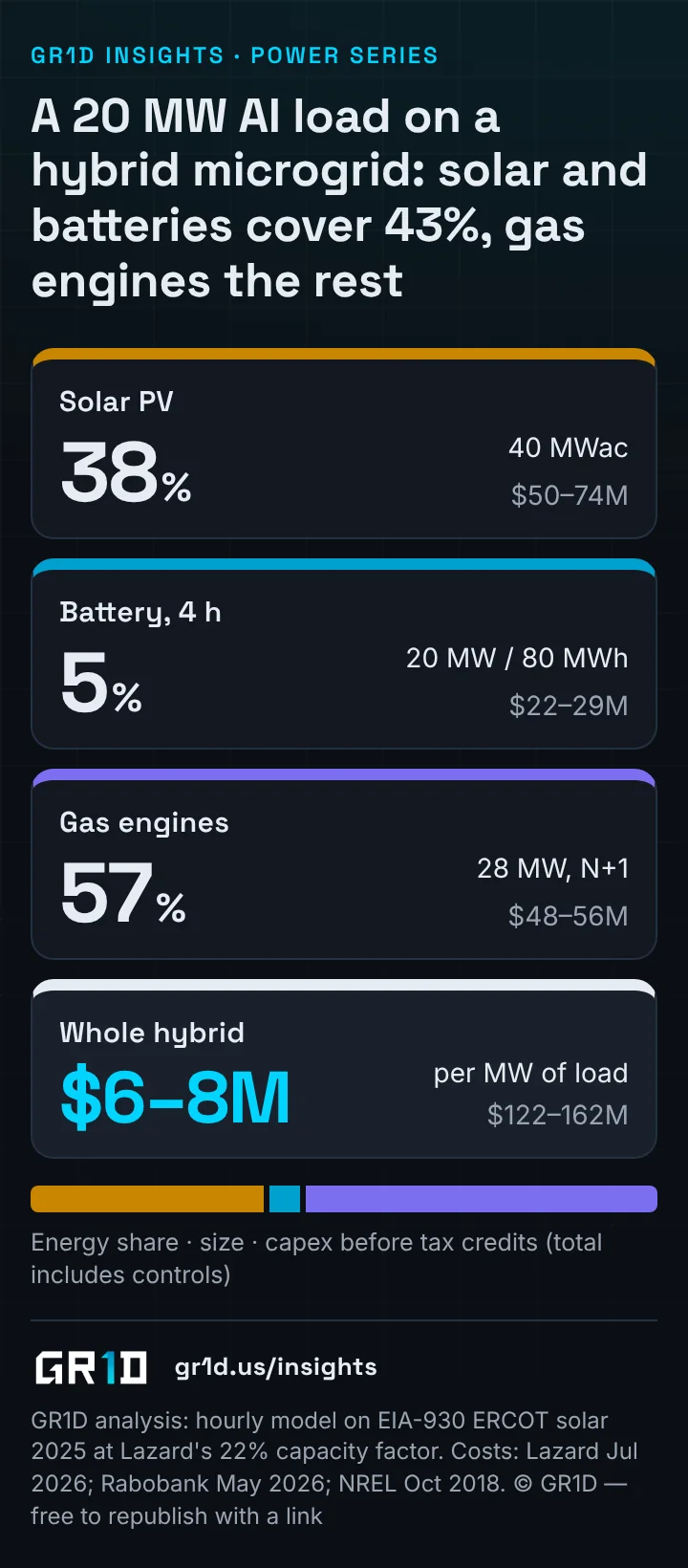
Read as text
- A 20 MW AI load on a hybrid microgrid: solar and batteries cover 43%, gas engines the rest
- Solar PV · 38% · 40 MWac · $50–74M
- Battery, 4 h · 5% · 20 MW / 80 MWh · $22–29M
- Gas engines · 57% · 28 MW, N+1 · $48–56M
- Whole hybrid · $6–8M · per MW of load · $122–162M
- Energy share · size · capex before tax credits (total includes controls)
What is a data center microgrid?
In 2026, a data center microgrid stacks five layers (grid, firm gas or fuel cells, solar, batteries, UPS) under one controller that runs the site with or without the utility. NREL defines a microgrid as "a group of interconnected loads and resources within clearly defined electrical boundaries" that can connect to or disconnect from the grid (NREL, Dec 2019). Each layer works on its own clock:
- Grid, where available: the cheapest firm power in Texas, where industrial customers in the West South Central region paid 6.48¢/kWh in 2025 (EIA, Oct 2026).
- Firm generation: gas engines, turbines or fuel cells, sized to carry the whole load on a cloudy night.
- Solar PV: daytime energy at the 22% capacity factor Lazard assumes for ERCOT solar (Lazard, Jul 2026).
- Batteries: lithium-ion, typically two to four hours (Data Center Knowledge, May 2026), for fast response and the evening shift; flow batteries for longer durations.
- UPS: inside the building, bridging milliseconds to minutes.
- Controller: dispatches every source and handles mode changes; NREL found controllers averaged $155,000 per MW, a median 7% of project cost (NREL, Oct 2018).
Grid-parallel, the utility sets the frequency and on-site sources follow; islanded, a grid-forming source (an engine, a turbine or a grid-forming battery inverter) sets voltage and frequency itself (NREL, Dec 2019). The seven supply configurations are compared in How Data Centers Are Powered; this article sizes the layers and runs them together.
Why are AI data centers building their own microgrids now?
In August 2026 ERCOT held about 474 GW of large-load requests, roughly 90% from data centers, more than five times its 91.1 GW record peak (POWER, Aug 2026; EIA, Aug 2026). A US grid connection takes about four years on average, per JLL figures cited by Bloomberg (Fortune, Apr 2026), while reciprocating engines arrive in 12–24 months, solar in 18–36 months and fuel cells in as little as 90 days (Rabobank, May 2026).
More than 130 GW of co-located generation has been announced for US data centers, over 80% of it gas, with about 22 GW of solar, wind and solar-plus-storage (Rabobank, May 2026). Batteries follow the gas: BloombergNEF counted 4.9 GW of storage announced alongside on-site fossil generation, about 32% of announced on-site data center battery capacity (Fortune, Apr 2026).
The load is the second driver. AI training swings "tens or hundreds of megawatts," with most of the energy between 0.2 and 3 Hz, according to Microsoft, OpenAI and NVIDIA engineers (arXiv, Aug 2025). NERC issued a Level 3 alert on computational loads on May 4, 2026 (NERC, May 2026), and on July 22, 2026 about 3,800 MW of large load in Dominion's zone switched to on-site backup after a normally cleared 230 kV fault (PJM, Aug 2026).
The counterpoint: BNEF says the ERCOT pause below "is not long enough for data centers to buy and build behind-the-meter generation on-site" as a hedge, though later-stage projects outside Batch Zero may build more on-site generation and storage (POWER, Aug 2026). The grid process is covered in ERCOT Large-Load Interconnection.
How do solar, batteries and gas share a day of load?
In GR1D's 2026 model of a flat 20 MW AI load, solar supplies 38% of annual energy directly, batteries shift 5% into the evening and gas engines 57%. The model runs all 8,760 hours of ERCOT's 2025 solar output from EIA-930, scaled to Lazard's 22% ERCOT capacity factor. At midday solar carries the load and charges the battery; the battery discharges from late afternoon, peaking near 7 MW at 7 p.m. on the average day; overnight the engines carry everything.

Read as text
- One average day on a 20 MW hybrid: solar carries midday, the battery the evening, gas the night
- 0 · 10 · 20 MW · 12 am · 6 am · Noon · 6 pm · 12 am · Solar → battery
- Share of the year
- 38% · Solar, direct
- 5% · Via battery
- 57% · Gas engines
| Layer | Size in GR1D's model | Share of 175,200 MWh a year | Capex, 2026, before tax credits |
|---|---|---|---|
| Gas engines, N+1 | 5 × 5.6 MW = 28 MW | 57% | $48–56M at $1,700–2,000/kW (Rabobank) |
| Solar PV, single-axis | 40 MWac, about 220 acres | 38% direct | $50–74M at $1,250–1,850/kW (Lazard) |
| Lithium-ion battery, 4 h | 20 MW, 80 MWh | 5% shifted solar, plus ride-through | $22–29M at $270–365/kWh (Lazard) |
| Microgrid controller | Whole site | — | About $3M at $155,000/MW (NREL, 2018 data) |
| Total | 20 MW flat load | 100% | $122–162M, about $6–8M per MW of load |
Gas is sized N+1 to the full load, 40% above it, the low end of Rabobank's 40–65% overbuild; the 5.6 MW engines and 8,295 Btu/kWh heat rate come from EIA's reference engine plant (EIA, Feb 2020). The 22% capacity factor is conservative: ERCOT's fleet delivered 23.3% in 2025 (GR1D analysis of ERCOT data, Oct 2026) and LBNL puts typical US plants near 25% (LBNL, Oct 2025), at which this design reaches 47% solar.
| Configuration, 20 MW flat load | Solar share of energy | Hours at least one engine runs | Solar output curtailed |
|---|---|---|---|
| Gas engines only, 28 MW N+1 | 0% | 8,760 | — |
| + 20 MWac solar | 22% | 8,760 | 0% |
| + 40 MWac solar | 38% | 6,718 | 14% |
| + 40 MWac solar, 20 MW / 80 MWh battery | 43% | 6,037 | 1% |
| + 60 MWac solar, 30 MW / 120 MWh battery | 56% | 4,421 | 13% |
| + 100 MWac solar, 40 MW / 200 MWh battery | 72% | 2,774 | 31% |
Three results stand out. Solar saves fuel, not engines: the gas plant must still carry 20 MW through a cloudy January week. The battery's energy job is small, about five points of solar share at 116 full cycles a year; its real job is the millisecond layer below. And the curve flattens: 72% solar takes two and a half times the solar and battery of the 43% design and curtails 31% of solar output. An off-grid study by Stripe, Scale Microgrids and Paces found the same shape: about $93/MWh at 44% solar and $109/MWh at 90%, against $86/MWh for gas turbines alone (Heatmap, Jan 2025).
How does a microgrid keep voltage and frequency steady for GPUs?
In 2026, a microgrid holds GPU power steady by layering response speeds: capacitors and UPS in milliseconds, batteries in under a second, gas engines in seven seconds to minutes. Under the ITI (CBEMA) curve, IT equipment rides through an interruption of up to 20 ms, a sag to 70% voltage for 0.5 seconds and to 80% for 10 seconds (ITI curve, rev. 2000). In an ON.energy trial, AI loads moved between 30% and 100% of capacity in 10 ms to one second (Gas Turbine World, Oct 2026). Engines alone cannot follow. ISO 8528-5 class G3 lets a gas genset's frequency dip 15% on a load step, against 7% for diesel, with up to three seconds to recover; as Kohler puts it, "Gaseous engines respond slower than diesel" (Kohler, 2024).
| Layer | How fast it responds | What it covers |
|---|---|---|
| Rack power shelf | Sub-second; 65 J of capacitor storage per GPU in GB300 NVL72 | Cut grid-side peak 30% in NVIDIA's test (NVIDIA, Jul 2025) |
| UPS | Milliseconds | Keeps IT inside the ITI curve |
| Battery inverter | "Significantly shorter" than 100 ms, Fluence says | Load steps, ride-through, engine starts (Utility Dive, May 2026) |
| Gas engines | 7 s to full load for a Cat G3516; 2.5 min for a Wärtsilä 31SG | Energy for hours, not millisecond swings (POWER, Mar 2026) |
| Aeroderivative turbine | 5-minute start for a 35 MW LM2500XPRESS | Bulk energy; cycling adds wear (GE Vernova) |
Grid-forming inverters set the island's voltage. ERCOT's NOGRR272, effective December 1, 2025, requires transmission-connected batteries with interconnection agreements signed on or after April 1, 2026 to hold a near-constant internal voltage phasor through sub-transient and transient disturbances, the defining trait of grid-forming control (ERCOT NOGRR272; ERCOT, Mar 2026). Caterpillar's deployment for Joule Capital Partners' Utah campus totals 4 GW of capacity, including 1.1 GWh of grid-forming batteries (POWER, Mar 2026), and synchronous condensers are going in beside batteries to cover "voltage regulation, frequency support, and inertia shortfalls" (Data Center Knowledge, May 2026).
Batteries buffer the swings so engines see a smoother load. Williams says batteries smooth load swings and cut the turbine starts and ramps that are its most emissions-intensive operating conditions (Fortune, Apr 2026). VoltaGrid disagrees for its own platform, which it says has "zero reliance on battery storage" (POWER, Oct 2025); test it against the site's load profile.
Ride-through is now a rule. ERCOT's NOGRR282, effective August 1, 2026, covers new large computational loads, defined in ERCOT's filing as loads of 75 MW or more that are at least half computing, after 26 ride-through events at such sites since 2023; sites approved before November 14, 2025 are exempt (ERCOT NOGRR282; ERCOT, Dec 2025). Such a load "shall remain connected to the Transmission Grid" through defined voltage dips and recover to 90% of pre-fault consumption within two seconds, measured at the point of interconnection bus when generation or storage is co-located (ERCOT Board report, Jun 2026), so a hybrid's battery is part of compliance. Nationally, FERC ordered NERC to file a first phase of large-load standards by December 31, 2026; minimum ride-through requirements are expected in 2027 (PJM, Aug 2026). The rack side is covered in 800 VDC and Vera Rubin.
Who supplies each layer of a data center microgrid?
As of October 2026, no single vendor supplies every layer: announced data center power splits across engine, turbine, fuel-cell and battery makers, with gas over 80% of it (Rabobank, May 2026).
| Layer | Suppliers, one of several | Dated signal | Limits and open questions |
|---|---|---|---|
| Modular gas engines | VoltaGrid (INNIO Jenbacher), ERock (formerly Enchanted Rock), Caterpillar, Wärtsilä, Rolls-Royce mtu | VoltaGrid–Oracle 2.3 GW for Texas sites, announced Oct 15, 2025 (POWER, Oct 2025); ERock about 1,000 MW at 400-plus sites (Energy Capital, May 2026) | Air permits, firm gas; battery pairing varies |
| Gas turbines | GE Vernova, Siemens Energy, Solar Turbines | GE Vernova backlog 116 GW, booking 2031 deliveries (Utility Dive, Jul 2026) | Lead times; cycling wear on hot-gas parts |
| Fuel cells | Bloom Energy | Oracle up to 2.8 GW, 1.2 GW contracted (Bloom, Apr 2026) | $3,000–4,000/kW; long start-up, limited shutdowns |
| Lithium-ion batteries | Tesla, Fluence and others | Tesla began Texas production of 5 MWh Megapack 3 units in August 2026 (MGRID, Sep 2026); Fluence signed supply agreements with two hyperscalers (Utility Dive, May 2026) | Two to four hours; fire codes; degradation |
| Flow batteries | Invinity, among vanadium and iron suppliers | Design selected for up to 1.5 GWh of vanadium storage, expandable to 2.1 GWh, at a Swiss data center campus (Energy-Storage.News, Jun 2026) | Early market; stack supply |
VoltaGrid packages INNIO Jenbacher engines in 25 MW blocks, 92 of them for Oracle (POWER, Mar 2026). Bloom says it delivered a working system to Oracle in 55 days (Bloom, Apr 2026); Power Engineering lists long start-up times and limited shutdowns as solid-oxide drawbacks (Power Engineering, Jul 2026).
Projects already combining the layers:
- xAI, Memphis: about 720 Megapack containers sat at Colossus 2 in July 2026, the company cites 3.3 GWh of storage, and TVA approved a grid connection on August 20, 2026 (Canary Media, Sep 2026), beside gas turbines in a 1.2 GW off-grid plant (Fortune, Apr 2026).
- Google and Intersect, Texas: Quantum in Haskell County pairs 640 MW of solar and 1.3 GWh of storage with a Google data center; Meitner in Gray and Roberts counties adds more than 1 GW of wind, solar and storage, firmed by on-site gas (Intersect, Jun 2026).
- GW Ranch, Pecos County: a private grid permitted for 7.65 GW of gas, with 1.8 GW of batteries and 750 MWac of solar; developer Pacifico Energy targeted the first 1 GW for the first half of 2027 (Pacifico, Jan 2026), and Amazon confirmed in August 2026 that it owns the campus, which will start off the Texas grid (ENR, Aug 2026).
- Meta Socrates, Ohio: two off-grid 200 MW plants built by Williams from Solar Turbines, Siemens Energy and Caterpillar units, plus about 173 MW of batteries by Cleanview's satellite estimate (Cleanview, 2026).
What does a hybrid microgrid cost, and what are the trade-offs?
In 2026, unsubsidized solar costs $40–98/MWh, four-hour battery storage $210–292/MWh and behind-the-meter gas $100–165/MWh, against $90–95/MWh for grid-connected alternatives (Lazard, Jul 2026; Rabobank, May 2026).
| Layer | Upfront cost, 2026 | Cost per MWh | Main trade-off |
|---|---|---|---|
| Gas engines | $1,700–2,000/kW all-in | $100–165, with 40–65% overbuild | Fuel price, air permits |
| Solar PV | $1,250–1,850/kW; ERCOT projects $1.38/WAC in 2024 | $40–98 unsubsidized | Land; daytime only |
| Battery, 4 h | $270–365/kWh | $210–292 to store a MWh | Duration; augmentation |
| ERCOT grid | $100,000 study fee + $50,000/MW security at 75 MW+ | 6.48¢/kWh, West South Central industrial, 2025 | Queue time; curtailment |
Solar's value depends on what it displaces. Off-grid, a solar MWh avoids only fuel and engine wear: about $35/MWh at EIA's $3.48/MMBtu Henry Hub forecast for 2026 (EIA, Oct 2026), the 8,295 Btu/kWh heat rate and EIA's $5.69/MWh engine variable O&M in 2019 dollars, below Lazard's $40–98. Behind a grid meter it displaces power bought at an average 6.48¢/kWh industrial rate, about $65/MWh. Lazard notes the One Big Beautiful Bill Act kept the storage tax credit through 2033 while wind and solar credits face phase-outs (Lazard, Jul 2026).
Fuel exposure cuts both ways. The hybrid's fuel bill would be about $0.6 million a year at West Texas Waha's 2024 average of $0.77/MMBtu (Pipeline & Gas Journal, Sep 2025), $2.9 million at $3.48 and $6.4 million if January 2026's $7.72 Henry Hub average lasted a year (EIA, Oct 2026), against $1.1, $5.1 and $11.2 million for engines alone. Off-grid, solar is a fuel hedge first.
Emissions and permits scale with engine hours. At 117 lb of CO2 per MMBtu (EIA, Feb 2020), the engines-only plant emits about 77,000 tonnes a year and the hybrid about 44,000. Texas air permits run from permits-by-rule for units up to 3.2 MW to case-by-case reviews of up to 285 days for minor sources and 365 for major ones (TCEQ, Apr 2026).
Land and maintenance. LBNL's 2019 median for tracking solar plants is 0.18 MWac per acre of array (LBNL, Jan 2022), so 40 MWac needs about 220 acres, against about 10 acres for EIA's 21 MW engine plant, with $35.16/kW-year of fixed O&M in 2019 dollars. Solar adds $8.25–26.25/kW-year and batteries $3.75–7.75/kWh-year (Lazard, Jul 2026). Full build costs are in Data Center Cost per MW.
What should a 20–150 MW site check before choosing a hybrid?
A 20–150 MW site should settle nine questions before choosing a hybrid in 2026, starting with grid status, firm gas and ERCOT's 75 MW line:
- Grid status. Is there substation headroom, and does the load cross ERCOT's 75 MW line ($100,000 study fee, $50,000/MW security)? A near-term grid makes the microgrid a bridge; otherwise it is the plant.
- Firm gas. A 20 MW engine plant burns about 4,000 MMBtu a day at full load; confirm firm transport and the pricing hub.
- Air permit. Map generator MW to TCEQ's authorization ladder and plan for no issued data center permit until ERCOT's review ends.
- Redundancy. Engines N+1 to the full load, plus black start and maintenance spares.
- Battery power before energy. Size battery MW to the largest load step and the loss of one engine, with reserve for engine starts.
- Grid-forming and ride-through. Specify grid-forming inverters, design to NOGRR282 at 75 MW or more, and commission against NERC's Level 3 alert.
- Land. About 5.6 acres of array per MWac: 220 acres for the 20 MW design, roughly 1,700 for 150 MW.
- Load shape. Training swings harder than inference; rack-level smoothing changes what the site battery must absorb.
- Exit plan. Decide what stays when the grid arrives (solar, batteries, controls) and what becomes backup (engines).
The site-level screen is in AI Data Center Site Selection in Texas.
Frequently asked questions
What is a data center microgrid?
An on-site power system behind one point of connection that can run with the grid or island from it, usually combining gas engines, turbines or fuel cells for firm power, solar for daytime energy, batteries for fast response, UPS and a controller that dispatches them.
Can solar and batteries power a data center on their own?
Not at data center reliability today. The Stripe, Scale Microgrids and Paces study modeled 90% solar with batteries at about $109/MWh and reliability upwards of 99%, still with gas backup sized to 125% of load, against the 99.999% data centers usually require (Heatmap, Jan 2025).
How much does a data center microgrid cost?
About $6–8 million per MW of load in GR1D's 2026 model: $122–162 million before tax credits for 28 MW of N+1 gas engines, 40 MWac of solar and a 20 MW, 80 MWh battery, against $48–56 million for engines alone.
Why do AI data centers pair batteries with gas generators?
Because GPU loads swing faster than engines respond. Under ISO 8528-5, a gas genset may dip 15% in frequency on a load step, and it takes seconds to minutes to reach full load; batteries respond in a fraction of a second. BloombergNEF counted 4.9 GW of storage paired with on-site fossil generation.
What is the difference between island mode and grid-parallel mode?
Grid-parallel, the utility sets the frequency and on-site generators and batteries follow it. In island mode, a grid-forming source (an engine, a turbine or a grid-forming battery inverter) must set voltage and frequency itself.
Do Texas permits apply to off-grid data center power?
Yes. TCEQ air permits cover on-site generation whether or not it connects to ERCOT, and the September 21, 2026 order paused data center permits, off-grid and behind-the-meter included, until ERCOT's review ends, expected in mid-December. As of October 21, 2026, TCEQ says it has issued none.
Sources
- Microgrids (NREL presentation) — NREL, 2019-12-11
- Phase I Microgrid Cost Study: Data Collection and Analysis of Microgrid Costs in the United States — NREL, 2018-10
- Short-Term Energy Outlook, Table 7c: US regional electricity prices — EIA, 2026-10
- Levelized Cost of Energy+ (Version 19.0) and Levelized Cost of Storage (Version 11.0) — Lazard, 2026-07-13
- Battery storage gains ground as data centers seek diesel alternatives — Data Center Knowledge, 2026-05-15
- Texas audit could delay 49.8 GW of data center load, cost projects up to $15 billion, BNEF warns — POWER, 2026-08-06
- Hourly peak load in ERCOT set a new record, exceeding 91 GW on July 22 — EIA, 2026-08-03
- Data centers are finding a surprising way to deploy batteries — Fortune (Bloomberg), 2026-04-24
- The sprint: data centers are building a parallel energy system in the US — Rabobank, 2026-05-06
- Power stabilization for AI training datacenters (arXiv 2508.14318) — Microsoft, OpenAI and NVIDIA, 2025-08-20
- Essential Action: Computational Load Modeling, Studies, Instrumentation, Commissioning, Operations, Protection, and Control — NERC, 2026-05-04
- PJM, Dominion review large load transfer event — PJM Inside Lines, 2026-08-11
- Batch Zero Update — ERCOT, 2026-09-11
- Governor Abbott orders TCEQ to pause all permit issuance for data center projects — Bracewell, 2026-09-23
- "It ain't right": Texas said it would halt data center permits, the state is pushing ahead anyway — 404 Media, 2026-10-19
- Texas data center permits after the governor's halt — FracTracker Alliance, 2026-10-19
- Capital cost and performance characteristics for utility-scale power generating technologies (AEO2020) — EIA and Sargent & Lundy, 2020-02
- Utility-Scale Solar, 2025 Edition (slides) — Lawrence Berkeley National Laboratory, 2025-10
- Can solar microgrids power data centers? — Heatmap, 2025-01-07
- ITI (CBEMA) curve application note — Information Technology Industry Council via powerquality.blog, 2022-02-04
- AI data center load swings challenge gas turbine operations — Gas Turbine World, 2026-10-01
- ISO 8528-5 and generator transient performance — Kohler Energy, 2024
- How new GB300 NVL72 features provide steady power for AI — NVIDIA, 2025-07-28
- Fluence Energy signs master supply agreements with two major hyperscalers — Utility Dive, 2026-05-12
- Engine power plants surge as data centers drive unprecedented demand — POWER, 2026-03-02
- LM2500XPRESS powering Crusoe AI data centers (case study) — GE Vernova, 2026
- NOGRR272: Advanced grid support requirements for inverter-based ESRs — ERCOT, 2025-12-01
- Oracle taps VoltaGrid for 2.3-GW modular gas fleet to power AI data centers across Texas — POWER, 2025-10-15
- NOGRR282: Large computational load ride-through requirements — ERCOT, 2026-08-01
- Item 6.2: Large Electronic Load Ride-Through Requirements (NOGRR282 and NPRR1308) — ERCOT Board of Directors, 2025-12-01
- NOGRR282 Board Report — ERCOT, 2026-06-02
- Buoyed by $1.3B sales backlog, microgrid company ERock files for IPO — Energy Capital HTX, 2026-05-21
- GE Vernova gas turbine backlog climbs to 116 GW — Utility Dive, 2026-07-23
- Bloom Energy and Oracle expand strategic partnership to deploy up to 2.8 GW — Bloom Energy, 2026-04-13
- Tesla starts Megapack 3 production in Texas at 5 MWh a unit — MGRID, 2026-09-04
- Giga-scale Swiss data centre project will be world first in carving out niche for flow batteries, Invinity says — Energy-Storage.News, 2026-06-04
- Brookfield, Bloom Energy expand partnership to $25 billion framework for onsite data center power — Power Engineering, 2026-07-09
- xAI has quietly built a massive battery at its Memphis data center — Canary Media, 2026-09-11
- Google and Intersect deepen Texas roots with new data center and energy investments in Gray and Roberts counties — Intersect, 2026-06-04
- Pacifico Energy secures 7.65 GW power generation permit for GW Ranch project — Pacifico Energy via Business Wire, 2026-01-26
- Behind-the-meter data centers: Meta New Albany (Socrates) — Cleanview, 2026
- Short-Term Energy Outlook, October 2026 — EIA, 2026-10
- Permian Waha hub gas prices turn negative amid pipeline constraints — Pipeline & Gas Journal (Reuters), 2025-09-15
- Air permitting for data centers (AAPCA presentation) — TCEQ Air Permits Division, 2026-04-07
- Land requirements for utility-scale PV: an empirical update on power and energy density — LBNL (IEEE Journal of Photovoltaics), 2022-01
- Amazon discloses ownership of GW Ranch, giant Texas data center-gas power complex — ENR, 2026-08-11
- Advanced Grid Support (AGS) incentive program concept overview, IBRWG — ERCOT, 2026-03-27
Building or financing an AI data center in Texas?
GR1D develops powered-shell and turnkey AI data centers — 20 MW to 150 MW sites with power, fiber and entitlements solved before the first rack arrives. See how we build, browse our sites or talk to us.