Flow Batteries for Data Centers: Vanadium, Iron and Zinc vs Lithium-Ion
A flow battery can serve a data center as long-duration storage, not as its uninterruptible power supply (UPS). Vanadium, iron and zinc flow batteries hold energy in tanks of liquid electrolyte, so hours are added with liquid rather than power hardware. That suits 4–12 hours of solar shifting, peak management and extended backup in a hybrid microgrid. In 2026 most return 70–80% of the energy stored, against about 85% for lithium-ion, cost more per kWh, outlast it in cycles and cannot enter thermal runaway.
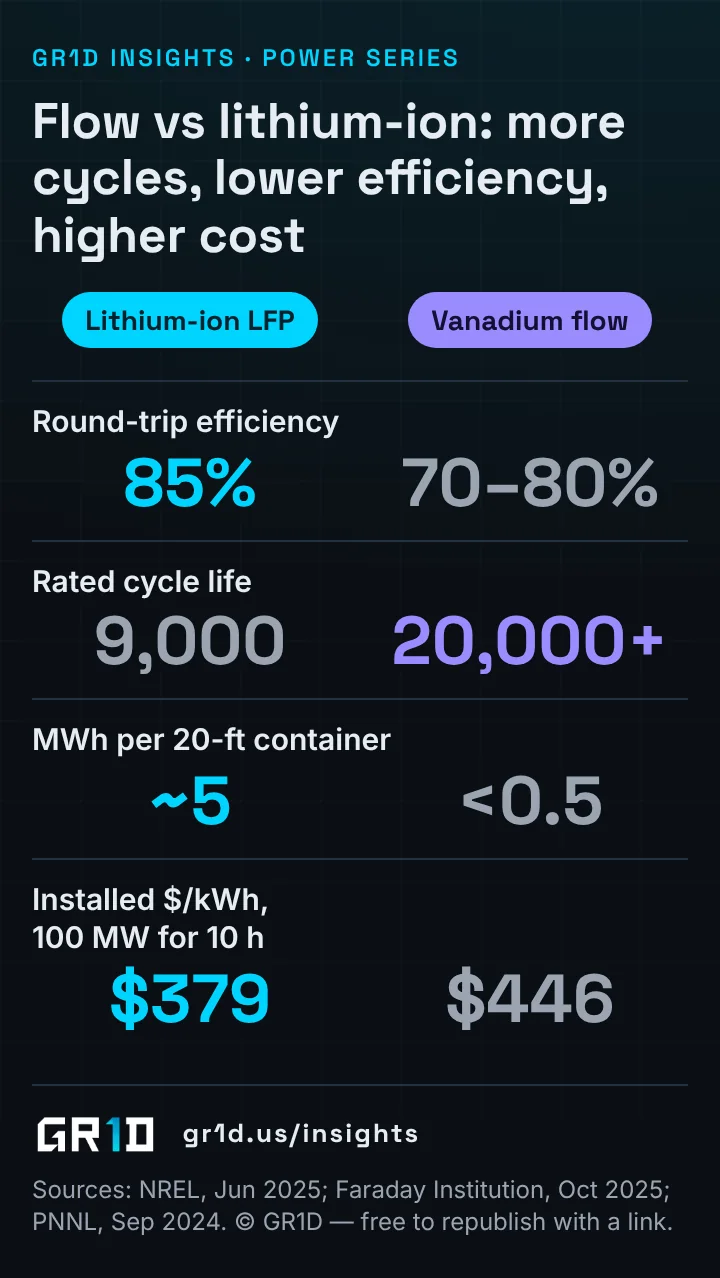
Read as text
- Flow vs lithium-ion: more cycles, lower efficiency, higher cost
- Lithium-ion LFP
- Vanadium flow
- Round-trip efficiency
- 85%
- 70–80%
- Rated cycle life
- 9,000
- 20,000+
- MWh per 20-ft container
- ~5
- <0.5
- Installed $/kWh, · 100 MW for 10 h
- $379
- $446
How does a flow battery work, and why does that matter for a data center?
A flow battery stores energy in two tanks of liquid electrolyte pumped through a cell stack; a vanadium system needs about 68,000 liters of electrolyte per MWh (Energy-Storage.News, May 2023). Inside the stack, the electrolytes flow on either side of a membrane and exchange charge as dissolved ions change oxidation state. Stacks, pumps and inverters set the megawatts; tank volume sets the hours. The Faraday Institution calls this separation of power and energy the defining feature of the design (Faraday Institution, Oct 2025).
That split decides where the technology competes. Lithium-ion adds cells for each extra hour; a flow battery adds electrolyte and tank. Most flow vendors target 4–12 hours, head-on with lithium-ion, and vanadium products span 2–18 hours, most at 4–8 (Faraday Institution). The US Department of Energy's Long-Duration Storage Shot targets systems of 10 hours or more (DOE, Jul 2023).
Batteries are now on virtually every data center project electrical contractor Rosendin builds, with generator coverage down to 15–40% on new projects (pv magazine USA, Jul 2026). The question is what carries the hours beyond the first few; the rest of the power chain is in How Data Centers Are Powered. Wear is the flow battery's argument: the electrolyte does not degrade with cycling, while the Department of Energy's cost model replaces stacks and pumps after about 12 years (DOE) in a plant life of 20 years or more (PNNL).
Which flow battery chemistries are in use in 2026?
Vanadium is the only flow chemistry at gigawatt-hour scale in 2026 (Energy-Storage.News, Jan 2026); iron, zinc and organic designs remain pilots or demonstrations (PNNL, Sep 2024).
Vanadium redox flow batteries
China dominates vanadium redox flow batteries (VRFB): 98% of vanadium flow capacity operating or under construction in Vanitec's 2023 data was in China (Faraday Institution), and China connected about 2.16 GWh in 2025, up 24%, across 27 projects (Mysteel data via Huxiu, Jun 2026). On December 31, 2025 Rongke Power announced that its 200 MW/1,000 MWh, five-hour Jimsar plant in Xinjiang was operating; reported investment was RMB 3.8 billion (Energy-Storage.News, Jan 2026).
Iron flow batteries
ESS Inc.'s iron flow battery runs mainly on iron, salt and water (Utility Dive, Oct 2025): low materials risk, high company risk. ESS warned of going-concern doubt in August 2025 and shifted to Energy Base, a 12–14-hour product aimed at data centers (Energy-Storage.News, Aug 2025). It booked $73,000 of second-quarter 2026 revenue, held $5.6 million of unrestricted cash on July 31 and entered a non-binding letter of intent for a business combination (ESS, Aug 2026). Its 5 MW/50 MWh pilot with Salt River Project is due by December 2027, and in June 2026 ESS said it would accelerate sodium-ion storage development (ESS, Jun 2026). The literature reports only about 50% round-trip efficiency for iron/iron hybrids (Faraday Institution).
Zinc-bromine and what happened to Redflow
Australia's Redflow, a zinc-bromine maker, entered voluntary administration on August 23, 2024 and went into liquidation. Its administrators blamed an inability to raise funding; repair and replacement costs had outgrown sales, and one Melbourne council reported a 90% failure rate across 36 of its batteries (ABC News, Dec 2024). Primus Power still sells a 125 kWh zinc-bromine unit (Faraday Institution).
Organic and other chemistries
Organic flow batteries replace metals with carbon-based molecules, at a density cost: about 7 kWh per cubic meter for one organic electrolyte against about 30 for vanadium (Faraday Institution). XL Batteries plans a 333 kW demonstration at a Prometheus Hyperscale data center in 2027, then 12.5 MW/125 MWh systems in 2028 and 2029, and says near-term costs will fall below $200/kWh (Energy-Storage.News, May 2025). CMBlu Energy's battery is due at a DataHall data center in Saale, Germany in 2027/28, starting at 4 MW (DCD, Oct 2025). Caution is warranted: three US flow battery companies ceased operations in the past decade, PNNL notes (PNNL).
Flow battery vs lithium-ion: which is better for a data center?
Neither wins outright: in 2026 lithium iron phosphate (LFP) returns about 85% of stored energy, flow batteries 70–80%, but vanadium advertises 20,000+ cycles (NREL, Jun 2025; Faraday Institution, Oct 2025).
| Metric, as of Oct 2026 | Lithium-ion (LFP) | Vanadium flow | Iron flow |
|---|---|---|---|
| Round-trip efficiency | 85% at system level (NREL, Jun 2025); 90%+ at cell level | 70–80% for most flow batteries | About 50% in the literature |
| Cycle life | About 9,000 at 80% depth of discharge | 20,000+ advertised; stacks and pumps about 12 years (DOE, Jul 2023) | Claimed to match LFP; less field data |
| Typical duration | 2–8 h | 2–18 h, most 4–8 h | 5–12 h; Energy Base 12–14 h |
| Energy per 20-foot container | About 5 MWh | Under 0.5 MWh | No figure found |
| Heat | 80% health after 4.5 years at 40 °C; runaway risk rises above 60 °C | Electrolyte can precipitate above 40 °C; mixed acid to 50 °C | 50 °C ambient claimed |
| Fire | Thermal runaway possible | No thermal runaway (PNNL, Sep 2024) | No thermal runaway |
| Installed cost, 100 MW for 10 h | $379/kWh (PNNL) | $446/kWh (PNNL) | No independent figure |
Three caveats apply. Efficiency figures flatter both sides: in the Faraday Institution's data, pilot flow figures leave out pumping losses of about 5% and lithium-ion figures leave out cooling (Faraday Institution). Density depends on where it is measured: vanadium electrolyte holds about 10% of lithium-ion's energy per volume, yet built sites averaged 15 kWh per square meter for vanadium against 34 for lithium-ion in a 2023 review, though the vanadium sites averaged 2.6 hours against 4.3. A flow battery CEO's op-ed claims flow needs four times less land than LFP (DCD, Mar 2026); the independent data do not support that. Heat cuts both ways: a lithium-ion cell held at 40 °C falls to 80% state of health after 4.5 years, while water-based electrolyte has high thermal mass and is easy to cool.
Are flow batteries safer than lithium-ion in a data center?
Yes on fire: water-based flow electrolytes cannot enter thermal runaway (PNNL, Sep 2024), while lithium-ion batteries were at the center of major data center fires in Korea and Singapore.
On October 15, 2022 a fire in the battery room of SK C&C's Pangyo data center caused Kakao outages of more than 11 hours; Korea's ICT ministry pinpointed lithium-ion batteries not physically separated from the uninterruptible power supply (UPS) as the main reason recovery was slow (Korea Herald, Dec 2022). Uptime Institute counted 14 publicly reported, high-profile outages caused by fire or fire suppression since 2020, while noting that fires remain rare (Uptime Institute, Jan 2023). On September 10, 2024 a lithium-ion fire at Digital Realty's SIN11 in Singapore disrupted Alibaba Cloud (DCD, Sep 2024). On September 26, 2025 the lithium-ion batteries of a UPS being relocated at Korea's National Information Resources Service in Daejeon caught fire; six days later 115 of 647 affected government systems were back (Korea Herald, Oct 2025).
Flow batteries are not hazard-free: many electrolytes are strongly acidic or alkaline and some are toxic (Faraday Institution), so the main risk becomes a spill, which containment handles (PNNL). The 2021 International Fire Code reflects both facts. Flow batteries need a permit above the same 20 kWh as lithium-ion, face the same 600 kWh cap per fire area and must add spill containment, neutralization to pH 5–9 and exhaust ventilation, but they are exempt from the explosion control and thermal-runaway protection lithium-ion requires (IFC 2021 tables, City of Redmond, Dec 2024). NFPA 855 lists flow batteries in the same 20 kWh row; its 2026 edition makes a hazard mitigation analysis standard, and Texas enforces the 2020 edition where the State Fire Marshal has jurisdiction (Compute Law Blog, Sep 2026). PNNL warns that local officials unfamiliar with the chemistry may ask for unnecessary information (PNNL).
How much does a flow battery cost in 2026?
A 100 MW, 10-hour vanadium flow plant costs about $446/kWh installed against $379/kWh for lithium-ion LFP (PNNL, Sep 2024); China's first sub-2-yuan/Wh bid, in 2025, equals about $292/kWh.
| Estimate | Scope | Flow battery | Lithium-ion |
|---|---|---|---|
| PNNL, Sep 2024 | 100 MW, 10 h, installed | Vanadium $446/kWh; LCOS $0.21/kWh | $379/kWh; LCOS $0.17/kWh |
| EPRI for the LDES Council, via Energy-Storage.News, Jan 2026 | 100 MW, 10 h intraday electrochemical class, chemistries not named | $220–572/kWh in 2025; $244–358 by 2030 | Not separated |
| BNEF via Energy-Storage.News, Dec 2025 | 2025 turnkey average | No figure | $117/kWh global; $219/kWh US |
| China, Sep 2025 and Jun 2026; dollars at the FRED rate | Rongke Power bid, 10 MWh, 4 h; Chinese lithium storage price | Vanadium RMB 1.958/Wh, about $292/kWh | About RMB 0.4/Wh, about $60/kWh |
Long durations were supposed to favor flow batteries, since extra hours add only electrolyte. With vanadium, the electrolyte is the expensive part: about 40% of a 4–6-hour battery's cost, rising with duration (Energy-Storage.News, May 2023), and about half in China (Huxiu). Supply is concentrated: of about 110,000 tonnes of vanadium mined in 2025, China produced 82,000, Russia 21,000 and South Africa 5,000; Brazil and South Africa supplied 47% and 43% of US vanadium pentoxide imports in 2021–24, and a 50% US tariff on high-purity vanadium products from Brazil began on August 6, 2025. The Chinese price averaged about $5.02/lb in 2025, down from $9.29 in 2022 (USGS, Feb 2026); Europe's benchmark rose 17.5% to $6.03/lb in the second quarter of 2026 (Largo, Aug 2026).
GR1D analysis. A megawatt-hour of vanadium storage carries about 9.89 tonnes of vanadium pentoxide (Energy-Storage.News, May 2023). At $5.02–6.03/lb, that oxide alone is worth $109–131 per kWh of storage, about the price of a whole turnkey lithium-ion system at BNEF's 2025 global average of $117/kWh (method: 9.89 tonnes times 2,204.6 lb per tonne times the price). Hence electrolyte leasing: a TerraFlow Energy customer in Bellville, Texas leases its electrolyte through Storion Energy, backed by Largo Physical Vanadium's metal (Storion Energy, Jul 2025), and China Energy Storage Network reports that Beijing Puneng's pay-per-use model cuts initial investment by 40% (Sina Finance, Sep 2025). PNNL called leasing not yet proven at scale. Invinity targets a cost cut of at least 66% for 2027 deliveries (Kalkine Media, Sep 2026) and puts its own storage cost for AI inference at £56.6/MWh against £66.3 for lithium-ion (Investing.com, Sep 2026), a company analysis.
Where does a flow battery fit in a data center power system?
Behind the uninterruptible power supply (UPS): Invinity's flow batteries responded in 110 ms in DNV GL-observed tests (Feb 2021), while IT power supplies ride through 20 ms dropouts.
The ITI (CBEMA) curve, revised in 2000, lets IT power supplies lose voltage entirely for up to 20 milliseconds (powerquality.blog, Feb 2022); by then the UPS must carry the load. Invinity's 110 ms meets the two-second response grid frequency markets ask for (Invinity, Feb 2021) but is more than five times the IT window. Vendors report faster: a Storion Energy and TerraFlow Energy white paper measured a ten-cell lab stack taking over a DC bus in about 1.2–2.5 ms, with an emulated inverter and no complete system tested (Storion and TerraFlow, Oct 2025). Until a complete system is independently tested, plan the UPS in front.

Read as text
- Flow batteries cover hours, not the first 20 milliseconds
- The UPS holds the load first; a flow battery carries the hours after.
- 20ms · dropout an IT power supply rides through
- 110ms · independently observed flow response
- 4–12h · where most flow vendors aim
- 10+h · DOE long-duration target
- Milliseconds: UPS territory
- Hours: flow battery territory
That leaves three jobs:
- Solar shifting, 4–12 hours. Daily long-duration cycling is where cycle life pays; the Faraday Institution singles out solar-supported firming (Faraday Institution). Our guide to data center microgrids with solar, batteries and gas covers the full design.
- Long-duration backup behind the UPS. Stored hours can cut generator runtime; ESS aims its 12–14-hour Energy Base at data centers.
- Peak and connection management. Invinity says its batteries let operators shrink grid connections (Invinity, 2026), a claim without a published data center result.
Sub-second smoothing of GPU training swings also stays with the UPS for now. Announced projects will test the rest:
| Project | Chemistry and size | Status, as of Oct 20, 2026 |
|---|---|---|
| FlexBase AI data center campus, Laufenburg, Switzerland | Vanadium, Invinity: up to 1.5 GWh, later 2.1 GWh | Selected to design in May 2026; purchase order expected after engineering (Invinity, May 2026) |
| Prometheus Hyperscale data center, US | Organic, XL Batteries: 333 kW, then two 12.5 MW/125 MWh systems | Planned for 2027, 2028 and 2029 (Energy-Storage.News, May 2025) |
| DataHall data center, Saale, Germany | Organic, CMBlu: 4 MW, aiming for 50 MW | Planned for 2027/28 (DCD, Oct 2025) |
GR1D analysis, sizing. Eight hours behind a 20 MW load is 160 MWh; the efficiency gap is priced at ERCOT's 2025 average real-time price of $36.94/MWh (Potomac Economics, May 2026).
| Illustrative 20 MW load, 8 hours | Vanadium flow, 160 MWh | Basis |
|---|---|---|
| Electrolyte | About 10.9 million liters | 68,000 liters per MWh |
| Vanadium pentoxide | About 1,580 tonnes, holding about 0.8% of world vanadium output in 2025 | 9.89 tonnes per MWh; USGS output |
| Land, containers double-stacked | At least about 1.6 acres | Up to 100 MWh per acre |
| Extra charging energy vs LFP | About 25 MWh per daily cycle, about $0.34 million a year | 75% vs 85% efficiency at $36.94/MWh |
Who makes flow batteries, and how are the vendors doing?
As of October 2026 Rongke Power builds the largest vanadium plants, up to 1,000 MWh (Energy-Storage.News, Jan 2026); Western specialists are small: Invinity's first-half revenue and grants were £1.7 million.
| Vendor and base | Chemistry | Latest dated facts |
|---|---|---|
| Rongke Power, Dalian, China | Vanadium | 200 MW/1,000 MWh Jimsar plant announced operating Dec 31, 2025 |
| Sumitomo Electric, Japan | Vanadium | 11 MW/33 MWh for Hokkaido's grid operator by May 2029; portfolio above 200 MWh (Energy-Storage.News, Apr 2026) |
| Invinity Energy Systems, UK and Canada | Vanadium | FlexBase design selection, May 2026; first-half 2026 revenue and grants £1.7 million |
| CellCube (Enerox), Vienna, Austria | Vanadium | About 23 MWh across 130 systems by late 2022 (Energy-Storage.News, Nov 2022); no 2025–26 project data found |
| VFlowTech, Singapore | Vanadium | Raised $20.5 million, May 2025; claims 80% efficiency and 55 °C operation without cooling (ESS News, May 2025) |
| ESS Inc., US | Iron | Second-quarter 2026 revenue $73,000; $5.6 million cash on Jul 31, 2026 |
| TerraFlow Energy, Katy, Texas | Vanadium | 48 MWh Bellville, Texas project with leased electrolyte, energization planned Q1 2027 |
Two patterns stand out. Vanadium, the chemistry that works at scale, carries the supply risk; the chemistries that avoid it have the least operating history. And vendors are small next to their customers: Invinity's first-half revenue and grant income of £1.7 million (Investing.com) sits beside a 1.5 GWh design selection not yet converted into a purchase order. Katy-based TerraFlow Energy (TerraFlow Energy, Aug 2025) gets its own profile next.
What does this mean for a data center in Texas?
As of October 21, 2026, Texas has paused state environmental permits for data center projects; a battery needs no air permit, but the gas generation beside it does.
Heat matters too: vanadium electrolyte can precipitate above 40 °C (Faraday Institution), so electrolyte cooling is a design item for a Texas summer, as HVAC is for lithium-ion. The grid side is covered in ERCOT Large-Load Interconnection in Texas.
Frequently asked questions
Can a flow battery replace a UPS in a data center?
Not on its own yet: IT power supplies ride through dropouts of only 20 milliseconds, and the fastest independently observed flow battery response we found is 110 ms. Vendor lab tests report 1.2–2.5 ms for a stack, not a complete system. Plan a flow battery behind the UPS.
How long does a vanadium flow battery last?
Makers advertise 20,000+ cycles and plant lives of 20 years or more, because vanadium electrolyte does not wear out. Stacks and pumps do: the US Department of Energy's cost model replaces them after about 12 years. LFP cells now reach about 9,000 cycles.
Are flow batteries cheaper than lithium-ion?
Not in 2026. PNNL estimated $446/kWh installed for a 100 MW, 10-hour vanadium plant against $379 for lithium-ion, and lifetime costs of $0.21 against $0.17 per kWh delivered. Vendor claims of lower lifetime cost are their own analyses.
Do flow batteries catch fire?
Water-based flow batteries cannot go into thermal runaway, so the fire code waives explosion control for them. Their electrolytes can be acidic or toxic, so codes require spill containment, neutralization and ventilation and keep lithium-ion's 600 kWh cap per fire area.
Which flow battery chemistry is best for a data center?
Vanadium has the longest record but costly electrolyte and concentrated supply. Iron flow uses cheap materials but reports about 50% efficiency, and ESS, its main US maker, held $5.6 million of cash in July 2026. Redflow, a zinc-bromine maker, collapsed in 2024; organic designs arrive from 2027.
Is any data center using flow batteries today?
We found no megawatt-scale flow battery operating at a commercial data center as of October 2026. Announced projects include a 1.5 GWh vanadium design for FlexBase in Switzerland, XL Batteries systems at Prometheus Hyperscale from 2027 and a CMBlu battery at a DataHall site in Germany.
Sources
- Market and Technology Assessment of Flow Batteries for Developing Economies — Faraday Institution, 2025-10-16
- Adoption Readiness Level Assessment of Redox Flow Batteries (PNNL-36780) — Pacific Northwest National Laboratory, 2024-09
- Technology Strategy Assessment: Flow Batteries, Storage Innovations 2030 — US Department of Energy, 2023-07
- Cost Projections for Utility-Scale Battery Storage: 2025 Update — NREL, 2025-06
- Vanadium electrolyte: the fuel for long-duration energy storage — Energy-Storage.News, 2023-05-22
- Data center power shifts favor BESS, solid-state transformers — pv magazine USA, 2026-07-15
- Vanadium flow battery industry scales up in 2025: 2.16 GWh installed, cost below 2 yuan per Wh (in Chinese) — Huxiu, 2026-06-02
- World's first gigawatt-hour-scale flow battery project goes into operation in China — Energy-Storage.News, 2026-01-06
- Sumitomo Electric flow battery wins Japanese transmission operator HEPCO's renewables integration tender — Energy-Storage.News, 2026-04-28
- Salt River Project taps ESS for 50-MWh iron flow battery — Utility Dive, 2025-10-10
- Iron flow battery maker ESS Inc warns of survival battle through operational reset period — Energy-Storage.News, 2025-08-18
- ESS Tech, Inc. announces second quarter 2026 financial results — ESS Tech via SEC, 2026-08-11
- Redflow was the great hope of Australian manufacturing. Its collapse left customers with broken batteries — ABC News, 2024-12-05
- US organic flow battery startup XL Batteries partners with Prometheus Hyperscale to power data centres — Energy-Storage.News, 2025-05-15
- Going with the flow: are flow batteries the answer for data center energy storage? — DCD, 2025-10-16
- Flow batteries' role in the AI boom (opinion) — DCD, 2026-03-20
- All stakeholders blamed for Kakao server shutdown — Korea Herald, 2022-12-06
- Major data center fire highlights criticality of IT services — Uptime Institute Journal, 2023-01-11
- Fire at Digital Realty's Singapore data center under control — DCD, 2024-09-12
- Police raid NIRS offices over Daejeon data center fire — Korea Herald, 2025-10-02
- Energy storage system permit application, with IFC 2021 Tables 1207.1.1, 1207.5 and 1207.6 — City of Redmond, 2024-12-06
- Hazardous materials and battery storage rules for AI data centers — Compute Law Blog, 2026-09-28
- Battery storage system prices continue to fall sharply, BNEF and Ember reports find — Energy-Storage.News, 2025-12-16
- Vanadium flow storage enters the one-yuan-plus era (in Chinese) — Sina Finance via China Energy Storage Network, 2025-09-26
- Chinese yuan renminbi to US dollar spot exchange rate (EXCHUS) — Federal Reserve Bank of St. Louis, 2026-10
- Mineral Commodity Summaries 2026: Vanadium — US Geological Survey, 2026-02
- Largo reports Q2 2026 financial results — Largo via Yahoo Finance, 2026-08-14
- TerraFlow Energy announces 9.6 MW / 5-hour vanadium flow battery project in Bellville, Texas — Storion Energy, 2025-07-15
- Invinity Energy Systems H1 2026 interim results — Kalkine Media, 2026-09-21
- Invinity H1 2026 slides: orders triple as AI storage opportunity emerges — Investing.com, 2026-09-22
- ITI (CBEMA) curve application note — powerquality.blog, 2022-02-04
- Flow battery response time — Invinity Energy Systems, 2021-02-10
- Data centre energy storage — Invinity Energy Systems, 2026
- Invinity selected to design GWh-scale VFB system — Invinity Energy Systems, 2026-05-21
- 2025 State of the Market Report for the ERCOT Electricity Markets — Potomac Economics, 2026-05
- Bushveld restructures CellCube investment — Energy-Storage.News, 2022-11-28
- Flow battery startup VFlowTech banks $20.5M as ramp up continues — ESS News, 2025-05-14
- TerraFlow Energy announces new headquarters and manufacturing — TerraFlow Energy, 2025-08-15
- Batch Zero update, ERCOT Board item 14 — ERCOT, 2026-09-11
- Governor Abbott orders TCEQ to pause all permit issuance for data center projects — Bracewell, 2026-09-23
- It ain't right: Texas said it would halt data center permits, the state is pushing ahead anyway — 404 Media, 2026-10-19
- Texas data center permits after the governor's halt — FracTracker Alliance, 2026-10-19
- Fast response validation of Storion flow battery stacks for LDUPS systems — Storion Energy and TerraFlow Energy, 2025-10-22
- Long-duration energy storage costs declining, European policymakers urged to make strategic choice — Energy-Storage.News, 2026-01-22
- ESS to accelerate sodium-ion battery energy storage system development following surging customer interest — ESS Tech via SEC, 2026-06-23
Building or financing an AI data center in Texas?
GR1D develops powered-shell and turnkey AI data centers — 20 MW to 150 MW sites with power, fiber and entitlements solved before the first rack arrives. See how we build, browse our sites or talk to us.