Realistic Data Center Timelines in 2026: How Long Each Phase Actually Takes
A data center takes 18 to 30 months to build once it has power, permits and a design; JLL's 2026 average for a 50 MW facility is 18 months. Power is the longer job: the average wait for a grid connection in primary US markets now exceeds four years and a large power transformer averages 128 weeks. End to end, plan on nine to fourteen months for a site that already has power and permits, and three to six years where a new transmission interconnection is on the path.
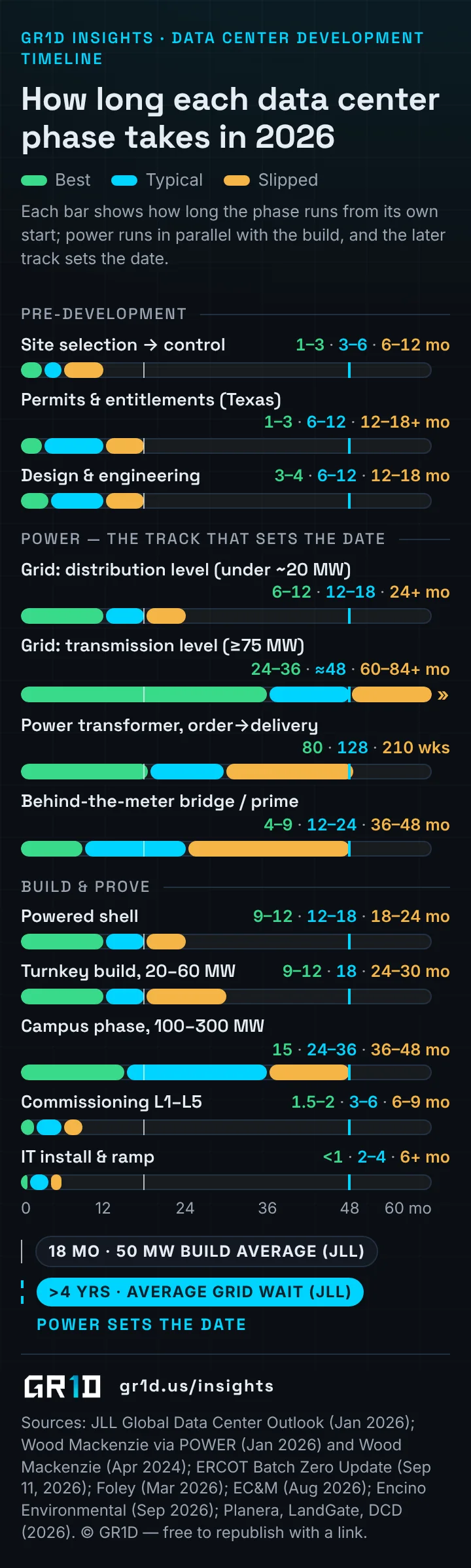
Read as text
- How long each data center phase takes in 2026
- Best
- Typical
- Slipped
- Each bar shows how long the phase runs from its own start; power runs in parallel with the build, and the later track sets the date.
- PRE-DEVELOPMENT
- Site selection → control · 1–3 · 3–6 · 6–12 mo
- Permits & entitlements (Texas) · 1–3 · 6–12 · 12–18+ mo
- Design & engineering · 3–4 · 6–12 · 12–18 mo
- POWER — THE TRACK THAT SETS THE DATE
- Grid: distribution level (under ~20 MW) · 6–12 · 12–18 · 24+ mo
- Grid: transmission level (≥75 MW) · 24–36 · ≈48 · 60–84+ mo · »
- Power transformer, order→delivery · 80 · 128 · 210 wks
- Behind-the-meter bridge / prime · 4–9 · 12–24 · 36–48 mo
- BUILD & PROVE
- Powered shell · 9–12 · 12–18 · 18–24 mo
- Turnkey build, 20–60 MW · 9–12 · 18 · 24–30 mo
- Campus phase, 100–300 MW · 15 · 24–36 · 36–48 mo
- Commissioning L1–L5 · 1.5–2 · 3–6 · 6–9 mo
- IT install & ramp · <1 · 2–4 · 6+ mo
- 0 · 12 · 24 · 36 · 48 · 60 mo
- 12
- 24
- 36
- 48
- 60 mo
- 18 MO · 50 MW BUILD AVERAGE (JLL)
- >4 YRS · AVERAGE GRID WAIT (JLL) · POWER SETS THE DATE
How long does it take to build a data center in 2026?
Two numbers answer the question; most guides blur them. Time-to-build runs from sitework to a commissioned facility: 18 to 30 months in most published ranges (Mastt, Feb 2026; Broadstaff, Mar 2026); JLL's global survey puts the average 50 MW build at 18 months (JLL, Jan 2026).
Time-to-power runs from site control to the day the utility lets the load flow: more than four years on average in primary US markets (JLL), against 12 to 18 months before 2022 (EC&M, Aug 2026). Add three to twelve months of pre-development and the answer is three to six years for a greenfield site (Planera, Sep 2026) or 9 to 14 months for one that already has power.
Why does the utility set the finish date, not the contractor?
A contractor controls the build, not the interconnection queue, the transformer factory or the permit office, and all three now run longer than the building. 57% of data center projects slipped three months or more in 2025, and the average US equipment lead time is 42 weeks, 83% longer than in 2019 (JLL). 48% of Turner & Townsend's respondents name power availability the top schedule obstacle (Turner & Townsend, Nov 2025); Bloom Energy's survey of 152 executives found utilities' time-to-power estimates run one and a half to two years longer than developers assume (Bloom Energy, Jan 2026). Close to half of the roughly 12 GW slated for 2026 is projected to slip or be canceled (Bloomberg, Apr 2026), and SynMax's satellite review found at least 40% of 2026-due AI sites more than three months late (SynMax via FT, Apr 2026).
The realistic schedule is therefore two parallel tracks, build and power, and the finish date is whichever ends last. The phase sequence itself is in How a Data Center Is Built.
How long does each phase take: best, typical and slipped?
"Best" assumes substation headroom or on-site generation and no permit hold; "slipped" is what the 57% experienced.
| Phase | Best | Typical | Slipped | Sources |
|---|---|---|---|---|
| Site selection to control | 1–3 mo (existing industrial site) | 3–6 mo | 6–12 mo | Planera; Broadstaff |
| Grid, distribution level (substation headroom, under about 20 MW) | 6–12 mo | 12–18 mo | 24+ mo | EC&M |
| Grid, transmission level (new substation; 75 MW+ in ERCOT) | 24–36 mo | about 4 yrs | 5–7+ yrs | JLL; Foley; EEI |
| Behind-the-meter bridge or prime power | 4–9 mo (engines, fuel cells, mobile turbines) | 12–24 mo | 36–48 mo (new frame turbines) | DCD; The Register |
| Permitting and entitlements | 1–3 mo (Texas permit-by-rule, no zoning) | 6–12 mo | 12–18+ mo (NSR in nonattainment counties; opposition) | Encino Environmental |
| Design and engineering | 3–4 mo (reference design) | 6–12 mo | 12–18 mo | Planera |
| Powered shell | 9–12 mo | 12–18 mo | 18–24 mo | LandGate; EC&M |
| Turnkey, 20–60 MW | 9–12 mo (prefabricated) | 18 mo | 24–30 mo | JLL; datacentres.com |
| Campus phase, 100–300 MW | 15 mo | 24–36 mo | 36–48 mo | DCD, modular; DCD, Abilene |
| Commissioning, Levels 1–5 | 6–8 weeks per hall | 3–6 mo | 6–9 mo | Planera; SmartBarrel |
| IT installation and ramp | 19 days (100,000 GPUs at Colossus) | 2–4 mo per hall | 6+ mo | Data Center Frontier; DCD, Denton |
How long does it take to get power to a data center?
Distribution-level service from a substation with spare capacity is the only grid path that still fits inside a construction schedule. Above roughly 10–20 MW the request becomes transmission-level, with a new substation, a system impact study and a queue: LBNL's 2026 study puts the median generator at more than three years to an interconnection agreement and more than five to operation (LBNL, Jul 2026).
Texas has formalized the threshold. Under Senate Bill 6 and the PUCT rule adopted September 18, 2026 (16 TAC §25.194), loads of 75 MW or more pay a $100,000 study fee and post $50,000 per MW of security, with a 24-month energization grace period (White & Case, Sep 2026). ERCOT's large-load requests total about 474 GW, roughly 90% data centers (Utility Dive, Aug 5, 2026) and more than five times ERCOT's record peak of 91.1 GW, set on July 22, 2026 (EIA, Aug 2026). The Batch Zero process that sorts them allocates capacity dated 2028 to 2032 (Foley, Mar 2026).
Behind-the-meter generation takes the queue off the critical path, within limits. Colossus launched on 8 MW of grid plus gas turbines and batteries and was permitted for 15 turbines (247 MW) in July 2025 (DCD, Jul 2025); JLL reports operators funding their own generation and using batteries to pull grid timelines forward (JLL). The limit is the turbine calendar: GE Vernova's backlog and reservations reached 116 GW in the second quarter of 2026 (GE Vernova, Jul 2026), it expects to be sold out through 2030 (Utility Dive, Dec 2025), and Uptime puts the wait list at three to four years (The Register, Jan 2026). Engines, fuel cells and mobile turbines are the 4-to-9-month bridge, as in AEP Ohio's 100 MW fuel-cell contract (EEI, Sep 2026); see How Data Centers Are Powered.
What are transformer lead times in 2026?
| Equipment | 2026 order-to-delivery | Sources |
|---|---|---|
| Large power transformers | 128 weeks average (Wood Mackenzie Q2-2025 survey); range 80–210 weeks; outliers of up to five years | POWER; Wood Mackenzie; Sightline via Bloomberg |
| Generator step-up transformers, above 50 MVA | 144 weeks average; 100–150+ weeks | POWER; IndustrialSage |
| MV switchgear, 15 kV and 38 kV | 52–80 and 78–104 weeks, against about 24 before COVID | IndustrialSage |
| Diesel and gas gensets above 2.5–3 MW | 90–110 weeks | IndustrialSage |
| UPS, 500–1,500 kVA | 30–48 weeks | IndustrialSage |
At the 128-week average a large power transformer takes about 30 months to arrive, longer than the 18-month building it serves, so the order goes in at site control, not at the final investment decision; new plants from Siemens Energy (early 2027), Eaton (2027) and Hitachi (2028) land after anything energizing in 2026 or 2027 has ordered (POWER, Jan 2026).
How long does permitting take in Texas?
Normally, Texas is the fast case: TCEQ's 2024 data put a permit-by-rule at 12 days on average and a standard permit at 9, while a minor New Source Review permit averaged 241 days (Encino Environmental, Sep 2026). The jump comes when on-site generation outgrows permit-by-rule limits, especially in the Houston and Dallas–Fort Worth nonattainment areas. BaRupOn's Liberty County project shows it: told the utility could not deliver substantial power until 2029 for an estimated $35 million interconnect, the developer permitted 25 MW growing to 60 MW of on-site gas, and nonattainment air permitting added friction (Data Center Knowledge, May 2026).
Since September 21, 2026, TCEQ has paused permits sought by data center projects: on October 14 it said applications can be submitted but "will not advance through the review process," while FracTracker's records through October 16 show generator applications and stormwater coverages still moving (FracTracker, Oct 19, 2026). For a schedule, an application on file is not a permit: plan on no TCEQ data center permit before ERCOT's review ends, expected in mid-December. Opposition blocked or delayed 75 projects worth $130 billion in the first quarter of 2026 (Fortune, Jun 2026) and 45 worth $68 billion in the second (Data Center Watch via AI Weekly, Sep 2026).
How long does construction take: powered shell, turnkey or campus?
A powered shell takes 9 to 18 months and the tenant's fit-out 3 to 6 after it (LandGate, Jan 2026). A turnkey 20–60 MW building averages 18 months (JLL), 12 to 18 prefabricated against 24 to 36 stick-built (datacentres.com, Sep 2026); hyperscale campus phases run 24 to 36 months stick-built (DCD, Jul 2026), 36 to 48 when they slip. Commissioning adds three to six months per building (Planera), overlapped hall by hall, and IT ramp is weeks: 100,000 GPUs in 19 days at Colossus (Data Center Frontier).
The gap between size classes is mostly power. A 20–60 MW block fits an existing substation or feeder far more often than a 300 MW phase does, and in ERCOT it sits under the 75 MW large-load line and outside the current energization pause, though inside the 25 MW community-impact review (ERCOT). That is the premise behind smaller, bespoke AI data centers.

Read as text
- Best, typical and slipped: site control to first live MW
- Two project types, three cases each. Bars are months from site control on a common 0–7 year scale.
- 20–60 MW SITE · Existing industrial site, substation headroom or BTM-capable parcel · BEST · 9–14 months · Existing shell or substation headroom, or a behind-the-meter bridge; prefab build; under ERCOT's 75 MW line. Colossus 122 days · IREN Horizon 1 ≈9 mo · Hut 8 Vega <12 mo. · TYPICAL · 18–30 months · 18-month build (JLL 50 MW average) plus 3–9 months of pre-development; distribution or substation-headroom energization runs in parallel. · SLIPPED · 36–60+ months · » · A new transmission interconnection or a large power transformer lands on the path: >4-year average grid wait, 128-week transformer. · 0 · 1 yr · 2 yrs · 3 yrs · 4 yrs · 5 yrs · 6 yrs · 7 yrs
- 100–300 MW CAMPUS · Greenfield or converted campus, delivered in phases · BEST · 14–18 months per phase · Pre-powered site, phased halls. Galaxy Helios ≈14 mo on an approved 800 MW substation · Stargate Abilene Phase 1 ≈15 mo on Lancium powered land. · TYPICAL · 30–48 months · 24–36-month build plus 6–12 months of pre-development; grid or behind-the-meter power procured in parallel. · SLIPPED · 5–7+ years · » · ERCOT Batch Zero capacity dated 2028–2032 · Dominion serving 300 MW tranches through 2033 · Applied Digital Ellendale ≈39 mo to Building 1. · 0 · 1 yr · 2 yrs · 3 yrs · 4 yrs · 5 yrs · 6 yrs · 7 yrs
- How to read it: GR1D synthesis of published phase durations and dated projects. The best cases require existing substation headroom or on-site generation and, in Texas, apply only once the TCEQ data-center permit pause (Sep 21, 2026) lifts; 20–60 MW loads sit outside ERCOT's ≥75 MW energization pause but inside the ≥25 MW community-impact review.
- How to read it:
| Project type | Best | Typical | Slipped |
|---|---|---|---|
| 20–60 MW on an existing industrial site, substation headroom or a BTM-capable parcel | 9–14 months. Colossus 122 days; IREN Horizon 1 about 9; Hut 8 Vega under 12 | 18–30 months. An 18-month build plus 3–9 months of pre-development; substation-headroom energization in parallel | 36–60+ months if a new transmission interconnection or large transformer is on the path |
| 100–300 MW campus | 14–18 months per phase on a pre-powered site. Helios about 14; Abilene Phase 1 about 15 | 30–48 months. A 24–36-month build plus 6–12 months of pre-development; grid or BTM in parallel | 5–7+ years. Batch Zero capacity 2028–2032; Dominion tranches to 2033; Applied Digital's first Ellendale building about 39 months |
What do real data center timelines look like?

Read as text
- The fast builds started with power already on site
- Six dated projects ordered by months from start (site acquisition, groundbreaking or contract) to first live load (energization or customer acceptance).
- Power already on site, or bridged behind the meter
- Greenfield campus, financing-gated
- 4 mo · 122 days
- 122 days
- xAI Colossus · Memphis, TN · 100k H100s, >150 MW · Infrastructure built in 122 days; 100,000 GPUs installed in 19 days; live Jul–Sep 2024 · Why fast: Existing Electrolux factory; launched on 8 MW of grid plus gas turbines and batteries; 150 MW of grid by Nov 2024.
- ≈9 mo · Nov 2025 → Aug 2026
- Nov 2025 → Aug 2026
- IREN Horizon 1 · Childress, TX · 50 MW IT, GB300, liquid-cooled · Microsoft contract Nov 2025 → customer acceptance Aug 13, 2026 · Why fast: Existing 750 MW campus power; vertically integrated developer building on its own site.
- <12 mo · Jul 2024 → Jun 2025
- Jul 2024 → Jun 2025
- Hut 8 Vega · Texas · 205 MW ASIC colocation, 180 kW/rack DTC · Site acquired Jul 2024 → energized Jun 30, 2025 · Why fast: ERCOT grid plus behind-the-meter wind; non-Tier design.
- ≈14 mo · Apr 2025 → Q2 2026
- Apr 2025 → Q2 2026
- Galaxy Helios, Phase 1 · Dickens County, TX · 133 MW IT (800 MW gross approved) · CoreWeave deal Apr 23, 2025 → ready for service Q2 2026 · Why fast: Bitcoin-site conversion on an already-approved private substation.
- ≈15 mo · Jun 2024 → Sep 2025
- Jun 2024 → Sep 2025
- Stargate Abilene, Phase 1 · Abilene, TX · 2 buildings, >200 MW · Groundbreaking Jun 2024 → energized Sep 2025 · Why fast: Pre-existing Lancium powered land; substation plus on-site gas; 30 MW halls.
- ≈39 mo · Sep 2022 → Dec 2025
- Sep 2022 → Dec 2025
- Applied Digital Polaris Forge 1 · Ellendale, ND · 400 MW IT campus (CoreWeave) · Campus start Sep 2022 → Building 1 first 50 MW Oct 2025, complete Dec 2025 · Why slow: Crypto-to-HPC pivot; financing-gated, with the first building delivered three years after the campus started.
The fast builds started with power on site: Colossus, an Electrolux factory on 8 MW of grid plus turbines, 122 days of infrastructure work plus 19 days to install 100,000 GPUs (Data Center Frontier, Nov 2024); IREN Horizon 1, 50 MW of liquid-cooled GB300 capacity on an existing 750 MW campus, Microsoft contract November 2025 to acceptance August 13, 2026 (IREN 8-K, Aug 2026); Hut 8 Vega, a 205 MW ASIC colocation facility on ERCOT grid plus behind-the-meter wind, site bought July 2024 and energized June 30, 2025 (Hut 8, Jun 2025); Galaxy Helios, a bitcoin site with an approved 800 MW substation, CoreWeave signed April 23, 2025 and 133 MW of critical IT load delivered in the second quarter of 2026 (Galaxy, Apr 2025; Fox34, Jul 2026); and Abilene Phase 1, two buildings above 200 MW on Lancium's powered land, groundbreaking June 2024 to energization September 2025 (Crusoe, Sep 2025; DCD, Nov 2025).
The slow cases were gated elsewhere. Applied Digital started its Ellendale campus in September 2022 and completed Building 1 in December 2025, about 39 months, after a financing-gated crypto-to-HPC pivot (DCD, Jul 2026). Vantage's 1.4 GW Frontier campus targeted the second half of 2026; April imagery showed one of six cleared plots active, and SynMax expects at most one building by year-end (SynMax via FT).
What compresses a data center schedule?
- Start with a powered site. Every fast example above began with an existing shell or substation; converting air-cooled space for liquid still adds more than six months (CBRE via Data Center Frontier, Aug 2026).
- Bridge with behind-the-meter power. Batteries and bridge generation pull grid timelines forward (JLL); LBNL lists provisional and flexible interconnection among its speed-to-power solutions (LBNL, Jun 2026). The TCEQ pause currently covers islanded Texas projects too (Bracewell).
- Prefabricate. Modular delivery cuts 24–36-month builds to 12–16 months and room assembly from 15 weeks to 2–3 (DCD); Flex claims 30% (Facilities Dive, Jun 2026).
- Take a powered shell. Entitlements and utility work are done; the tenant's fit-out is 3 to 6 months (LandGate).
- Order long-lead gear at site control. Up to 24 months ahead with 6–12 months of inventory (JLL).
- Stay inside permit-by-rule. Twelve days versus 241 for a minor NSR permit (Encino Environmental).
- Phase the build. Open at a known density and add power and cooling as demand clears (Uptime via Data Center Knowledge, Jul 2026); in ERCOT, 25–75 MW blocks sit outside the 75 MW energization pause (ERCOT).
Frequently asked questions
How long does it take to build a 20 MW data center?
The building takes 9 to 18 months; JLL's 2026 average for 50 MW is 18 months. End to end, 18 to 30 months is typical with substation-headroom power in parallel, and 9 to 14 is possible where power and permits already exist.
How long does it take to get power for a data center in Texas right now?
For loads of 75 MW or more, no energization approvals are being issued as of October 20, 2026, and Batch Zero capacity is dated 2028 to 2032. Substation-headroom service has typically taken 12 to 18 months, but TCEQ has paused data center permits since September 21, 2026, off-grid sites included, and says none have been issued.
What are transformer lead times in 2026?
Large power transformers average 128 weeks on Wood Mackenzie's Q2-2025 survey, in a range of 80 to 210 weeks with outliers of up to five years. Generator step-ups average 144 weeks, 38 kV switchgear 78 to 104 and 15 kV switchgear 52 to 80.
Can you build a data center in under a year?
Yes, when the power is already there: Colossus took 122 days in an existing factory, IREN's Horizon 1 about nine months on a powered campus and Hut 8's Vega under twelve. None waited on a new transmission interconnection; in Texas a sub-12-month plan also needs the TCEQ permit pause to lift.
What is the difference between a powered shell and a turnkey timeline?
A powered shell is delivered in 9 to 18 months with utility power, substation and fiber in place; the tenant then spends 3 to 6 months on UPS, generators and cooling. A turnkey building takes 18 to 30 months and hands over commissioned.
Sources
- 2026 Global Data Center Outlook — JLL, 2026-01-08
- Data Center Construction Timeline: Phases, Time and Delays — Planera, 2026-09-25
- Data Center Construction Timeline — Broadstaff, 2026-03-26
- Data Center Construction Timeline, Step by Step — SmartBarrel, 2026-09-16
- Data Center Construction: Costs, Timeline, and Delivery Steps — Mastt, 2026-02-20
- How long does it take to power a data center? — EC&M, 2026-08-17
- Backlog of power plants seeking transmission grid connection eased somewhat in 2025 — Lawrence Berkeley National Laboratory, 2026-07-01
- Beyond the bottleneck: solutions for accelerating large-load connections — Lawrence Berkeley National Laboratory, 2026-06-11
- 2026 Data Center Power Report — Bloom Energy, 2026-01
- Transformers in 2026: shortage scramble or self-inflicted crisis? — POWER, 2026-01-02
- Supply shortages and an inflexible market give rise to high power transformer lead times — Wood Mackenzie, 2024-04-02
- Half of planned US data center capacity for 2026 could be delayed or canceled — Bloomberg via Yahoo Finance, 2026-04-03
- Switchgear lead times 2026 — IndustrialSage (Terrapin data), 2026-09-01
- GE Vernova reports second quarter 2026 financial results — GE Vernova, 2026-07-22
- GE Vernova expects gas turbine slots sold out through 2030 — Utility Dive, 2025-12-11
- Power limits data center expansion: Uptime's predictions for 2026 — The Register, 2026-01-14
- AI drives data center uncertainty in Uptime's 2026 survey — Data Center Knowledge, 2026-07-31
- AI data centre rush raises alarm over construction supply chain — Turner & Townsend, 2025-11-05
- Batch Zero Update — ERCOT, 2026-09-11
- ERCOT's proposed Batch Zero process: what developers of large loads need to know — Foley & Lardner, 2026-03-19
- Texas large load interconnection update: ERCOT Batch Zero pause and verification process — Baker Botts via Mondaq, 2026-08
- Texas hits pause on data center interconnections — Utility Dive, 2026-08-05
- Texas audit could delay 49.8 GW of data center load, cost projects up to $15 billion — POWER, 2026-08-06
- PUCT sets financial commitments for data center interconnection; Governor pauses permits — White & Case, 2026-09-25
- Governor Abbott orders TCEQ to pause all permit issuance for data center projects — Bracewell, 2026-09-23
- Air permitting for data centers in Texas — Encino Environmental, 2026-09-03
- List of large customer projects and tariffs — Edison Electric Institute, 2026-09-11
- CBRE: record data center construction fails to ease capacity crunch — Data Center Frontier, 2026-08-28
- Data center opposition blocked or delayed $130B of projects — Fortune, 2026-06-16
- Data Center Watch: 45 US AI data center projects worth $68B blocked or delayed — AI Weekly, 2026-09-21
- Modular approach can speed data center construction by 30%: Flex — Facilities Dive, 2026-06-15
- Modular by necessity: why the AI boom is making prefabricated data centers the new default — Data Center Dynamics, 2026-07-10
- Factory-built and fast: modular construction cuts data centre delivery times — datacentres.com, 2026-09-02
- Powered shell data centers: everything you need to know — LandGate, 2026-01-10
- The Colossus AI supercomputer — Data Center Frontier, 2024-11-20
- xAI gets permit for 15 gas turbines at Memphis data center — Data Center Dynamics, 2025-07-03
- Crusoe announces flagship Abilene data center is live — Crusoe, 2025-09-30
- Building Stargate: inside OpenAI's Abilene campus — Data Center Dynamics, 2025-11-14
- Applied Digital completes second building at North Dakota data center campus — Data Center Dynamics, 2026-07-02
- Hut 8 energizes Vega data center — Hut 8 via StreetInsider, 2025-06-30
- Galaxy announces commitment with CoreWeave — Galaxy, 2025-04-23
- Galaxy completes Phase I of its Helios data center campus, delivering 133 MW of critical IT load to CoreWeave — Fox34, 2026-07-09
- IREN Form 8-K exhibit 99.1: Horizon 1 accepted by Microsoft — IREN via SEC, 2026-08-13
- CoreWeave deploys 16,000 GPUs at delayed data center in Denton, Texas — Data Center Dynamics, 2026-01-13
- Unconventional Texas data center explores off-grid power — Data Center Knowledge, 2026-05-08
- Analytics group signals possible delays at AI data centers — SynMax via Financial Times and Yahoo Finance, 2026-04-17
- Hourly peak load in ERCOT set a new record, exceeding 91 GW on July 22 — U.S. Energy Information Administration, 2026-08-03
- Governor Abbott directs TCEQ to halt data center permits — Office of the Governor of Texas, 2026-09-21
- Texas said it would halt data center permits; the state is pushing ahead anyway — 404 Media, 2026-10-19
- Texas continued data center permitting after the governor's pause — FracTracker Alliance, 2026-10-19
Building or financing an AI data center in Texas?
GR1D develops powered-shell and turnkey AI data centers — 20 MW to 150 MW sites with power, fiber and entitlements solved before the first rack arrives. See how we build, browse our sites or talk to us.